Passa al contenuto

Historical Crests Cúcuta Deportivo

Name: Cúcuta Deportivo
Nickname(s): Los Motilones (The Motilones), Rojinegros (The Red and Blacks)
Founded: 1924
Stadium: Estadio General Santander
Capacity: 42,901


2022-2024
2024-Present

Cúcuta Deportivo Crest History
The crest of Cúcuta Deportivo is built around a remarkably simple and recognisable identity: the club's traditional red and black colours, the initials C.D., and a championship star representing the greatest achievement in the club's history.
The versions shown here cover the club's most recent period, from 2022 to the present, and demonstrate a clear movement towards a cleaner and more minimalist visual identity.
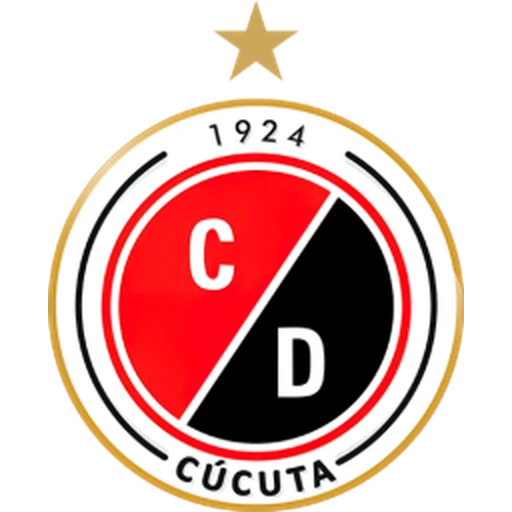
The 2022–2024 crest used a circular structure dominated by red, black, white and gold.
At the centre was a circle divided diagonally into two sections: red in the upper-left half and black in the lower-right half.
The white initials C and D, representing Cúcuta Deportivo, appeared separately within the two coloured sections.
This red-and-black combination is fundamental to the club's identity and directly reflects the traditional colours worn by the team, which have also produced the nickname Rojinegros — The Red and Blacks.
Surrounding the central emblem were several concentric rings, giving the badge a layered appearance.
The outer white ring contained the foundation year 1924 at the top and the name CÚCUTA at the bottom, explicitly connecting the club with its home city.
Small black decorative elements on either side helped balance the circular composition.
The entire badge was surrounded by a thin golden outline, adding a prestigious accent to the otherwise red, black and white design.
Above the crest appeared a single gold star.
The star commemorates Cúcuta Deportivo's greatest domestic achievement: winning the Colombian league championship in 2006.
That championship was the club's first top-flight national title and consequently became an important part of its visual identity.
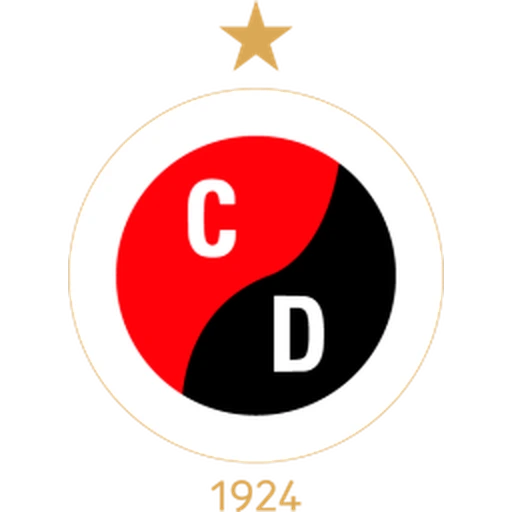
In 2024, Cúcuta Deportivo introduced a substantially simplified crest.
The multiple rings, decorative lines and prominent CÚCUTA inscription were removed, leaving a much cleaner circular emblem.
At its centre remains the familiar red-and-black composition, but the dividing line has changed from a straight diagonal into a flowing curved form.
This creates an almost interlocking appearance, with the red and black sections wrapping around one another while remaining clearly separated.
The white initials C and D remain positioned inside the red and black fields respectively, preserving an immediate connection with the previous badge.
A thin gold circular outline surrounds the central design, while the foundation year 1924 has been moved outside the badge and placed beneath it in gold.
The championship star also remains above the crest, ensuring that the historic 2006 title continues to be represented.
Although the 2024 redesign is considerably more minimalist, it retains the three elements most closely associated with the club: C.D., red and black, and the championship star.
The removal of the full CÚCUTA name means that the modern emblem relies more heavily on the strength and familiarity of the club's initials and colours.
Red and black have long been central to Cúcuta Deportivo's identity. They appear not only on the crest but also on the club's traditional shirts and are responsible for the widely used nickname Rojinegros.
The club's other famous nickname, Los Motilones, connects Cúcuta Deportivo more broadly with the history and regional identity of Norte de Santander.
The single gold star has particular significance because the 2006 championship transformed the club's history. The title was followed by Cúcuta's remarkable run to the semi-finals of the 2007 Copa Libertadores, one of the greatest international campaigns by a Colombian club outside the country's traditional giants.
Cúcuta Deportivo Club History
Cúcuta Deportivo is one of the most historic football clubs in northeastern Colombia and the principal sporting representative of Cúcuta, the capital of the Norte de Santander department. The club traces its origins to 1924 and is traditionally known as Los Motilones and Los Rojinegros — The Red and Blacks.
Cúcuta's location has always played an important role in the club's identity. Situated directly beside the Venezuelan border, the city developed strong commercial and cultural connections with neighbouring Venezuela, while its football club became an important symbol of Norte de Santander.
Although the club traces its history to 1924, the modern professional organisation took shape during the development of Colombia's professional football system in the middle of the twentieth century.
Cúcuta Deportivo entered the Colombian professional championship in 1950 and quickly became an important representative of the country's northeastern region.
The club's traditional red-and-black colours became firmly established during these early professional years, eventually producing the nickname Rojinegros.
Cúcuta also became widely known as Los Motilones, a regional nickname historically associated with Indigenous peoples of the Colombia-Venezuela border area and subsequently adopted as part of the football identity of Norte de Santander.
During its early professional decades, Cúcuta attracted a number of notable Colombian and foreign players. Its proximity to Venezuela and position as a border city helped give the club a distinctive character within Colombian football.
Despite periods of strong performances, however, Cúcuta spent much of the twentieth century without winning the Colombian championship.
The club experienced repeated fluctuations between periods of competitiveness and financial difficulty, and relegation eventually became part of its history.
One of the most important turning points came when Cúcuta dropped into Colombia's second division and had to rebuild its position within the professional game.
The breakthrough that ultimately transformed the club arrived in 2005, when Cúcuta Deportivo won promotion from Categoría Primera B and returned to the country's highest division.
Few could have predicted how quickly the newly promoted club would become a national champion.
During the 2006 Finalización, Cúcuta produced the greatest domestic campaign in its history under coach Jorge Luis Pinto.
Los Motilones progressed through the championship and reached the final against Deportes Tolima.
Cúcuta won the first leg 1–0 at the Estadio General Santander before securing a 1–1 draw in the return match in Ibagué.
The 2–1 aggregate victory gave Cúcuta Deportivo its first Colombian top-flight championship.
The achievement was extraordinary. Only a year after earning promotion, Cúcuta had gone from the second division to becoming champion of Colombia.
The streets of Cúcuta filled with celebrations as the club finally achieved the national championship that had eluded it throughout its professional history.
The 2006 title is represented today by the single star above the club's crest.
Winning the championship also qualified Cúcuta Deportivo for the 2007 Copa Libertadores, where the club produced an even more remarkable achievement.
Entering the tournament with relatively little international experience, Cúcuta surprised established South American opposition and emerged as one of the competition's outstanding teams.
Los Motilones successfully progressed through the group stage and advanced into the knockout rounds.
In the Round of 16, Cúcuta eliminated Mexican club Toluca, confirming that its strong performances were not simply a temporary surprise.
The quarter-finals brought an even greater challenge against Uruguay's Nacional.
Cúcuta again prevailed and advanced to the Copa Libertadores semi-finals, placing the Colombian club within two matches of the continental final.
The opponent was Argentine powerhouse Boca Juniors.
The first leg took place at a packed Estadio General Santander, producing one of the most famous nights in Cúcuta Deportivo's history.
Cúcuta defeated Boca Juniors 3–1, giving Los Motilones a genuine opportunity to reach the Copa Libertadores final.
The return match at La Bombonera in Buenos Aires proved considerably more difficult.
Boca overturned the deficit with a 3–0 victory, eliminating Cúcuta 4–3 on aggregate.
Boca Juniors subsequently won the Copa Libertadores, but Cúcuta's run to the semi-finals had already become one of the greatest achievements in the Colombian club's history.
The sequence of promotion in 2005, the Colombian championship in 2006 and the Libertadores semi-final in 2007 represents the undisputed golden period of Cúcuta Deportivo.
The club had transformed in only a few seasons from a second-division side into one of the strongest teams in South America.
Maintaining that level proved difficult, however.
Financial and administrative problems increasingly affected the club during the following years, while performances on the field declined.
Cúcuta was relegated from the Primera A in 2013, beginning another difficult period outside Colombia's highest division.
A brief return followed in 2015, but the club was unable to establish itself permanently in the top flight.
Cúcuta eventually rebuilt once again and enjoyed an excellent 2018 Primera B campaign.
Los Motilones won the second-division championship and secured promotion for 2019, bringing top-flight football back to the Estadio General Santander.
However, institutional and financial problems soon became even more serious.
In 2020, Cúcuta Deportivo faced a major crisis involving debts, administration and its ability to continue participating in Colombian professional football.
The club's sporting recognition was suspended, effectively removing Cúcuta from professional competition.
For supporters, this represented one of the darkest periods in the club's history. A team that had been Colombian champion and Copa Libertadores semi-finalist little more than a decade earlier was suddenly outside the professional league system.
The institution nevertheless survived.
After a restructuring process, Cúcuta Deportivo was able to return to Colombian professional football in 2022, entering Categoría Primera B.
The return was highly significant for both the club and the city. Professional football once again returned to the Estadio General Santander under the historic Cúcuta Deportivo identity.
Cúcuta's most important rivalry is with Atlético Bucaramanga.
Their meetings are traditionally known as the Clásico del Oriente Colombiano — the Eastern Colombian Derby, representing the football rivalry between Norte de Santander and Santander.
The club also has a special relationship with football across the nearby Venezuelan border. Cúcuta's geographical position means that supporters and football culture in the city have historically interacted closely with neighbouring Venezuelan communities.