Nickname(s):Los Tiburones(The Sharks),Rojiblancos (The Red and Whites)
Founded:1949
Stadium:Estadio Metropolitano Roberto Meléndez
Capacity:46,692
1920-1940
1940-1946
1946-1950
1950-1951
1951-1966
1966-1975
1975-1976
1976-1977
1977-1980
1980-1993
1993-1995
1995-2004
2004-2007
2007-2010
2010-2011
2011-2018
2018-2022
2019-2023
2022-2023
2023-Present
Junior FC Crest History
The crest history of Junior FC reflects more than a century of football tradition in Barranquilla. Although the club's earliest emblems were extremely simple, its identity gradually developed around three elements that remain instantly recognisable today: red-and-white vertical stripes, a dark-blue upper section and the name JUNIOR.
The earliest emblem shown here, used between 1920 and 1940, was radically different from the shield that would later become associated with the club.
It consisted simply of a large stylised red letter J, representing the Junior name. There was no shield, football or reference to Barranquilla, making it one of the simplest badges in the club's history.
Between 1940 and 1946, Junior adopted an entirely different circular emblem.
This badge used a dark-blue disc containing white lettering and an unusual central monogram. The initials F.C. appeared prominently beneath it, explicitly identifying the organisation as a football club.
The design was short-lived, but it introduced dark blue into Junior's visual identity, a colour that would later become an essential component of the crest.
A major transformation occurred in 1946.
The 1946–1950 badge introduced the basic visual formula that has defined Junior ever since: a traditional shield containing vertical red-and-white stripes.
Across the upper white panel appeared the initials J C D, referring to the club's institutional name during that period.
This was the first crest in the sequence to establish the famous red-and-white striped identity that later produced the nickname Rojiblancos — The Red and Whites.
The badge was redesigned again for 1950–1951.
The shield became more rounded and the word JUNIOR replaced the earlier initials across the top.
The red-and-white stripes remained dominant, while a dark-blue outline framed the entire emblem.
By this point, almost all the fundamental ingredients of Junior's modern crest had been established.
Between 1951 and 1966, the shield became cleaner and more conventional.
The name temporarily disappeared, leaving a particularly simple badge composed of the red-and-white striped shield beneath a dark-blue upper section.
This minimalist design placed complete emphasis on the club's colours rather than its name.
The 1966–1975 version restored the word JUNIOR, positioning it inside a white rectangular panel across the upper part of the stripes.
This arrangement proved extremely influential because it established the composition that, with numerous graphical refinements, would survive into the twenty-first century.
A brief redesign appeared during 1975–1976.
The shield received an additional blue-and-white outer border, while the JUNIOR nameplate was angled slightly across the striped field.
Although visually distinctive, this more elaborate badge lasted only a short period.
In 1976–1977, Junior returned to a simpler shield. The additional outer frame disappeared and the horizontal JUNIOR panel once again became the principal identifying feature.
A historically important change followed in 1977.
The 1977–1980 badge introduced a white star above the nameplate, commemorating Junior's first Colombian league championship, won in 1977.
For the first time, the club's sporting achievements were therefore incorporated directly into its visual identity.
Junior won another Colombian championship in 1980, and the crest evolved accordingly.
The 1980–1993 version displayed two stars, representing the championships of 1977 and 1980.
The shield itself remained remarkably consistent: dark-blue upper section, red-and-white vertical stripes and the JUNIOR name across the centre.
This established a pattern that would continue for decades. As Junior accumulated Colombian championships, additional stars were added to the crest.
After the club captured another league title in 1993, the badge was updated once again.
The 1993–1995 version displayed three stars, recording Junior's growing championship history.
The 1995–2004 crest then expanded the star arrangement further following another championship in 1995.
Four stars were positioned across the dark-blue upper portion of the shield, visually transforming the crest into a record of the club's domestic achievements.
Junior's success continued in the new century, particularly after the club won another Colombian championship in 2004.
The 2004–2007 version consequently displayed five stars.
Apart from the growing collection of stars, the underlying design changed very little. The red-and-white stripes and dark-blue upper section remained firmly established.
Between 2007 and 2010, the badge underwent a subtle graphical modernisation.
The shield became slightly broader and cleaner, while the stars were arranged more evenly across the blue section.
Another major sporting achievement came with Junior's 2010 Apertura championship.
The 2010–2011 crest reflected the club's expanding trophy collection through another revised arrangement of stars above the JUNIOR nameplate.
Junior then won the 2011 Finalización, requiring another update to the championship stars.
The 2011–2018 badge maintained the familiar shield but displayed the accumulated stars in a more compact formation above the name.
By this period, the stars had become almost as recognisable a component of Junior's badge as the stripes themselves.
Further success arrived in the 2018 Finalización, followed almost immediately by another championship in the 2019 Apertura.
These back-to-back titles created several closely related crest variations between 2018 and 2023, as the number and arrangement of stars were repeatedly updated.
The 2018–2022 version continued the traditional dark-blue shield with championship stars positioned above the central JUNIOR panel.
Another variation associated with the 2019–2023 period incorporated the expanded championship-star arrangement following Junior's ninth Colombian league title.
The shield remained otherwise almost unchanged, demonstrating how strongly the club had become attached to its traditional visual identity.
Junior added another championship in the 2023 Finalización, defeating Independiente Medellín to secure its tenth Colombian league title.
Consequently, versions used around 2022–2023 displayed the increasingly crowded collection of championship stars above the club name.
Interestingly, Junior subsequently moved in the opposite direction.
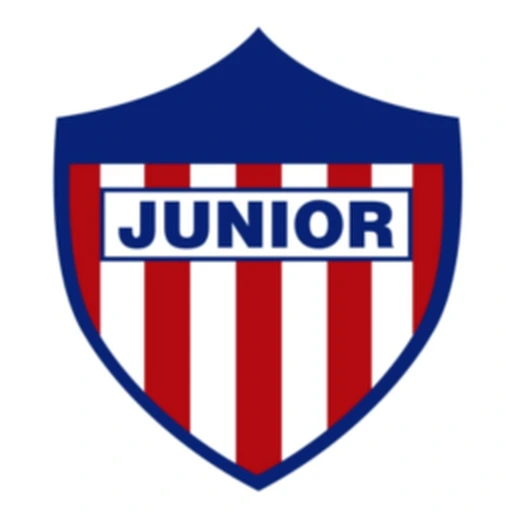
The 2023–present crest shown here removes the championship stars entirely, producing a much cleaner and more minimalist version of the traditional badge.
The modern emblem consists of a dark-blue shield containing vertical red-and-white stripes, with the word JUNIOR displayed prominently inside a white rectangular panel.
By removing the stars, the club returned visually to the fundamental design established during the middle decades of the twentieth century.
The result is a crest that is simpler, easier to reproduce and strongly connected with Junior's historical identity.
Junior FC Club History
Junior FC is the leading football institution of Barranquilla and one of the most successful clubs in Colombian football. Founded in 1924, Junior has developed into the dominant club of Colombia's Caribbean coast, with its red-and-white colours becoming closely associated with both Barranquilla and the wider Caribbean region.
The club's origins date to 7 August 1924, when it was established under the name Juventud Infantil. The initiative was closely associated with Micaela Lavalle de Mejía, who encouraged the creation of a team in which her sons and other young players could participate.
As the players grew older, the name evolved from Juventud Infantil to Juventud Junior, and eventually simply to Junior. The club gradually became one of the strongest teams in Barranquilla during the amateur era.
Junior's geographical identity has always been particularly important. While many of Colombia's traditional football powers emerged from Bogotá, Medellín or Cali, Junior became the great representative of Barranquilla and Colombia's Caribbean coast.
The club participated in the inaugural season of Colombia's professional championship in 1948, making Junior one of the historic participants in the country's professional game.
However, Junior's early professional history was not straightforward. Financial difficulties and disputes surrounding Colombian football resulted in periods when the club did not participate in the national championship.
Junior eventually returned permanently to the professional game during the 1960s, beginning the period in which the club developed into a consistent national contender.
The arrival of talented Colombian and foreign players helped raise the club's competitive level. Barranquilla's growing importance as a football city also strengthened Junior's supporter base.
During the 1970s, Junior assembled increasingly powerful teams and began challenging seriously for the Colombian championship.
The breakthrough finally came in 1977, when Junior captured its first Colombian league title.
The championship was a defining moment for football on Colombia's Caribbean coast. Junior had become national champion and demonstrated that the country's major trophies were not restricted to the traditional powers of Bogotá, Medellín and Cali.
Important players in the club's successful teams of this era included celebrated Colombian and international footballers, while the passionate Barranquilla support helped create an increasingly formidable home environment.
Junior did not have to wait long for another championship.
In 1980, Los Tiburones won their second Colombian league title, confirming that the 1977 triumph had not been an isolated success.
By this stage, Junior was firmly established among Colombia's leading clubs. Its distinctive red-and-white striped shirts had become famous nationally, giving rise to the nickname Rojiblancos — The Red and Whites.
Another identity became even more closely associated with the club: Los Tiburones — The Sharks. The nickname reflects Barranquilla's Caribbean character and has become one of the most recognisable club nicknames in Colombian football.
A major development occurred in 1986 with the opening of the Estadio Metropolitano Roberto Meléndez.
Junior moved its major home matches to the new stadium, which offered the club a significantly larger stage than its previous grounds.
The Metropolitano subsequently became one of Colombia's most famous football venues. Its large crowds and intense atmosphere turned it into both Junior's home and an important venue for the Colombia national team.
Junior entered another successful period during the 1990s.
The club won its third Colombian championship in 1993, with a team featuring one of the greatest players in Colombian football history, Carlos "El Pibe" Valderrama.
Valderrama's creativity and distinctive playing style made him the central figure of an exciting Junior side and further increased the club's profile throughout Colombia and South America.
Junior followed that success with another championship in 1995, securing its fourth league title.
The club was also increasingly competitive internationally.
Junior's most important Copa Libertadores campaign of the period came in 1994, when Los Tiburones reached the semi-finals of South America's premier club competition.
Junior faced Argentina's Vélez Sarsfield for a place in the final. The tie was eventually decided by penalties, with Vélez progressing before going on to win the Copa Libertadores.
Although Junior had fallen narrowly short of reaching the final, the campaign remains one of the club's strongest performances in the competition.
The beginning of the twenty-first century brought another generation of successful Junior teams.
In the 2004 Finalización, Junior reached the championship final against Atlético Nacional.
The dramatic confrontation ultimately required a penalty shoot-out, which Junior won to secure its fifth Colombian league championship.
Another title followed in the 2010 Apertura.
Junior faced La Equidad in the final and overturned a first-leg deficit in Barranquilla to capture its sixth championship.
The success demonstrated once again the importance of the Metropolitano, where large and passionate crowds had become a fundamental part of Junior's identity.
Junior returned to the summit only a year later.
In the 2011 Finalización, Los Tiburones reached the final against Once Caldas. After the two legs left the championship undecided, Junior prevailed in another penalty shoot-out to claim its seventh league title.
The club remained consistently competitive during the following years, regularly qualifying for the championship play-offs and representing Colombia in continental competitions.
Junior also began accumulating success in the Copa Colombia, adding another dimension to its domestic trophy record.
One of the most important international campaigns in Junior's history came in 2018.
The club progressed all the way to the final of the Copa Sudamericana, facing Brazilian club Athletico Paranaense.
Both legs finished level, and the continental championship ultimately had to be decided by penalties.
Athletico Paranaense won the shoot-out, leaving Junior agonisingly close to what would have been its first major CONMEBOL trophy.
Despite the defeat, reaching the 2018 Copa Sudamericana final represented one of Junior's greatest international achievements.
The disappointment was softened by major domestic success during the same period.
Junior won the 2018 Finalización, defeating Independiente Medellín in the championship final and securing its eighth Colombian league title.
Remarkably, Los Tiburones successfully defended their position at the top of Colombian football in the 2019 Apertura.
Junior faced Deportivo Pasto in the final. The championship was decided by penalties, with Junior emerging victorious and claiming a ninth league championship.
The back-to-back titles of 2018 and 2019 represented one of the strongest periods in the club's modern history.
Another memorable championship followed in 2023.
Junior had experienced an inconsistent year before improving dramatically during the second half of the season under coach Arturo Reyes.
Los Tiburones progressed through the 2023 Finalización and reached the championship final against Independiente Medellín.
Junior won the first leg 3–2 in Barranquilla, but Medellín recovered in the return match, leaving the final level on aggregate.
Once again, Junior's championship fate was decided from the penalty spot.
Los Tiburones won the shoot-out and secured their tenth Colombian league championship, reaching double figures in national titles for the first time.
The achievement reinforced Junior's position among the most successful clubs in Colombian professional football and produced enormous celebrations throughout Barranquilla.
Junior's most important traditional rivalry is with Unión Magdalena of Santa Marta.
Their meetings are known as the Clásico Costeño — the Coastal Derby and represent the historic football rivalry between two of the most important cities on Colombia's Caribbean coast.
Junior has also developed significant competitive rivalries with Colombia's other major clubs, particularly Atlético Nacional, América de Cali, Millonarios and Independiente Medellín, as repeated championship battles have brought them together in decisive matches.