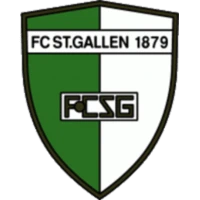
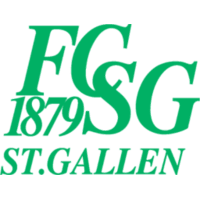
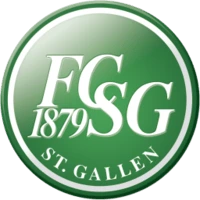
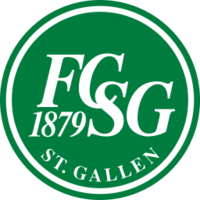
The crest of FC St. Gallen reflects the club's proud status as the oldest football club in continental Europe still in existence. Throughout more than 145 years of history, the badge has evolved from ornate Victorian designs to a clean, modern emblem while consistently preserving the club's traditional green and white colours.
The club's original crest, used from 1879 to 1950, featured an elegant green shield with intertwined white initials. Inspired by late nineteenth-century sporting emblems, it represented the club's founding identity and became one of the earliest football crests in Switzerland.
In 1950, FC St. Gallen adopted a more traditional shield-shaped badge divided into green and white sections. The crest displayed the club's full name, FC St. Gallen 1879, together with a stylised FCSG monogram. This version accompanied the club through several successful decades, including its first Swiss league championship.
During the late 1970s and early 2000s, the club experimented with various typographic logos, placing the initials FCSG and the founding year 1879 at the centre of a simplified visual identity. These designs reflected modern branding trends while maintaining the club's historic green colour.
To celebrate its 125th anniversary in 2004, FC St. Gallen introduced a special commemorative logo featuring a stylised football and the words "125 Jahre". This emblem was used alongside the club's regular identity during the anniversary celebrations.
In 2008, the club adopted a modern circular green crest displaying the FCSG initials, the founding year 1879, and the words "St. Gallen." The clean, minimalist design reflected the club's contemporary ambitions while honouring its historic roots.
A subtle refinement was introduced in 2018, simplifying the circular badge and improving its proportions without altering its overall appearance. The current crest continues to feature the iconic FCSG monogram within a green circle, creating one of the most recognisable identities in Swiss football.
FC St. Gallen 1879 Club History
Founded in 1879, FC St. Gallen is the oldest football club in continental Europe still in existence and one of Switzerland's most historic sporting institutions. Established in the city of St. Gallen by students inspired by the rapidly growing game of football, the club has played a pioneering role in the development of Swiss football. Wearing its traditional green and white colours, FC St. Gallen is affectionately known as "Espen", a nickname derived from the poplar trees (Espen in Swiss German) found throughout the region.
As one of the founding members of the Swiss Football Association in 1895, St. Gallen helped shape organised football in Switzerland. The club competed in the country's earliest national competitions and built a reputation for promoting fair play, youth development and attacking football.
FC St. Gallen enjoyed its first major success by winning the Swiss championship in 1903–04, becoming one of the early powerhouses of Swiss football. Although league titles proved elusive for much of the twentieth century, the club remained a regular participant in the top division and became renowned for its passionate supporters and strong regional identity.
A second league championship finally arrived in 1999–2000 under German coach Marcel Koller. Led by stars such as Charles Amoah, who finished as the league's top scorer, St. Gallen secured its first national title in 96 years, marking one of the greatest achievements in the club's history.
Throughout the modern era, FC St. Gallen has remained a competitive force in the Swiss Super League, regularly challenging for European qualification. The club has represented Switzerland in the UEFA Champions League, UEFA Europa League, and UEFA Europa Conference League, earning memorable victories against respected European opponents.
In 2008, the club moved into the modern Kybunpark, replacing the historic Espenmoos Stadium, which had served as the club's home for almost a century.
FC St. Gallen's greatest rivalry is with Grasshopper Club Zürich, while matches against FC Zürich, FC Basel, and BSC Young Boys are among the biggest fixtures in Swiss football. Encounters with neighbouring clubs also generate significant regional interest.