Nickname(s):Die Brenzstädter (The Brenz Town Club)
Founded:1846 (football department established in 1910; current club formed in 2007)
Stadium:Voith-Arena (formerly Albstadion)
Capacity:15,000
1972-2007
2007-Present
1.FC Heidenheim Crest History
Founded in 1846, the sporting roots of 1. FC Heidenheim 1846 lie in Turngemeinde Heidenheim, one of Germany's oldest gymnastics clubs. The football department, established in 1910, became part of Heidenheimer SB following several mergers during the twentieth century. Although earlier football emblems existed, the club's modern visual identity began with the crest adopted by Heidenheimer SB in the early 1970s.
From 1972 to 2007, Heidenheimer SB used a simple rectangular blue badge featuring the white initials "hsb 1846" above a distinctive red geometric emblem. The clean, minimalist design reflected the club's multi-sport identity while retaining the founding year 1846, emphasising its long sporting tradition rather than solely its football heritage.
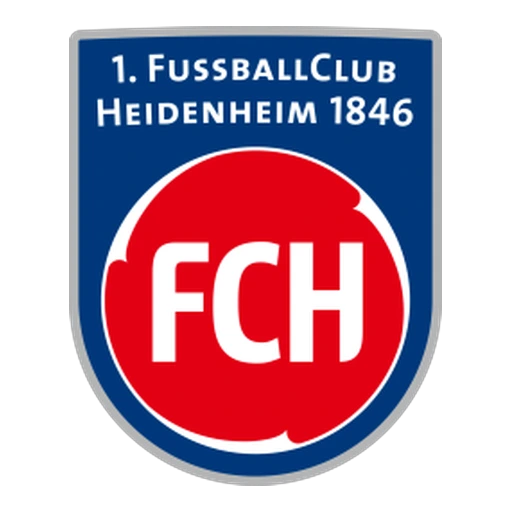
A new chapter began in 2007, when the football department separated from Heidenheimer SB to form the independent 1. FC Heidenheim 1846. To mark this historic transition, the club introduced an entirely new crest featuring a modern shield in the club's traditional blue, red and white colours. At its centre, a bold red circle containing the white initials "FCH" created a strong and instantly recognisable identity, while the club's full name and founding year appeared across the top of the shield.
Since its introduction, the crest has remained virtually unchanged, accompanying the club through the most successful period in its history. The current crest represents both tradition and ambition. While preserving the founding year 1846 to honour the club's historic roots, the modern shield and prominent FCH monogram reflect the identity of the independent football club created in 2007. Through its clean design and consistent use of the traditional blue, red and white colours, the badge successfully combines more than 175 years of sporting heritage with the modern era of 1. FC Heidenheim 1846.
1.FC Heidenheim Club History
Founded in 1846 as Turngemeinde Heidenheim, the club is one of Germany's oldest sporting institutions. Football was introduced in 1910, and through a series of mergers and reorganisations, the football department became part of Heidenheimer Sportbund (Heidenheimer SB). For decades, football remained one section of the multi-sport club, competing mainly in the amateur and regional leagues of southern Germany.
For much of the twentieth century, Heidenheim played outside the national spotlight, establishing itself as a respected regional club in Württemberg. While major honours proved elusive, the club earned a reputation for stability, strong community support and an emphasis on youth development. Playing at the Albstadion (now the Voith-Arena), Heidenheim gradually built the foundations for future success.
A defining moment came in 2007, when the football department separated from Heidenheimer SB to form the independent 1. FC Heidenheim 1846. The move allowed the club to focus exclusively on professional football and coincided with the appointment of Frank Schmidt as head coach. Schmidt, a former player, would become one of the longest-serving managers in world football and the architect of the club's remarkable rise.
Under Schmidt's leadership, Heidenheim achieved promotion to the 3. Liga in 2009, before winning the league title and earning promotion to the 2. Bundesliga in 2014. The club quickly established itself as a competitive second-tier side despite operating with one of the smallest budgets in professional football, earning widespread admiration for its organisation, continuity and long-term planning.
The greatest achievement in the club's history came in 2023, when Heidenheim secured promotion to the Bundesliga for the first time. Dramatically winning the 2. Bundesliga title on the final day of the season, the club completed an extraordinary journey from amateur football to Germany's top division in little more than fifteen years. In their debut Bundesliga campaign, Heidenheim exceeded expectations by securing qualification for European competition, marking another historic milestone for the club.
Heidenheim's principal rivalry is with SSV Ulm 1846 in the Württemberg Derby, while matches against VfB Stuttgart and Karlsruher SC also carry regional significance. Despite its relatively recent emergence at the highest level, 1. FC Heidenheim has established itself as one of German football's modern success stories.