Nickname(s):El Globo(The Balloon), Los Quemeros (The Burners)
Founded:1908
Stadium:Estadio Tomás Adolfo Ducó (El Palacio)
Capacity:48,314
1907-1908
1908-1911
1911-1933
1933-1957
1957-1973
1973-1988
1988-2011
2011-Present
CA Huracán Crest History
The crest history of CA Huracán is one of the most distinctive in Argentine football. Unlike most clubs, which traditionally use shields or monograms, Huracán has built its identity around the image of a hot-air balloon. The symbol is closely connected with Argentine aviation pioneer Jorge Newbery and the famous balloon Huracán, from which the club took both its name and emblem.
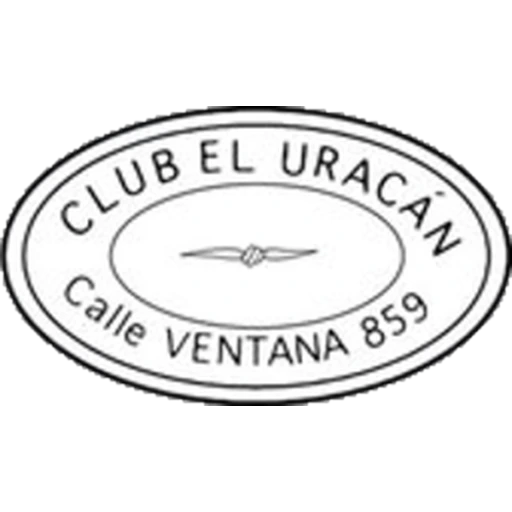
The earliest known emblem, used between 1907 and 1908, was very different from the modern badge. It consisted of a simple horizontal oval containing the name “Club El Uracán” and the address Calle Ventana 859. A small decorative symbol appeared in the centre. The spelling reflected the club's earliest formative period before the modern name became firmly established.
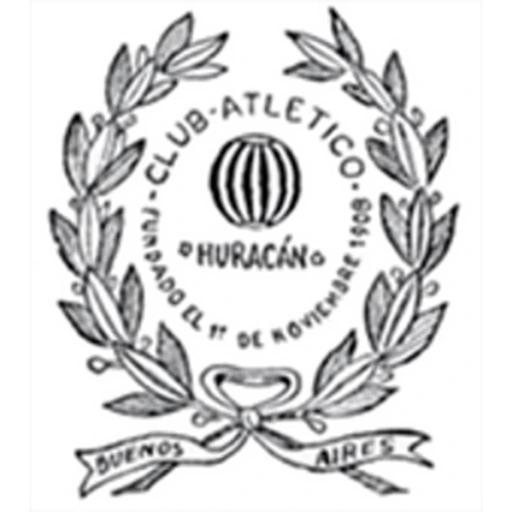
In 1908, following the formal establishment of Club Atlético Huracán, a considerably more elaborate emblem appeared. A small representation of a balloon was placed in the centre, surrounded by the club's name and decorative laurel branches. This marked the beginning of the balloon imagery that would define Huracán's identity for more than a century.
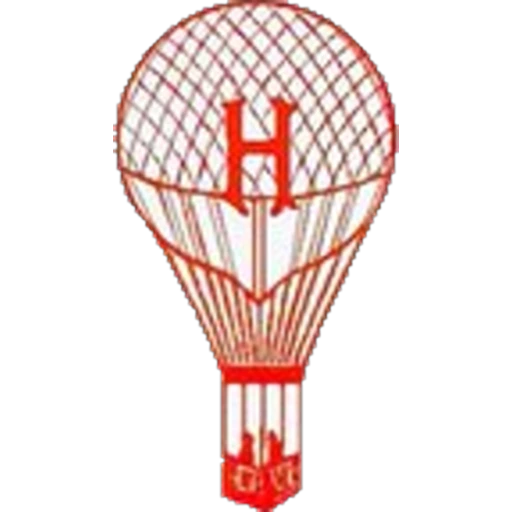
The decisive transformation came in 1911. Huracán adopted a detailed red outline of a hot-air balloon, directly inspired by Jorge Newbery's balloon Huracán. A prominent letter “H” appeared within the structure. This design established the fundamental visual identity that the club still uses today.
Between 1911 and 1933, the balloon was depicted in considerable detail, with a rounded envelope, extensive netting and a small basket underneath. The red linework against a white background also established the red-and-white colour combination that became synonymous with the club.
In 1933, the balloon was substantially redesigned. Its shape became narrower and more elongated, while the internal lines were simplified into a stronger geometric pattern. The letter H remained prominently positioned in the upper section of the balloon.
Another redesign arrived in 1957. The balloon became wider and more rounded, while the internal netting was made considerably more complex. The large central H was integrated directly into the geometric structure. This produced one of the most visually elaborate versions of the Huracán emblem.
In 1973, the crest was refined again. The balloon returned to a lighter and more realistic appearance, with thinner red lines and a clearly defined basket. The H remained at the centre, but the overall composition was cleaner and less dense than its predecessor.
A dramatic simplification occurred in 1988. Most of the traditional balloon netting disappeared, leaving a minimalist red outline. A large geometric H dominated the centre, while only a few structural lines suggested the shape of the balloon. The basket was reduced to a simple rectangular form below the main emblem.
Although modern and highly distinctive, this simplified badge moved significantly away from the historic appearance of the club's traditional balloon.
In 2011, Huracán therefore returned to a more traditional interpretation. The detailed balloon structure and basket were restored, while the prominent red H remained in the centre. Cleaner lines and more balanced proportions modernised the historic design without abandoning its origins.
The 2011–Present crest consequently represents a direct visual connection with the balloon first adopted a century earlier. Its red outline, intricate netting, central H and distinctive basket make it immediately recognisable even without the club's full name.
The balloon has a particularly important meaning for Huracán. Argentine aviation pioneer Jorge Newbery granted the young club permission to use an image inspired by his balloon Huracán. After Newbery completed a celebrated flight aboard the balloon, the connection between the aviator, the aircraft and the football club became permanently embedded in Huracán's identity.
This heritage also explains the club's famous nickname “El Globo” (The Balloon).
CA Huracán Club History
Founded in 1908, Club Atlético Huracán is one of the traditional football institutions of Buenos Aires. Based in the Parque Patricios neighbourhood, the club is famous for its white shirts with red details, its distinctive hot-air balloon emblem and the nicknames “El Globo” (The Balloon) and “Los Quemeros” (The Burners).
Huracán traces its origins to a group of young football enthusiasts who began playing together in the southern neighbourhoods of Buenos Aires in 1903. After several early organisational attempts, the club was formally reorganised on 1 November 1908, the date recognised as the official foundation of Club Atlético Huracán.
The club's unusual name and emblem are closely connected with Jorge Newbery, one of Argentina's pioneering aviators. Newbery's famous balloon was named Huracán, and the young football club received permission to use the balloon as its emblem. The association became permanent, giving Huracán one of the most distinctive identities in world football and producing the nickname El Globo.
Huracán progressed rapidly through the Argentine football system and reached the highest level during the 1910s. The club soon developed into one of the strongest teams of the amateur era.
The 1920s became Huracán's first golden period. The club won Argentine league championships in 1921, 1922, 1925 and 1928, establishing itself among the country's leading football institutions. These successes created a sporting tradition that remains an important part of Huracán's identity.
Following the introduction of professionalism in 1931, Huracán continued to compete at the highest level. Although it struggled to reproduce the league dominance of the 1920s, it remained an important Buenos Aires club and won several national cup competitions.
The club's home became another defining feature of its identity. Huracán inaugurated the present Estadio Tomás Adolfo Ducó in the 1940s. Located in Parque Patricios and commonly known as “El Palacio” (The Palace), its imposing concrete architecture and distinctive tower have made it one of Argentina's most recognisable traditional stadiums.
Huracán's greatest professional-era team emerged in 1973 under coach César Luis Menotti, who would later lead Argentina to victory at the 1978 World Cup. Menotti created an attacking team built around possession, technical quality and creative football.
Featuring players such as René Houseman, Miguel Brindisi, Carlos Babington and Omar Larrosa, Huracán produced one of the most celebrated teams in Argentine football history and won the 1973 Metropolitano championship.
The significance of the 1973 side extends beyond the championship itself. Its attractive, attacking approach became associated with a particular philosophy of Argentine football, and several members of the team subsequently played important roles with the national side. The championship remains the defining sporting achievement of Huracán's professional era.
The decades that followed were considerably less stable. Financial difficulties and inconsistent performances resulted in several relegations and promotions, but Huracán repeatedly returned to the country's highest divisions while maintaining a large and deeply loyal supporter base.
Another memorable team emerged in 2009 under coach Ángel Cappa. Known for its attractive attacking football, the side included players such as Javier Pastore, Matías Defederico and Mario Bolatti. Huracán came extremely close to winning the Clausura championship, losing the decisive final match against Vélez Sarsfield and finishing as runner-up.
A major modern success arrived in 2014, when Huracán won the Copa Argentina. The victory gave the club its first major national trophy in decades and qualified it for international competition.
Huracán followed this success by winning the Supercopa Argentina against River Plate in 2015. The club also enjoyed an exceptional campaign in the 2015 Copa Sudamericana, reaching the final before losing to Colombian side Independiente Santa Fe on penalties.
The defining rivalry in Huracán's history is with San Lorenzo de Almagro. Their meetings are known as the Clásico Porteño or Clásico de Barrio, one of the oldest and most traditional derbies in Argentine football. The rivalry developed from the geographical proximity of Huracán's roots in Parque Patricios and San Lorenzo's historic connection with nearby Boedo.
Although San Lorenzo later developed into one of Argentina's traditional “Big Five,” the rivalry with Huracán retained its strong neighbourhood character. For supporters of El Globo, matches against San Lorenzo remain among the most important fixtures of any season.
Huracán also has competitive relationships with other Buenos Aires clubs, but San Lorenzo is unquestionably its principal historic rival, and the derby represents an essential part of both clubs' identities.