The crest history of FC Dynamo Kyiv reflects almost a century of football history spanning the Soviet and independent Ukrainian eras. Despite numerous redesigns, the club's distinctive Cyrillic “Д” (D) monogram and diamond shape have remained the most important elements of Dynamo's visual identity.
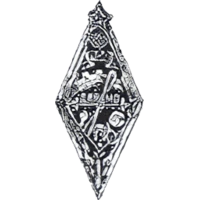
The earliest emblem shown, dating from 1924–1926, predates the official establishment of Dynamo Kyiv in 1927 and belongs to the wider Dynamo sports society tradition from which the football club emerged. Its intricate diamond-shaped design differs considerably from the much simpler identity that followed.
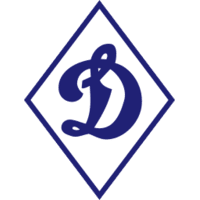
From 1927 to 1939, Dynamo Kyiv adopted the symbol that would become synonymous with the club: a stylised Cyrillic “Д” inside a diamond. The simple blue-and-white design established the foundations of an identity that would repeatedly return throughout the club's history.
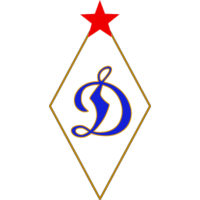
Between 1939 and 1972, the diamond remained but became narrower and was topped by a red Soviet star. The stylised “Д” continued in the centre. This version became associated with Dynamo's emergence as one of the strongest clubs in Soviet football, including its first Soviet championship in 1961.
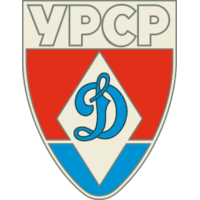
A major departure appeared in 1972. The traditional diamond was incorporated into a much more elaborate shield featuring the letters “УРСР”, the Ukrainian abbreviation for the Ukrainian Soviet Socialist Republic. Red and blue sections reflected the Soviet-era sporting identity, while the familiar Dynamo monogram remained at the centre. This crest was used during one of the greatest periods in the club's history, including the European successes of 1975 and 1986.
As the Soviet era approached its end, Dynamo introduced a simplified identity in 1989. The traditional stylised “Д” became the dominant feature again, accompanied by КИЇВ (Kyiv) beneath it. This minimalist emblem remained in use during Ukraine's transition to independence.
Between 1996 and 2011, Dynamo adopted a circular crest. A yellow centre contained the blue Dynamo monogram, while the outer blue ring displayed the Ukrainian wording “Футбольний клуб Динамо”. The name Київ and founding year 1927 appeared below the central monogram.
Championship stars were gradually added above the circular badge. A single star appeared during the 2003–2007 period, followed by two stars from 2007, reflecting the club's exceptional championship record across both Soviet and Ukrainian football.
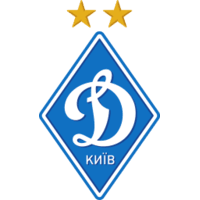
In 2011, Dynamo returned to its historic roots. The circular badge was abandoned in favour of the classic blue diamond, now containing a white “Д” and КИЇВ beneath it. Two gold stars appeared above the crest. The redesign deliberately reconnected the modern club with the iconic emblem used during much of its earlier history.
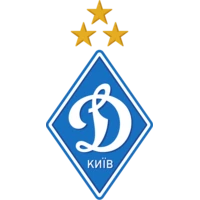
A further change was introduced in 2025. The fundamental diamond design remained untouched, but Dynamo added a third gold star above the badge. This followed the club reaching the milestone of 30 combined national league championships, counting its titles in both the Soviet Top League and Ukrainian championship.
The modern crest therefore closely resembles the emblem first established almost a century ago. Its blue diamond, white Cyrillic “Д” and the name Kyiv create one of the most recognisable identities in Eastern European football.
FC Dynamo Kyiv Club History
Founded in 1927, FC Dynamo Kyiv is the most successful club in Ukrainian football history and one of the most celebrated teams to emerge from Eastern Europe. Based in Kyiv, the club became famous for its distinctive blue-and-white colours, its iconic Dynamo diamond crest and a tradition of innovative football that produced success both domestically and in European competition.
Dynamo was established as part of the wider Dynamo sports society during the Soviet period. The football team quickly developed into one of Ukraine's strongest sides and became an important representative of Ukrainian football within the Soviet championship.
The club's first major national breakthrough came in 1954, when Dynamo won the Soviet Cup. Even greater history was made in 1961, when Dynamo Kyiv became the first club from outside Moscow to win the Soviet Top League, breaking the long-standing dominance of clubs from the Soviet capital.
The 1960s and 1970s transformed Dynamo into a dominant force. The arrival of Valeriy Lobanovskyi as head coach in 1973 marked the beginning of one of the most influential periods in European football. Lobanovskyi introduced an exceptionally systematic approach based on physical preparation, collective movement, pressing and detailed analysis.
In 1975, Dynamo achieved its first major European triumph by winning the European Cup Winners' Cup, defeating Hungarian side Ferencváros 3–0 in the final. Later that year, Dynamo defeated European champions Bayern Munich over two matches to win the UEFA Super Cup. Star forward Oleg Blokhin was subsequently awarded the 1975 Ballon d'Or.
Dynamo repeated its European success in 1986, winning a second European Cup Winners' Cup after defeating Atlético Madrid 3–0 in the final. The team included outstanding players such as Oleksandr Zavarov, Ihor Belanov and Vasyl Rats. Belanov subsequently won the 1986 Ballon d'Or.
By the end of the Soviet era, Dynamo had won a record 13 Soviet league championships, establishing itself as one of the most successful clubs in the history of Soviet football.
Following Ukrainian independence in 1991, Dynamo became a founding member of the new Ukrainian national championship. The club quickly established itself as the dominant force in the country, winning nine consecutive Ukrainian league titles between 1993 and 2001.
Another exceptional period developed during the late 1990s after Lobanovskyi returned as coach. Led by attacking stars Andriy Shevchenko and Serhiy Rebrov, Dynamo again became a major European force. The club reached the UEFA Champions League quarter-finals in 1997–98 and the semi-finals in 1998–99, defeating clubs including Barcelona and Real Madrid during this celebrated era.
Dynamo's greatest modern rivalry is with Shakhtar Donetsk. Known as the Ukrainian Clásico, the fixture developed into the country's defining football rivalry as Shakhtar emerged as Dynamo's principal challenger during the 2000s. Historically, Dynamo also shared an intense Soviet-era rivalry with Spartak Moscow.
The club has been associated with many of the greatest players in Ukrainian football history, including Oleg Blokhin, Ihor Belanov, Andriy Shevchenko, Anatoliy Demyanenko, Oleksandr Shovkovskyi, Serhiy Rebrov and Andriy Yarmolenko. Three players strongly associated with Kyiv football — Blokhin, Belanov and Shevchenko — have won the Ballon d'Or.
Dynamo's traditional home is the Valeriy Lobanovskyi Dynamo Stadium, named after its legendary coach. For larger domestic and European matches, the club has also extensively used Kyiv's much larger Olympic Stadium (NSC Olimpiyskiy).
Since the Russian invasion of Ukraine in 2022, Dynamo has had to operate under extraordinarily difficult circumstances. Domestic football has continued under wartime conditions, while European home fixtures have frequently been staged outside Ukraine.