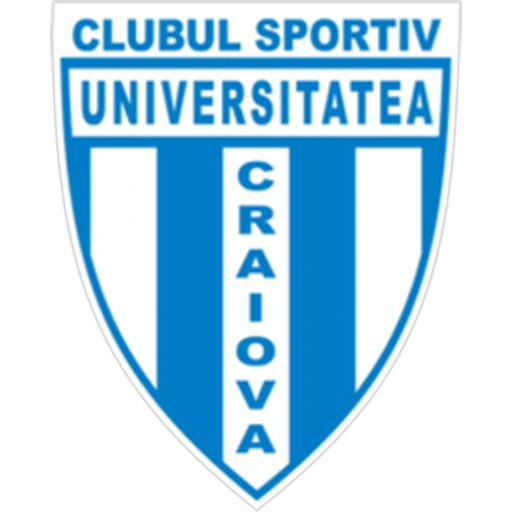
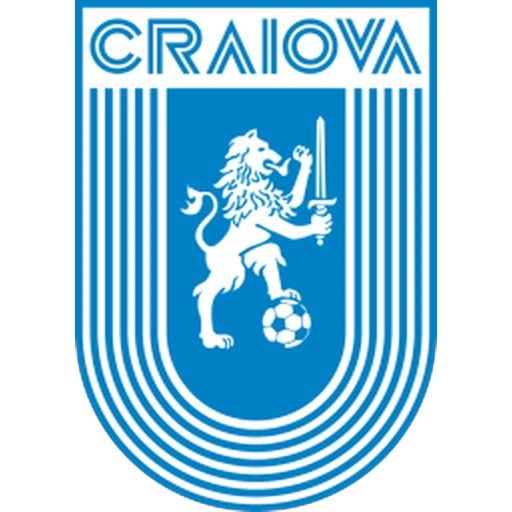
The modern crest history of CS Universitatea Craiova began with the club's re-establishment in 2013, following the revival of the historic Universitatea Craiova football tradition. Although only two modern crests have been used, both reflect the club's strong connection to the city of Craiova, its university roots and its proud football heritage.
The first crest, introduced in 2013, featured a traditional blue-and-white shield with vertical stripes and the words "Clubul Sportiv Universitatea Craiova." The design paid tribute to the historic colours of the original Universitatea Craiova while establishing the identity of the newly re-founded club. The shield symbolised continuity with one of Romania's most famous football institutions.
In 2015, the club unveiled a completely redesigned crest that remains in use today. The modern badge features a stylised blue lion standing over a football, enclosed within an elegant oval shield formed by multiple blue lines. The lion represents strength, courage and the historical symbol of the Oltenia region, while the blue-and-white colour scheme continues the club's traditional identity. The minimalist design combines heritage with a contemporary appearance and has become one of the most distinctive crests in Romanian football.
CS Universitatea Craiova Club History
Founded in 1948, Universitatea Craiova is one of Romania's most historic and beloved football clubs. Originally established as the football team of the University of Craiova, the club quickly became a symbol of the Oltenia region and earned the affectionate nickname "Știința" (The Science) in reference to its academic origins. Wearing its traditional blue and white colours, Universitatea developed one of the country's most passionate fan bases.
The club rose to national prominence during the 1960s and 1970s, winning its first Romanian league championship in 1973–74. This success marked the beginning of the club's golden era, during which Universitatea became one of Romania's dominant football forces.
The greatest team in the club's history was the legendary "Craiova Maxima" of the early 1980s. Led by stars such as Ilie Balaci, Rodion Cămătaru, Costică Ștefănescu and Silviu Lung, Universitatea won multiple domestic trophies and achieved historic success in European competition. In 1982–83, the club became the first Romanian team to reach the semi-finals of the UEFA Cup, eliminating several prestigious opponents before narrowly losing to Benfica on away goals.
Following the fall of communism, Universitatea remained a competitive force but struggled to match the success of its golden generation. Financial difficulties and administrative problems increasingly affected the club during the 1990s and 2000s.
A major turning point came in 2011, when the Romanian Football Federation temporarily excluded the club from competition following a legal dispute. Shortly afterwards, the original football company entered insolvency and eventually ceased operations. In 2013, Clubul Sportiv Universitatea Craiova, the original university sports club, re-established its football section and returned to professional football, claiming to continue the traditions of the historic club. This led to a long-running legal and sporting dispute with FC U Craiova 1948, another club claiming the Universitatea legacy.
Starting in the lower divisions, CS Universitatea Craiova earned promotion to Liga I in 2014 and quickly re-established itself among Romania's leading clubs. Playing at the modern Stadionul Ion Oblemenco, the club has regularly challenged for domestic honours, winning the Cupa României in 2017–18 and 2020–21, as well as the Supercupa României in 2021.
Universitatea's fiercest rivalry is with Dinamo București, while matches against FCSB, Rapid București, and CFR Cluj are among the biggest fixtures in Romanian football. The club also shares an intense local rivalry with FC U Craiova 1948, fuelled by the ongoing dispute over the identity and legacy of the original Universitatea Craiova.