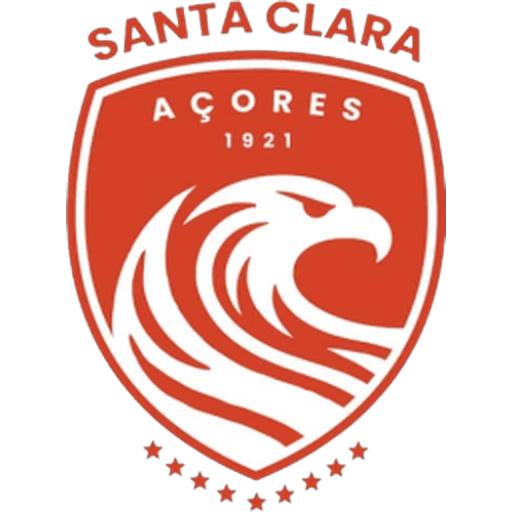
The visual identity of Clube Desportivo Santa Clara has evolved considerably over the years, reflecting both the club's ambitions and its unique position as the leading football club of the Azores. While each redesign introduced a fresh look, every crest has maintained a connection to the club's island heritage and proud traditions.
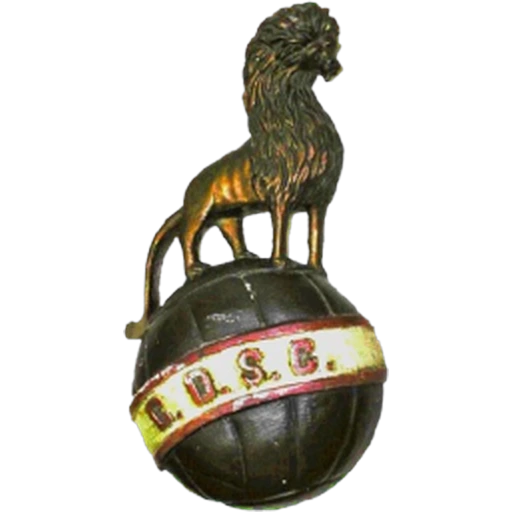
The club's first emblem, used between 1927 and 1935, was highly distinctive. It featured a football topped by a lion, symbolising strength, courage and sporting ambition. The initials "C.D.S.C." appeared across the ball, creating a simple but memorable badge that represented the club during its formative years.
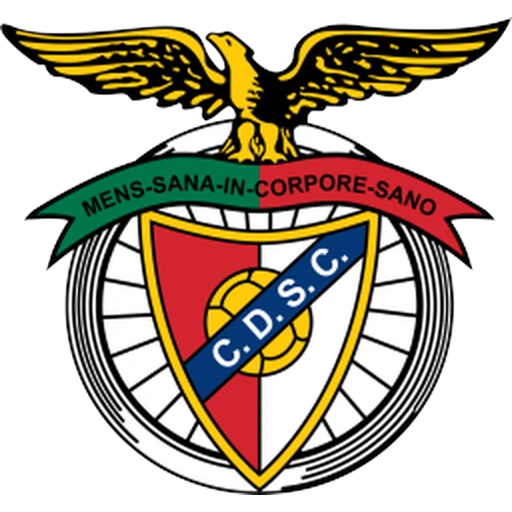
In 1935, Santa Clara adopted a crest strongly inspired by its historical links with S.L. Benfica. The new emblem incorporated an eagle, a shield in red, white and yellow, and a wheel, together with the Latin motto "Mens Sana in Corpore Sano" ("A healthy mind in a healthy body"). This badge remained the club's symbol for more than 75 years, becoming one of the longest-serving crests in Portuguese football.
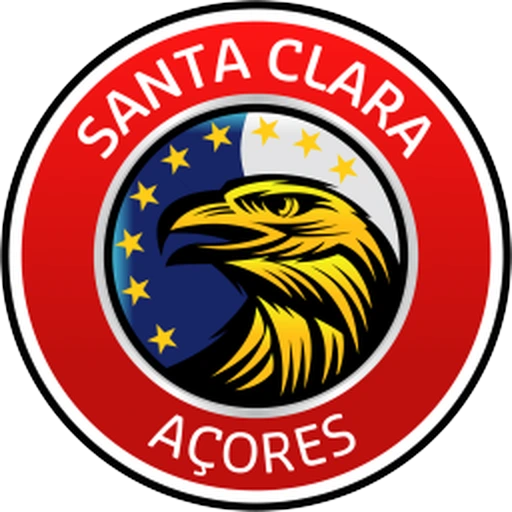
A dramatic redesign arrived in 2012, replacing the traditional Benfica-inspired badge with a modern circular emblem. At its centre stood a striking golden eagle's head, surrounded by a ring bearing the words "Santa Clara Açores" and decorated with stars. The redesign emphasised the club's identity as the representative of the Azorean islands while introducing a bold contemporary style.
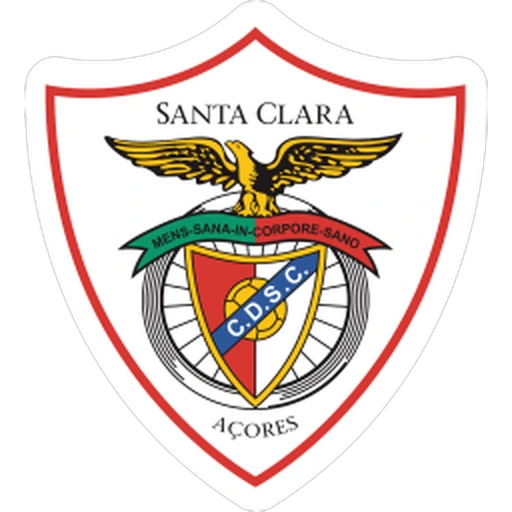
In 2015, the club returned to a design inspired by its historic emblem. The eagle, shield and wheel were restored inside a modern white shield with cleaner lines and updated proportions. This version successfully combined the club's traditional symbolism with a more contemporary appearance and remained in use for almost a decade.
The most significant rebranding came in 2024, when Santa Clara unveiled a completely new identity. The current crest features a stylised white eagle formed from flowing lines inside a red shield, accompanied by the words "Santa Clara Açores". The minimalist design reflects modern branding principles while symbolising both the club's ambition and its strong connection to the Atlantic Ocean and the Azorean archipelago.
CD Santa Clara Club History
Founded in 1927, Clube Desportivo Santa Clara is the most prominent football club in the Azores and one of Portugal's most unique professional teams. Based in Ponta Delgada on the island of São Miguel, the club represents the entire Azorean archipelago in national football. Wearing its traditional red and white colours, Santa Clara has become a symbol of regional pride and resilience.
For much of its early history, Santa Clara competed in the Azorean regional championships, where geographical isolation made participation in mainland competitions extremely difficult. Like many island clubs, long-distance travel presented significant logistical and financial challenges, making success at national level particularly difficult to achieve.
The club first reached Portugal's top flight, the Primeira Liga, in 1999, marking a historic moment not only for Santa Clara but for football in the Azores. Competing against the country's biggest clubs, Santa Clara quickly earned respect for its determination and the unique challenge faced by visiting teams travelling to the islands.
The most successful period in the club's history came under manager Daniel Ramos and later Daniel Ramos and Mário Silva, when Santa Clara achieved consecutive record-breaking league finishes. In the 2020–21 season, the club finished sixth in the Primeira Liga, its highest-ever league position, and qualified for the UEFA Europa Conference League, becoming the first Azorean club to compete in a major UEFA club competition.
Santa Clara's European debut in 2021 represented a landmark achievement. The club defeated Shkupi and Olimpija Ljubljana before narrowly losing to Partizan Belgrade in the play-off round. Although the European adventure ended just short of the group stage, it remains one of the greatest moments in the club's history.
Following relegation in 2023, Santa Clara responded immediately by winning the Liga Portugal 2 title in 2023–24, securing an instant return to the Primeira Liga. The swift promotion demonstrated the club's resilience and reaffirmed its status as the strongest football club in the Azores.
Due to its island location, the club has no traditional local derby, but matches against Marítimo, another Atlantic island club from Madeira, are often regarded as the Island Derby. Encounters with Nacional, Farense, and other clubs from southern Portugal also carry added significance because of the geographical similarities.