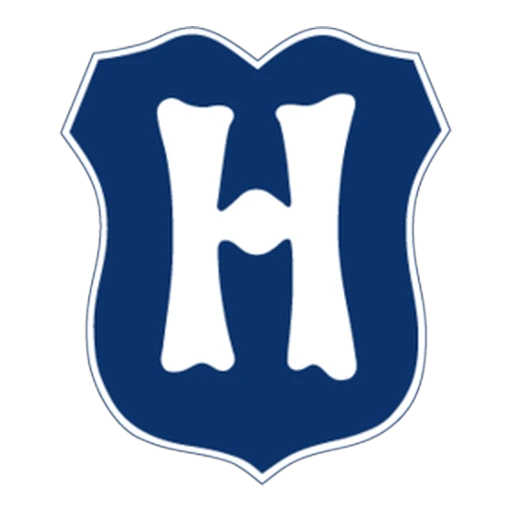
Founded in 1892 as BFC Hertha 1892, the club's first official crest featured a simple blue shield displaying a large white "H". The minimalist design reflected the traditions of Germany's earliest football clubs, while the blue-and-white colours, adopted from the funnel of the steamship Hertha, after which the club was named, became the defining elements of the club's identity.
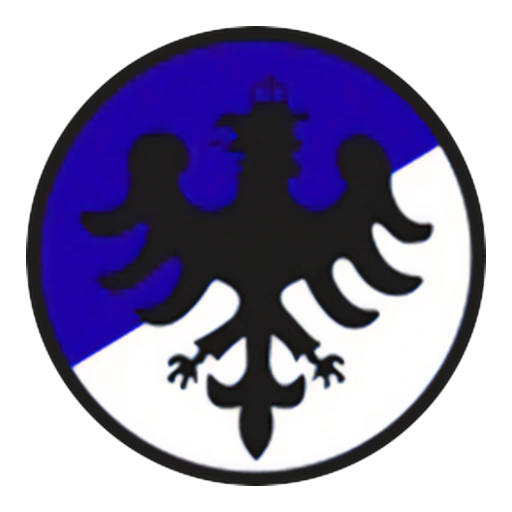
In 1923, following the merger with Berliner Sport-Club, Hertha adopted a circular crest featuring the Prussian Eagle at its centre. The eagle reflected Berlin's historical position within the Kingdom and later the Free State of Prussia, while the club's blue-and-white colours were retained in the background. The redesign gave Hertha a stronger civic and regional identity during one of the club's most successful periods.
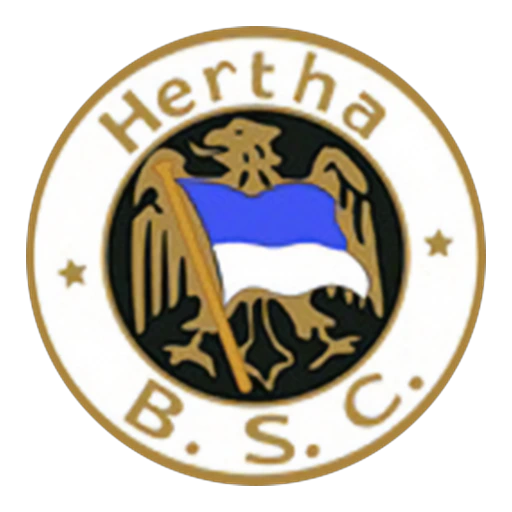
A further redesign followed in 1931, introducing a more elaborate circular badge that combined the Prussian Eagle with Hertha's famous blue-and-white flag. Surrounded by the inscription "Hertha B.S.C.", the crest blended heraldic symbolism with the club's traditional colours, creating one of the most elegant emblems in the club's history.
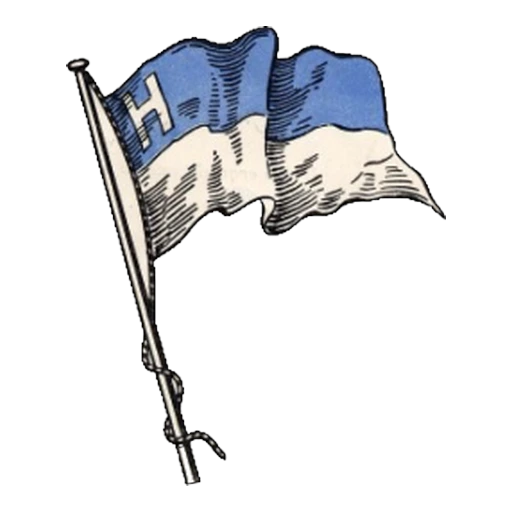
From 1933, Hertha abandoned the circular badge in favour of a waving blue-and-white flag, a motif that would become synonymous with the club. Inspired by the flag flown on the steamship Hertha, from which the club took its name, the emblem gave the club a unique identity unlike any other in German football. The flowing flag quickly became Hertha's defining symbol and has remained central to the club's visual identity ever since.
Following the Second World War, Hertha introduced several modern interpretations of the flag. Between 1948 and 1960, the flag appeared within a simple circular badge carrying the club's name, while the 1960s saw the club experiment with bold typographic logos that arranged the words "HERTHA BSC" into a circular graphic. Although these modern designs reflected contemporary graphic trends, they proved relatively short-lived.
In 1968, Hertha returned to the waving flag inside a circular badge before once again experimenting with the typographic logo between 1974 and 1987. Despite these temporary departures, the blue-and-white flag remained the club's most recognisable symbol and continued to represent Hertha's identity throughout the Bundesliga era.
A significant refinement arrived in 1987, when the club introduced a cleaner and more expressive version of the waving flag with stronger outlines and improved typography. In 1995, this design was placed within a blue circular border carrying the inscription "Hertha BSC Berlin", reinforcing the club's identity as Berlin's traditional football club while modernising its appearance for a new generation.
In 2012, Hertha returned to a simplified flag-only crest, removing the surrounding circular border and placing full emphasis on the iconic blue-and-white flag.
Hertha BSC Club History
Founded on 25 July 1892 as BFC Hertha 1892, Hertha BSC is one of Germany's oldest football clubs. The club was founded by brothers Fritz and Max Lindner, who named it after the steamship Hertha, whose blue-and-white funnel inspired the club's traditional colours. Following a merger with Berliner Sport-Club in 1923, the club adopted the name Hertha BSC, becoming one of the dominant forces in German football during the interwar years.
Hertha enjoyed its first golden era during the late 1920s and early 1930s, reaching six consecutive German Championship Finals between 1926 and 1931. After finishing runners-up on four occasions, the club finally claimed its first national title in 1930, successfully defending the championship in 1931. These back-to-back triumphs established Hertha as one of Germany's strongest clubs before the Second World War.
Following the war, Hertha became one of the leading clubs in West Berlin and was selected as one of the 16 founding members of the Bundesliga in 1963. Although the club remained a regular presence in Germany's top flight, its post-war history was marked by fluctuating fortunes, including relegations, promotions and periods of financial instability. Despite these challenges, Hertha maintained its status as Berlin's traditional football club and attracted large crowds to the Olympiastadion.
A new period of stability began after promotion to the Bundesliga in 1997. Under managers such as Jürgen Röber, Huub Stevens and Lucien Favre, Hertha became a regular competitor in the upper half of the Bundesliga and qualified repeatedly for European competition. The club reached the UEFA Cup and UEFA Champions League, while players including Marcelinho, Michael Preetz, Arne Friedrich and Pál Dárdai became modern club legends.
The following decade brought renewed inconsistency. Despite significant investment after the club's acquisition by investor Lars Windhorst in 2019, Hertha struggled to establish itself among Germany's leading clubs and suffered relegation to the 2. Bundesliga in 2023. The setback marked another chapter in the club's long history of rebuilding while remaining one of Germany's most recognisable football institutions.
Its fiercest rivalry is with 1. FC Union Berlin in the Berlin Derby, a fixture that reflects the city's historic division between East and West. Matches against Hansa Rostock and Energie Cottbus also carry historical significance, while encounters with Schalke 04 have developed into a notable rivalry through decades of Bundesliga competition.