Nickname(s):Die Schwarz-Gelben (The Black and Yellows)
Founded:1953
Stadium:Rudolf-Harbig-Stadion
Capacity:32,249
1953-1968
1968-1990
1990-2002
2002-2011
2013
2007-Present
SG Dynamo Dresden Crest History
Founded in 1953 as SG Dynamo Dresden, the club's first official crest featured a simple triangular shield displaying a stylised red "D" above the word "Dresden". Based on the visual identity of the SV Dynamo sports association, the badge reflected the club's place within East Germany's state-sponsored sporting system while establishing a distinctive identity for football in Dresden.
In 1968, Dynamo Dresden introduced a completely redesigned crest centred around a red shield bearing the white "D". Framed by bold black-and-yellow elements displaying the club's name, the new badge incorporated the club's traditional colours and created a stronger, more modern identity. This emblem accompanied Dynamo during the most successful period in its history, including multiple DDR-Oberliga championships and domestic cup victories.
Following German reunification in 1990, the club adopted a green version of the crest. While the overall design remained unchanged, the colour change symbolised a new beginning during a challenging period in which Dynamo adapted to the German football league system. Despite the updated appearance, the familiar shield and stylised "D" continued to represent the club's historic identity.
In 2002, Dynamo Dresden returned to its traditional red-and-black colour scheme. The crest was refined with cleaner outlines, brighter colours and improved proportions, restoring the visual identity that supporters most closely associated with the club's greatest successes in East German football.
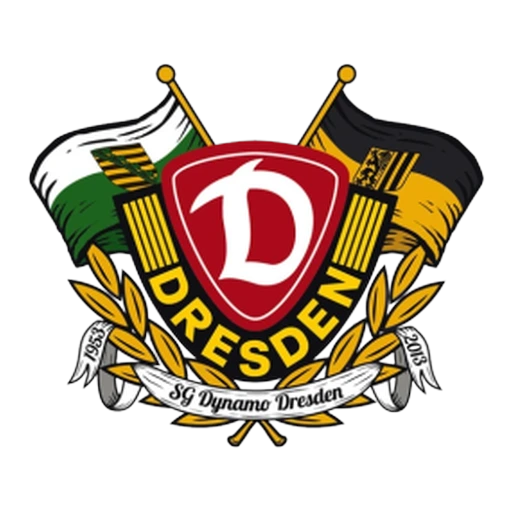
To celebrate the club's 60th anniversary in 2013, Dynamo unveiled a special commemorative crest. The traditional shield was combined with the flags of Saxony and Dresden, surrounded by laurel branches and a ribbon bearing the club's full name. The elaborate design honoured the club's rich history, its achievements and its close relationship with the city and its supporters.
Since 2011, and following the brief use of the anniversary crest in 2013, SG Dynamo Dresden has continued to use a refined version of the traditional shield introduced in 2002. Minor adjustments to the colours, outlines and typography have improved the badge's clarity across modern branding while preserving the iconic red shield, stylised "D" and black-and-yellow elements that have defined Dynamo Dresden's identity for more than half a century.
SG Dynamo Dresden Club History
Founded on 12 April 1953, SG Dynamo Dresden was established as part of the SV Dynamo sports association, which represented East Germany's security services. Although the club's early years were shaped by the political structure of the German Democratic Republic, Dynamo quickly developed its own identity in the city of Dresden and became one of the most successful and best-supported clubs in East German football.
Following promotion to the DDR-Oberliga in 1962, Dynamo Dresden emerged as a dominant force during the late 1960s and 1970s. The club won its first East German Championship in 1971 before adding further league titles in 1973, 1976, 1977, 1978, 1989 and 1990. Dynamo also lifted the FDGB-Pokal on seven occasions, establishing itself as one of the most decorated clubs in the history of East German football. Throughout this period, the club regularly represented East Germany in European competitions and earned a reputation for producing outstanding players and attractive football.
The club's greatest success came under legendary manager Walter Fritzsch, who guided Dynamo to five league championships during the 1970s. Players such as Hans-Jürgen Kreische, Dixie Dörner, Matthias Müller and Ulf Kirsten became club legends, while memorable European encounters against clubs including Bayern Munich, Liverpool, Ajax and Nottingham Forest established Dynamo Dresden as one of the strongest teams in Eastern Europe.
Following German reunification in 1990, Dynamo became one of the founding members of the reunited Bundesliga. However, the transition to professional football in a unified Germany proved difficult. Financial problems, sporting decline and administrative issues culminated in the club losing its Bundesliga licence in 1995, forcing Dynamo into the third tier and beginning a prolonged period outside Germany's top flight.
Despite these setbacks, SG Dynamo Dresden retained one of the largest and most passionate fanbases in German football. The club gradually rebuilt its position through the regional leagues, returning to the 2. Bundesliga on several occasions while remaining a regular competitor in the 3. Liga. Throughout this period, Dynamo became renowned for its exceptional home support at the Rudolf-Harbig-Stadion, regularly attracting crowds comparable to many Bundesliga clubs.
Dynamo's fiercest rivalry is with 1. FC Magdeburg in one of eastern Germany's biggest football rivalries, while matches against Hansa Rostock, Erzgebirge Aue and Lokomotive Leipzig also generate enormous passion, reflecting the club's deep roots in East German football and its enduring importance to the city of Dresden.