Although FC Hansa Rostock was officially founded in 1965, its visual identity traces its origins to predecessor club SC Empor Rostock, established in 1954. The earliest crest consisted of a simple blue wordmark displaying "Empor" in white script on a diagonal banner. The minimalist design reflected the sporting style of East Germany during the 1950s and established the club's first recognizable identity.
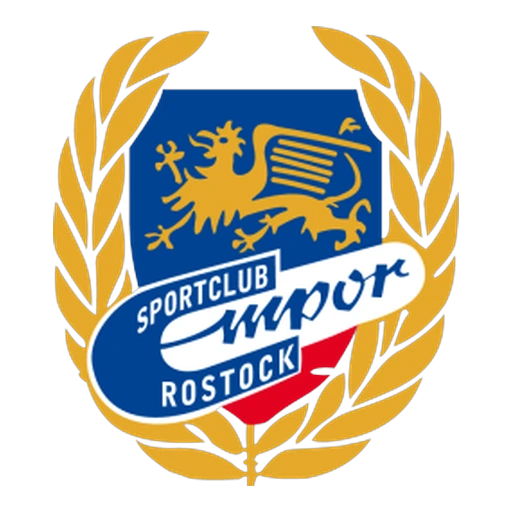
In 1964, SC Empor Rostock introduced a more elaborate crest featuring a blue shield surrounded by a golden laurel wreath. The badge incorporated the griffin from Rostock's historic coat of arms together with the name Sportclub Empor Rostock, creating a stronger civic identity while emphasising the club's growing importance within East German football.
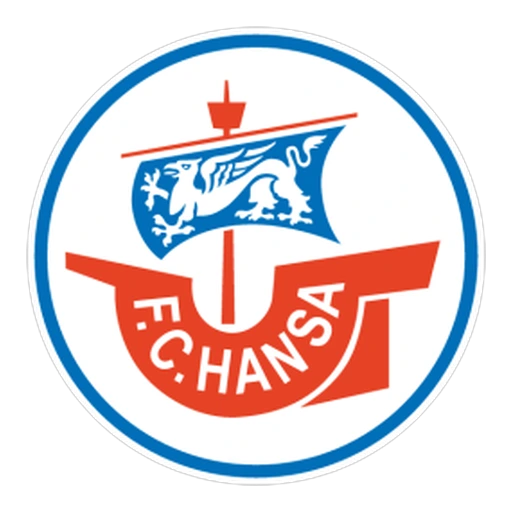
Following the foundation of FC Hansa Rostock on 28 December 1965, the club adopted an entirely new crest that would become one of the most recognisable emblems in German football. The design centred on a stylised Hanseatic cog (Kogge) sailing beneath a blue flag displaying Rostock's white griffin. Enclosed within a circular blue border, the badge symbolised the city's proud maritime heritage and its historic role as a member of the Hanseatic League, while the ship gave rise to the club's famous nickname, Die Kogge (The Cog).
For more than three decades, the crest remained virtually unchanged, accompanying Hansa during its greatest successes, including the club's 1990–91 DDR-Oberliga championship and subsequent participation in the Bundesliga following German reunification. Its stability made the badge one of the most enduring symbols of East German football.
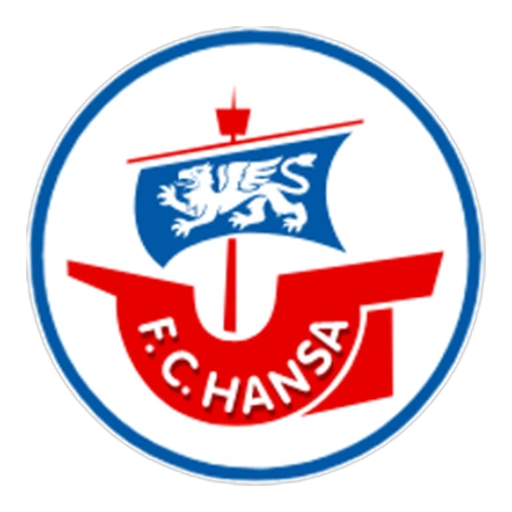
In 2000, the crest underwent its first significant modernisation. The circular border became darker and more prominent, while the proportions of the cog, flag and lettering were refined to create a cleaner and more contemporary appearance. Although the changes were subtle, they improved the badge's visibility and consistency across merchandise and modern media while preserving all of its traditional symbolism.
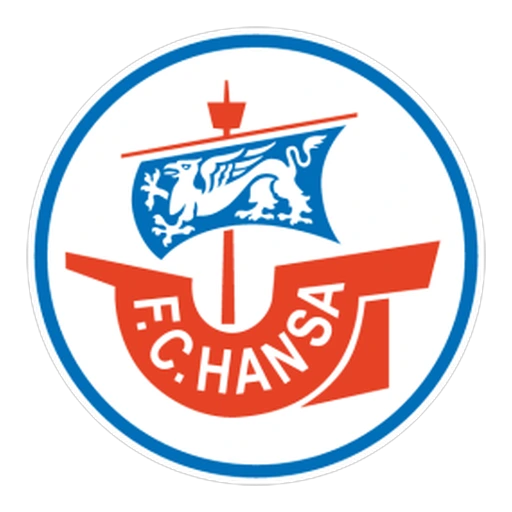
A further refinement followed in 2008, with minor adjustments to the colours, outlines and proportions. The blue border was slightly lightened, and the ship and flag received sharper detailing to enhance reproduction across digital platforms. These changes produced the polished crest that FC Hansa Rostock continues to wear today.
The current crest represents a careful evolution of the emblem first introduced in 1965. Featuring the iconic Hanseatic cog, the Rostock griffin and the club's traditional blue, white and red colours, it successfully combines the city's maritime heritage with a clean contemporary design.
FC Hansa Rostock Club History
Founded on 28 December 1965, FC Hansa Rostock emerged from the football department of SC Empor Rostock, continuing a football tradition in the city that stretched back to the early years of East German football. The club was established during a reorganisation of sport in the German Democratic Republic and quickly became the leading football institution in Mecklenburg-Vorpommern. Taking its name from the historic Hanseatic League, Hansa adopted a strong maritime identity that remains central to the club today.
During the following decades, Hansa Rostock established itself as one of the strongest clubs in the DDR-Oberliga. The club enjoyed its greatest success at the end of East German football, winning its first and only DDR-Oberliga Championship in the 1990–91 season under manager Uwe Reinders. In the same campaign, Hansa also lifted the FDGB-Pokal, completing the only domestic double in the club's history. These triumphs secured Hansa's place in history as the final champions of East Germany before German reunification.
Following reunification, Hansa Rostock became one of the founding members of the unified Bundesliga in 1991. Although immediately relegated, the club earned promotion again in 1995 and went on to enjoy its most successful period in the Bundesliga. Between 1995 and 2005, Hansa established itself as a respected top-flight club, consistently competing against Germany's traditional powers while developing talented players and maintaining a reputation for resilience despite operating with limited financial resources.
After relegation from the Bundesliga in 2005, the club experienced a prolonged period of instability, alternating between the 2. Bundesliga, 3. Liga and, briefly, the Regionalliga. Financial difficulties and inconsistent performances made it difficult to regain a permanent place in Germany's top two divisions, yet Hansa remained one of eastern Germany's best-supported clubs, regularly attracting large crowds to the Ostseestadion.
The club returned to the 2. Bundesliga in 2021, marking another important step in its long-term rebuilding process. Throughout its history, Hansa Rostock has remained a symbol of football in Mecklenburg-Vorpommern, supported by one of the country's most passionate fanbases and recognised for its proud regional identity.
The club's fiercest rivalry is with SG Dynamo Dresden, one of the biggest fixtures in eastern German football. Matches against 1. FC Magdeburg, Union Berlin and Energie Cottbus also carry considerable historical significance, while encounters with FC St. Pauli have developed into one of Germany's most politically charged rivalries due to the contrasting identities of the two clubs.