The earliest modern crest associated with Sporting Étoile Club Bastiais (SECB), used from 1970 to 1980, featured a blue circular badge containing the initials SECB in gold. Above the lettering appeared a stylised fortress tower crowned by a curved golden arc ending in a star. The tower represented the historic Citadel of Bastia, while the blue-and-gold colour scheme reflected the club's traditional colours during one of the most successful periods in its history, including its memorable run to the 1978 UEFA Cup Final.
In 1980, SC Bastia introduced a new identity centred on one of Corsica's most recognisable symbols: the Moor's Head (Testa Mora). The badge became a white shield bearing the black Moor's Head wearing its traditional white headband, with the initials S.E.C.B. across the top. The redesign strengthened the club's Corsican identity and established the Moor's Head as the defining feature of future Bastia crests.
A refined version followed in 1985, retaining the same shield and Moor's Head while adding a blue outer border and replacing S.E.C.B. with S.C. Bastia. This crest became closely associated with the club's return to the top flight and remained in use throughout the late 1980s and 1990s.
In 1998, Bastia unveiled a more elaborate badge inspired by a traditional heraldic shield. The upper section displayed both the Corsican flag featuring the Moor's Head and the coat of arms of the city of Bastia, while the lower section prominently featured the initials SCB. The redesign celebrated both the club's Corsican heritage and its connection to the city, creating one of the most distinctive identities in French football.
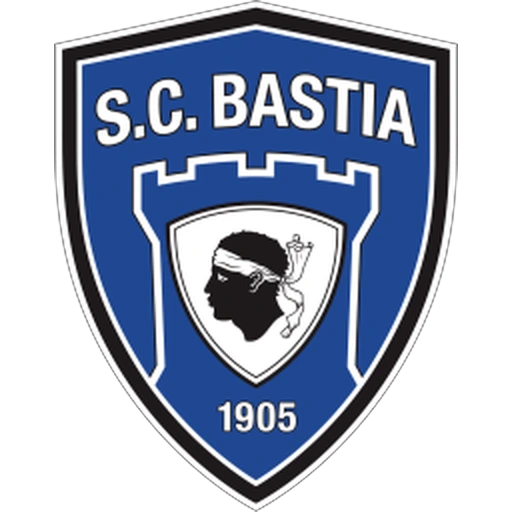
The club adopted a cleaner, more modern shield in 2011. The new crest returned the focus to the Citadel of Bastia, represented by a stylised fortress along the top of the badge, while the Moor's Head occupied the centre inside a smaller shield. The founding year 1905 appeared at the bottom, and the overall design combined Bastia's two strongest symbols, the citadel and the Corsican emblem, into a contemporary identity.
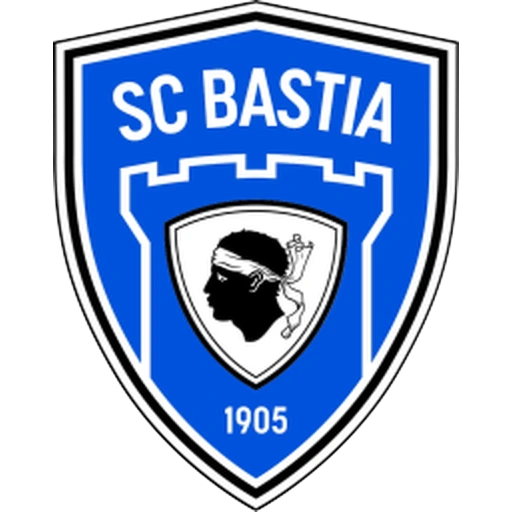
A subtle redesign in 2024 modernised the proportions, typography, and colours while preserving the overall composition introduced in 2011. The badge retained the fortress, the Moor's Head, and the founding year 1905, presenting a sharper and more streamlined visual identity suited to the club's new era.
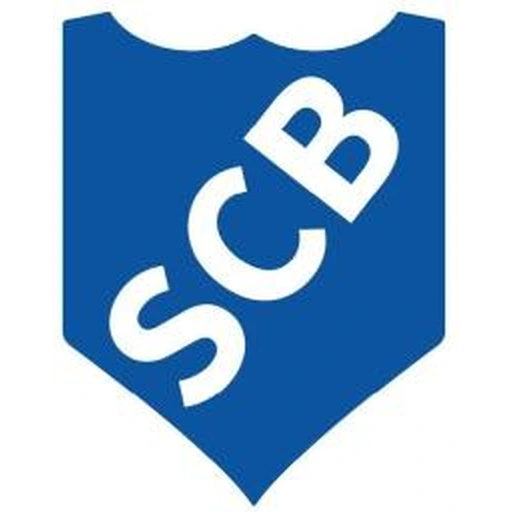
For the 2025–26 season, SC Bastia unveiled a special commemorative crest celebrating the club's 120th anniversary. Departing from its traditional design, the anniversary logo featured a minimalist blue shield containing the white initials SCB arranged diagonally. The simplified emblem was created exclusively for the anniversary celebrations before the club returned to its regular crest.
SC Bastia Club History
Founded in 1905 as Sporting Club Bastiais, SC Bastia is one of the oldest and most successful football clubs on the island of Corsica. Established in the Terra-Vecchia district of Bastia, the club initially competed in regional competitions before gradually becoming the dominant force in Corsican football. Throughout its history, Bastia has been regarded as a symbol of Corsican pride and identity, with its supporters renowned for their passionate backing and strong regional culture.
SC Bastia turned professional in 1965 and was promoted to the French top flight three years later. The club quickly established itself among France's leading teams, achieving its first major success by winning the Coupe de France in 1981, defeating AS Saint-Étienne 2–1 in the final. The victory secured Bastia's only major domestic trophy and remains one of the defining moments in the club's history.
The greatest European achievement came during the 1977–78 UEFA Cup. Led by players such as Claude Papi, Johnny Rep, and Jean-François Larios, Bastia defeated Sporting CP, Newcastle United, Torino, Carl Zeiss Jena, and Grasshoppers Zürich to reach the UEFA Cup Final. Although they lost to PSV Eindhoven over two legs, the remarkable run remains one of the greatest achievements by a French club in European competition and is still celebrated throughout Corsica.
Throughout the 1980s, 1990s, and early 2000s, Bastia became a regular presence in Ligue 1, earning a reputation for developing talented players and maintaining one of France's strongest home atmospheres at the Stade Armand-Cesari (Furiani). However, the club's history was also marked by tragedy. On 5 May 1992, a temporary stand collapsed before the Coupe de France semi-final against Olympique de Marseille, killing 18 people and injuring more than 2,300. The Furiani disaster remains the worst stadium tragedy in French football history, and no professional matches are played in France on 5 May in remembrance of the victims.
Financial difficulties eventually caught up with the club. In 2017, SC Bastia was declared bankrupt and administratively relegated to the fifth tier (National 3). Rather than disappearing, the club rebuilt under new ownership, achieving consecutive promotions back through the French football pyramid. By 2021, Bastia had returned to Ligue 2, completing one of the most impressive recoveries in modern French football.
SC Bastia's fiercest rivalry is with AC Ajaccio in the Derby Corse, the biggest football match on the island of Corsica. Matches against Gazélec Ajaccio have also been highly significant, while fixtures against mainland southern clubs such as OGC Nice and Olympique de Marseille have often carried added intensity due to geographical proximity and historic rivalries.