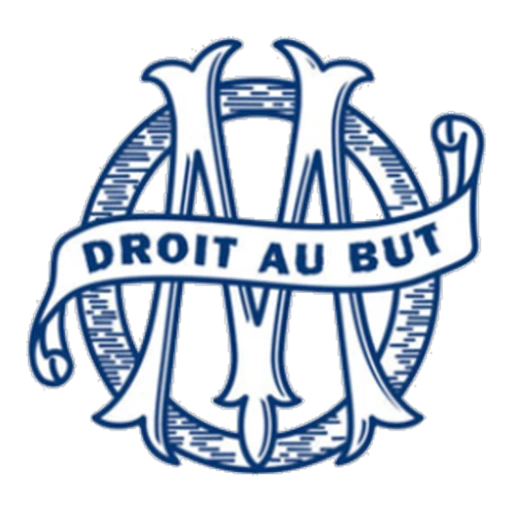
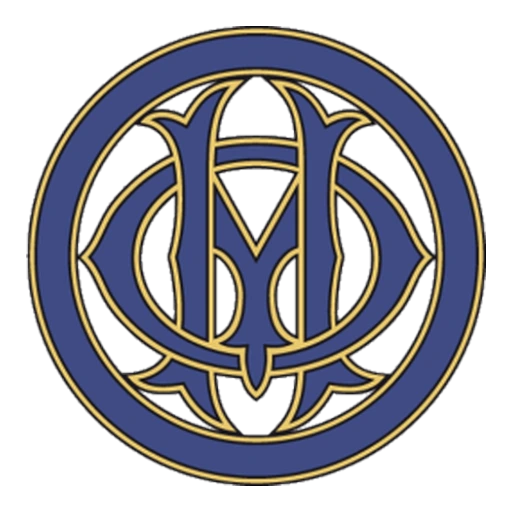
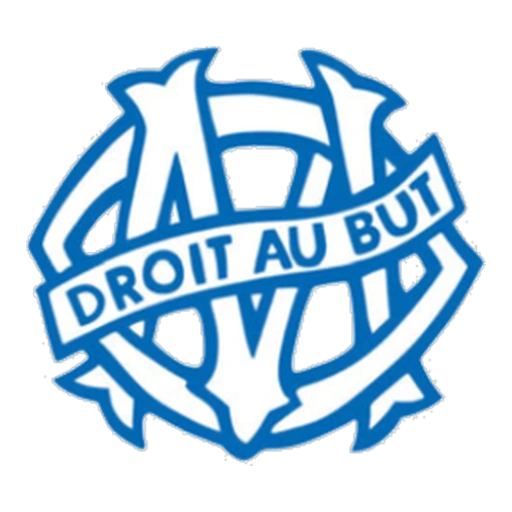
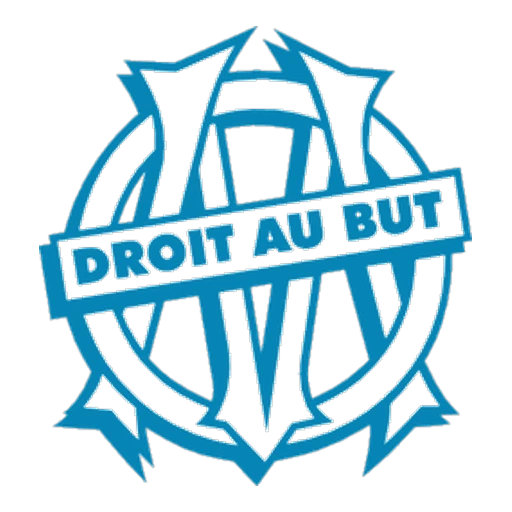
The earliest crest of Olympique de Marseille, introduced in 1899, consisted of an elegant intertwined "OM" monogram inspired by the Art Nouveau style of the period. Across the centre ran the club's famous motto, "Droit au But" ("Straight to the Goal"), a phrase adopted from the city's rowing club that symbolises determination and ambition. This monogram established the visual identity that would define Marseille for more than a century.
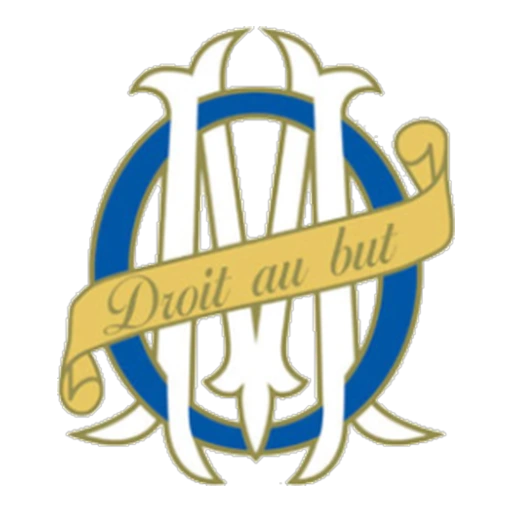
During the club's earliest years, several slight variations of the monogram appeared. Between 1899 and 1910, black-and-white versions were commonly used in official documents and publications, while from 1910 to 1935, the crest adopted the club's traditional blue and white colours and featured a gold ribbon carrying the "Droit au But" motto. These refinements enhanced the elegance of the original emblem without altering its distinctive intertwined initials.
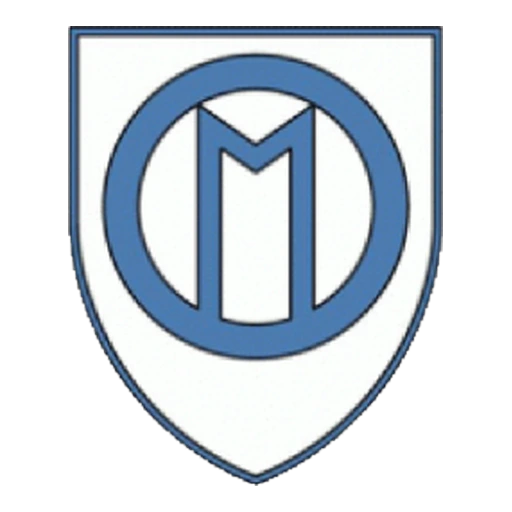
In 1935, Olympique de Marseille introduced a rare departure from the monogram by adopting a shield featuring a large blue "M" inside a circle. The simplified badge abandoned the intertwined initials in favour of a more geometric design that reflected the graphic trends of the era. This version remained the club's primary emblem until 1972.
A completely redesigned circular crest followed in 1972, combining the traditional OM monogram with gold detailing inside a blue ring. Although visually striking, the design lasted only until 1981, after which the club returned to a modernised interpretation of its classic intertwined initials.
From 1981 onwards, Marseille embraced a cleaner and more minimalist identity. The intertwined OM initials returned as the sole focus of the crest, accompanied by the "Droit au But" ribbon. Between 1981 and 1996, the badge underwent several subtle refinements, mainly involving cleaner lines, brighter shades of blue, and improved typography, while always remaining faithful to the historic monogram.
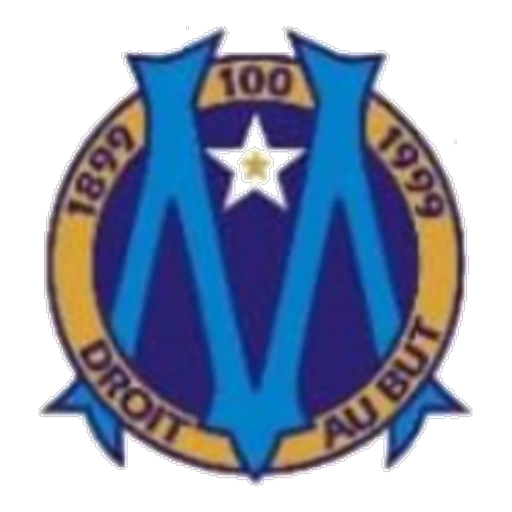
To celebrate the club's centenary in 1998, Olympique de Marseille introduced a special commemorative crest featuring a gold ring, the years 1899–1999, and a gold star above the monogram. The design honoured one hundred years of club history while retaining the traditional intertwined initials and motto. This anniversary badge was used for a single season.
In 1999, the club returned to a simplified version of its classic crest, once again emphasising the OM monogram and "Droit au But" banner. A significant milestone came in 2004, when a gold star was permanently added above the emblem to commemorate Marseille's victory in the 1992–93 UEFA Champions League, making OM the first—and still only—French club to win Europe's premier club competition. This crest became one of the most recognisable symbols in French football.
In 2026, Olympique de Marseille unveiled a bold new identity. The traditional intertwined initials were simplified into a modern circular emblem featuring a stylised blue "M" enclosed within a ring. The redesign abandoned both the "Droit au But" motto and the commemorative star in favour of a minimalist approach while maintaining the club's iconic blue-and-white colours. The new crest represents a contemporary interpretation of Marseille's historic identity while looking toward the club's future.
Olympique Marseille Club History
Founded in 1899, Olympique de Marseille (OM) is the oldest major professional football club in France and one of the country's most successful sporting institutions. Originally established as a multi-sport club by René Dufaure de Montmirail, football quickly became its flagship discipline. The club adopted the motto "Droit au But" ("Straight to the Goal") from a local rowing club, a phrase that has remained at the heart of its identity ever since. OM has played at the Stade Vélodrome since 1937, making it one of the most iconic football venues in Europe.
Marseille established itself as a national power during the interwar years, becoming the first club from outside Paris to win the Coupe de France in 1924 before adding further victories in 1926 and 1927. The club won its first French league championship in 1929 (amateur era) and claimed its first professional league title in 1937, shortly after the introduction of professionalism in French football. OM remained one of the country's leading clubs throughout the twentieth century, collecting numerous domestic honours and building a passionate nationwide following.
The greatest period in the club's history came under president Bernard Tapie between the late 1980s and early 1990s. Led by legendary players such as Jean-Pierre Papin, Didier Deschamps, Chris Waddle, Abedi Pelé, Rudi Völler, Marcel Desailly, and Basile Boli, Marseille won five consecutive French league titles from 1989 to 1993. The crowning achievement came on 26 May 1993, when Basile Boli's decisive goal secured a 1–0 victory over AC Milan in the UEFA Champions League Final.
The club's success was overshadowed by the VA–OM match-fixing scandal in 1993, which led to the loss of the 1992–93 French league title, relegation, and a period of rebuilding. Despite these setbacks, Marseille returned to the top flight and remained one of France's biggest clubs. The team won the 1993 UEFA Champions League title retained in the record books, reached the UEFA Cup finals in 1999, 2004, and 2018, and lifted the Ligue 1 title again in 2009–10 under Didier Deschamps, ending an eighteen-year wait for the championship.
Throughout its history, Olympique de Marseille has been home to some of the world's finest footballers, including Jean-Pierre Papin, Didier Drogba, Fabien Barthez, Steve Mandanda, Samir Nasri, Franck Ribéry, Mamadou Niang, Eric Cantona, and Josip Skoblar. The club remains one of the most passionately supported in Europe, with the Orange Vélodrome regularly attracting some of the largest crowds in French football. OM continues to compete for domestic honours and European qualification while maintaining its status as one of the country's most iconic clubs.
Olympique de Marseille's greatest rivalry is with Paris Saint-Germain in Le Classique, the most famous fixture in French football. Matches against Olympique Lyonnais are also highly competitive, while encounters with OGC Nice carry added significance as a Mediterranean rivalry between two of southern France's biggest clubs