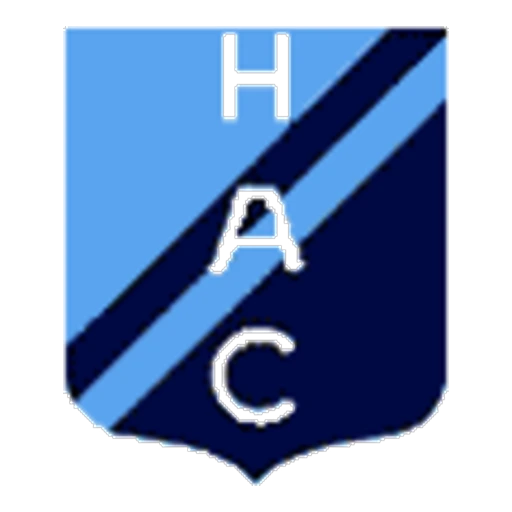
The earliest recognised crest of Le Havre AC, used from 1894 to 1970, featured a simple shield in the club's traditional sky blue and navy blue colours. A diagonal stripe divided the badge, while the initials HAC were arranged vertically down the centre. Inspired by English football heraldry, the minimalist design reflected the club's British origins and established the famous ciel et marine colour combination that remains synonymous with Le Havre today.
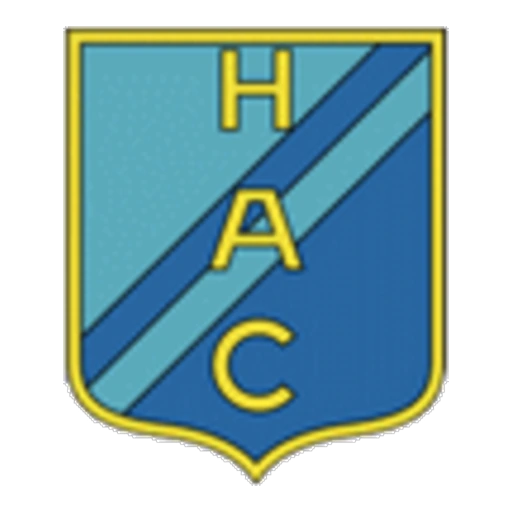
In 1970, the shield was modernised while retaining its familiar layout. The colours became brighter, a gold border was added, and the diagonal stripe was refined to give the badge a cleaner appearance. The vertically stacked HAC initials remained central, preserving the club's historic identity while updating it for a new era.
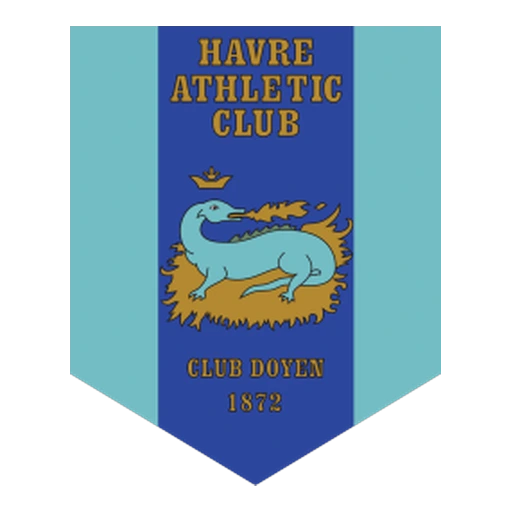
A completely new crest was introduced in 1990. The traditional initials were replaced by a heraldic design featuring the words "Havre Athletic Club" above a crowned salamander, the historic symbol of the city of Le Havre and the personal emblem of King Francis I, founder of the city in 1517. The badge also included the inscription "Club Doyen 1872", highlighting the club's long-standing claim to being France's oldest football club. The redesign placed greater emphasis on the club's history and civic heritage.
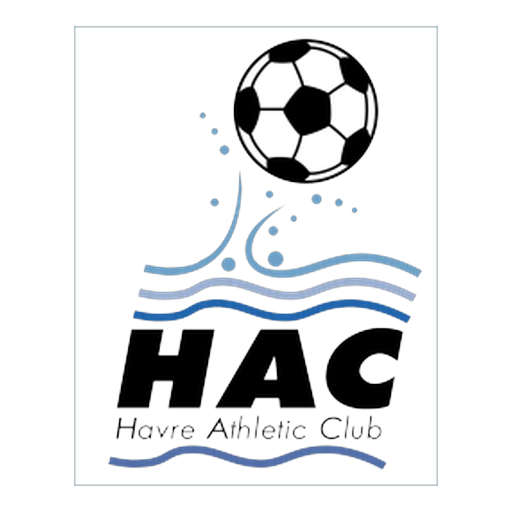
In 2000, Le Havre adopted a much more modern visual identity. The heraldic elements disappeared in favour of a minimalist logo featuring a football above stylised waves, symbolising the city's close relationship with the sea and its status as one of France's largest ports. The bold HAC lettering became the focal point, creating a clean corporate identity while maintaining references to the club's maritime roots.
A circular crest followed in 2005, combining modern graphics with traditional symbolism. The badge retained the football and waves, while introducing a circular blue border carrying the club's full name. The initials HAC were displayed prominently in the centre above the founding year 1872, presenting a more balanced and contemporary identity while continuing to celebrate Le Havre's connection to the sea.
Since 2012, Le Havre AC has used a refined shield that returns to a more traditional football crest. The badge features the large HAC initials above a white crowned salamander, once again highlighting the city's historic emblem. The founding year 1872 appears beneath, while the familiar sky blue and navy blue colours are complemented by subtle gold detailing. The current design successfully combines the club's English origins, maritime identity and civic heritage into a modern emblem that reflects one of France's oldest football institutions.
Le Havra AC Club History
Founded in 1894 as the football section of Le Havre Athletic Club, Le Havre AC is widely recognised as the oldest existing football club in France. The parent multi-sports club was established in 1884 by British residents in the port city of Le Havre, initially playing a hybrid game known as "combination" before fully adopting association football. The club's traditional sky blue and navy blue colours were inspired by the colours of the universities of Oxford and Cambridge, reflecting its English roots.
Le Havre quickly became one of the pioneers of French football. The club won the USFSA French Championship in 1899 and 1900, becoming the first team from outside Paris to claim the national title. After the introduction of professional football in 1932, Le Havre turned professional in 1933 and remained a regular presence in the top two divisions. The club's greatest domestic success came in 1959, when it completed a historic Coupe de France and Division 2 double before adding the Challenge des Champions later that year.
Although Le Havre has rarely challenged for the Ligue 1 title, it has built one of Europe's most respected youth academies. The club has developed numerous international players, including Paul Pogba, Steve Mandanda, Riyad Mahrez, Dimitri Payet, Lassana Diarra, Benjamin Mendy, Ferland Mendy, Jean-Alain Boumsong, and Vikash Dhorasoo. This commitment to youth development has become one of the defining characteristics of Le Havre AC and continues to underpin the club's philosophy.
Le Havre has enjoyed considerable success in France's second division, winning a record-equalling six Ligue 2 championships in 1938, 1959, 1985, 1991, 2008, and 2023. Following promotion in 2008, the club spent one season in Ligue 1 before returning to Ligue 2, where it remained for over a decade. Under coach Luka Elsner, Le Havre finally secured promotion back to Ligue 1 by winning the 2022–23 Ligue 2 title, ending a fifteen-year absence from the top flight.
Le Havre AC's principal rivalry is with FC Rouen in the Normandy Derby, one of the oldest and most prestigious regional rivalries in French football. Matches against SM Caen also carry significant importance, reflecting the long-standing competition between Normandy's leading clubs.