Nickname(s):Leão da Alta Araraquarense(Lion of Alta Araraquarense),Leão (The Lion)
Founded:1925
Stadium:Estádio Municipal José Maria de Campos Maia(Maião)
Capacity:15,000
1925-1964
1964-1969
1972-1982
1982-1985
1985-1989
2015-Present
Mirassol FC Crest History
The crest history of Mirassol Futebol Clube has undergone several significant transformations since the club's foundation in 1925. While the shape and graphic style have changed considerably, the initials MFC have appeared throughout most of its history, while the distinctive green and yellow colours eventually became the defining elements of Mirassol's modern identity.
The original 1925–1964 crest was a simple circular emblem featuring the intertwined initials MFC. The badge was divided vertically into yellow and green sections, surrounded by a double circular border in the same colours. Its straightforward monogram established both the club's initials and the colour combination that would later become permanently associated with Mirassol.
Between 1964 and 1969, the basic circular concept was retained but the colours changed dramatically. The crest became dark blue and white, with a redesigned MFC monogram occupying almost the entire centre of the badge. The letters were more geometric and tightly integrated, producing a cleaner and more formal appearance.
The 1972–1982 crest represented a complete departure from the earlier circular badges. Mirassol adopted a traditional green shield containing an elaborate white intertwined MFC monogram. The design was considerably more heraldic and restrained, with the initials rather than additional decoration providing the entire identity of the club.
Between 1982 and 1985, Mirassol returned decisively to its green and yellow identity. The badge remained shield-shaped but became more pointed and geometric, with a thick yellow border surrounding a green interior. Large stylised yellow letters MFC filled almost the entire shield, creating one of the simplest and most immediately recognisable designs in the club's history.
A radically different crest appeared between 1985 and 1989. The shield became broader and was outlined heavily in black, while the initials M.F.C. appeared in yellow across the upper section. The centre was dominated by a large yellow lion standing against a green background, directly representing the club's Leão identity. The name MIRASSOL was written prominently in yellow across a black band at the bottom.
The lion badge represented one of the most distinctive departures from Mirassol's traditional monogram-based identity. Rather than relying primarily on the MFC initials, the club's nickname and mascot became the central visual feature, giving the emblem a much more illustrative appearance.
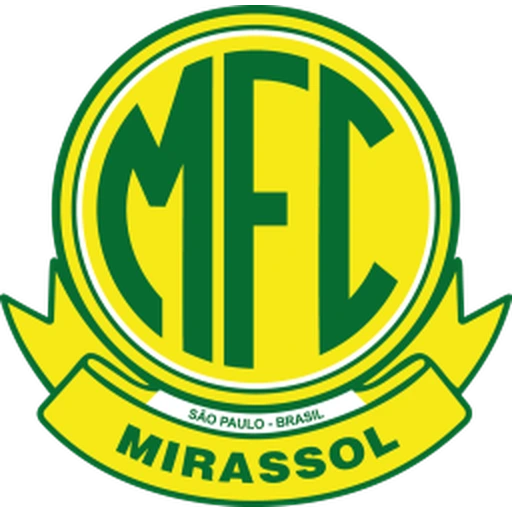
Since 2011, Mirassol has used a crest that deliberately reconnects with the club's earliest identity. The circular MFC monogram returned as the central feature, presented in green and yellow and surrounded by multiple circular outlines. The design strongly recalls the original 1925 badge while using cleaner, more modern geometry.
The modern crest also introduced a prominent yellow ribbon beneath the circular emblem carrying the name MIRASSOL in green. A small inscription reading SÃO PAULO – BRASIL appears between the central roundel and the ribbon, clearly identifying the club's geographic origin.
Mirassol FC Club History
Mirassol Futebol Clube was founded on 9 November 1925 in the city of Mirassol, in the state of São Paulo. The club developed as a representative of football in the interior of the state and became known as the Leão da Alta Araraquarense (Lion of Alta Araraquarense). Its green and yellow colours eventually became one of its most recognisable characteristics.
For much of its early history, Mirassol competed primarily in regional and lower-level state competitions. Like many clubs from smaller cities in the interior of São Paulo, its development was gradual, and the club experienced periods away from professional football before becoming more firmly established within the state league structure.
A major step in Mirassol's development came during the 1990s and 2000s, when the club began climbing through the divisions of the Campeonato Paulista. The increasingly professional structure of the club eventually brought it into regular competition with the traditional powers of São Paulo football.
Mirassol reached the top division of the Campeonato Paulista and gradually established a reputation as one of the competitive clubs from the state's interior. Matches against giants such as Corinthians, Palmeiras, Santos and São Paulo gave the club greater exposure and provided opportunities for some memorable results.
One of the most famous came in the 2013 Campeonato Paulista, when Mirassol defeated Palmeiras 6–2. The remarkable result attracted national attention and remains one of the best-known victories in the club's history.
Mirassol's ambitions increasingly extended beyond state football. The club competed in the lower levels of the Brazilian national league system and began building the foundations for a remarkable climb through the divisions during the late 2010s and early 2020s.
The first major national breakthrough came in 2020, when Mirassol won the Campeonato Brasileiro Série D. The club defeated Floresta in the final and secured its first national championship, as well as promotion to Série C. The title represented a turning point, transforming Mirassol from a primarily regional force into an increasingly important club on the national stage.
Progress continued rapidly. In 2022, Mirassol enjoyed another outstanding national campaign and won the Campeonato Brasileiro Série C, defeating ABC in the final. Only two years after winning Série D, the Leão had captured another national title and earned promotion to Série B for the first time.
Mirassol adapted impressively to the second tier. After a competitive first Série B season in 2023, the club mounted a serious promotion challenge in 2024. The campaign ended with one of the greatest achievements in its history: Mirassol finished inside the promotion positions and earned a place in the Campeonato Brasileiro Série A for the first time.
The club consequently made its historic Série A debut in 2025, completing an extraordinary rise from Série D to the highest level of Brazilian football in only a few seasons. For a club representing a relatively small municipality in the interior of São Paulo, reaching the national top flight was an exceptional achievement and significantly raised Mirassol's profile throughout Brazil.
Mirassol plays its home matches at the Estádio Municipal José Maria de Campos Maia, commonly known as the Maião. The stadium has been closely associated with the club's rise and has developed into an important home advantage as increasingly prominent Brazilian clubs have travelled to Mirassol.
In terms of rivalries, Mirassol's strongest traditional relationships are regional rather than national. Matches against other clubs from the interior of São Paulo carry particular importance, with Grêmio Novorizontino becoming an especially relevant nearby opponent as both clubs have risen through Brazilian football. Encounters with teams such as São José do Rio Preto have also formed part of Mirassol's regional football history.