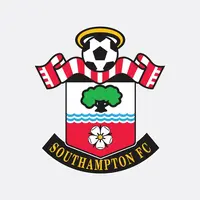
Known as “The Saints” due to its origins as St Mary’s Church Young Men’s Association, the club’s badge incorporates a range of elements that reflect Southampton’s history, geography and identity.
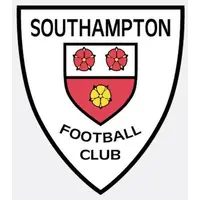
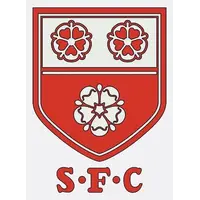
For much of the club’s early history, Southampton used the same crest as the City of Southampton.
A major change came in 1974 when the club launched a competition inviting supporters to design a new crest. The winning entry, created by Rolland Parris, introduced a unique badge that remains the foundation of Southampton’s identity today.
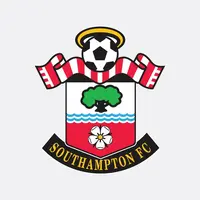
The design brought together a number of symbols representing both the club and the city. At the top of the crest sits a halo, referencing the club’s nickname, “The Saints,” and its origins as a church team. Beneath it is a football, representing the sport itself, while a red-and-white scarf symbolises both the supporters and Southampton’s traditional colours.
The tree featured on the badge represents the nearby New Forest and Southampton Common, two important landmarks closely associated with the area. Beneath the tree, the water reflects Southampton’s historic connections with rivers, the sea and international maritime trade. At the bottom of the crest sits a white rose, a symbol long associated with the city of Southampton itself.
The 1974 design quickly became one of the most recognisable badges in English football and remained largely unchanged for two decades. During the mid-1990s, the club introduced a subtle redesign, the most noticeable change being the replacement of the original vintage-style football with the modern black-and-white football featured on the crest today. Other elements were refined, but the overall design and symbolism remained intact.
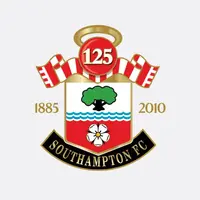
In 2010, Southampton celebrated its 125th anniversary with a special commemorative crest. The badge retained the traditional design while incorporating gold detailing, anniversary dates and references to the club’s long history. Following the celebrations, the club returned to its standard crest.
Southampton FC Club History
Southampton Football Club was founded in 1885 by members of St. Mary’s Church of England Young Men’s Association in Southampton. The club’s origins as a church team gave rise to the nickname “The Saints,” which has remained associated with Southampton throughout its history. Originally known as St. Mary’s Y.M.A., the club evolved through several names before officially becoming Southampton Football Club in 1897.
The Saints quickly established themselves as one of the strongest clubs in southern England. After joining the Southern League in 1894, Southampton enjoyed considerable success, winning six Southern League titles between 1897 and 1904 and reaching several FA Cup Finals. These achievements helped build the club’s reputation long before its entry into the Football League.
In 1898, Southampton moved to The Dell, a stadium that would become one of the most famous grounds in English football. The Dell served as the club’s home for more than a century and witnessed many of Southampton’s greatest moments. In 2001, the Saints left their historic home and moved to the modern St Mary’s Stadium, named in recognition of the area where the club was founded and its connection to St. Mary’s Church.
Southampton joined the Football League in 1920 and gradually established itself within the professional game. The club achieved promotion to the top flight for the first time in 1966 and became a regular presence in the highest divisions of English football.
The greatest achievement in Southampton’s history came during the 1975–76 season when the club won the FA Cup for the first and only time. In one of the competition’s most famous upsets, Second Division Southampton defeated Manchester United 1–0 at Wembley Stadium thanks to Bobby Stokes’ winning goal. The victory remains the defining moment in the club’s history and secured Southampton’s place in English football folklore.
Throughout the late twentieth century, Southampton developed a reputation for producing talented footballers. The club’s academy became one of the most respected in England, producing players such as Matt Le Tissier, Theo Walcott, Gareth Bale, Alex Oxlade-Chamberlain and James Ward-Prowse. This commitment to youth development remains a central part of the club’s identity.
Southampton was a founding member of the Premier League in 1992 and spent many seasons competing at the highest level. Although the club experienced relegation and financial difficulties during the 2000s, it successfully rebuilt and returned to the Premier League in 2012, beginning another successful chapter in its history.
One of the defining aspects of Southampton’s identity is its rivalry with Portsmouth. The close proximity of the two cities and their shared maritime heritage have created a fierce competition that stretches back more than a century. Matches between the clubs are known as the South Coast Derby and are among the most passionate rivalries in English football.