Historical Crests FCSB
Name: FCSB
Nickname(s): Roș-Albaștrii (The Red-Blues)
Founded: 1998
Stadium: Arena Națională
Capacity: 55,634
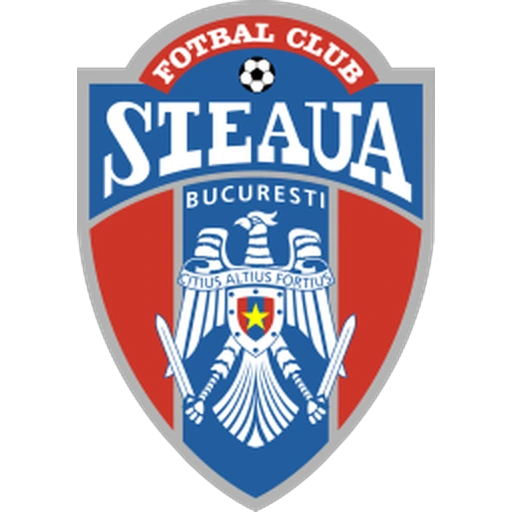
1998-2003
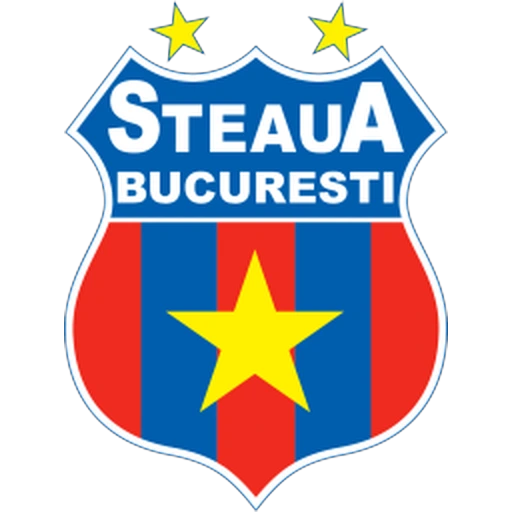
2003-2015
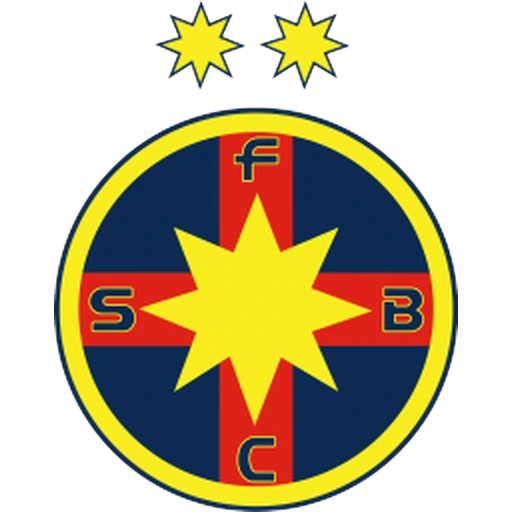
2015-Present
FCSB Crest History
The crest history of FCSB reflects the club's transition from the professional football section of Steaua București into an independent football club. While its early badges continued the traditional Steaua identity, legal disputes over the club's name and trademarks eventually led to the creation of an entirely new emblem.
The first crest, used between 1998 and 2003, was introduced after the football section became an independent professional club. The badge featured a red-and-blue shield with the word "Steaua București", an eagle carrying a shield, and the Latin motto "Virtus Romana Rediviva." It represented continuity with the club's military heritage while establishing the newly organised football club.
In 2003, the club adopted a redesigned version that returned to the classic Steaua shield with its famous golden star on a red-and-blue background. Two gold stars were added above the crest to celebrate the club's remarkable domestic success. This badge became closely associated with the team's achievements in the 2000s and early 2010s, including numerous league championships and regular participation in the UEFA Champions League and UEFA Europa League.
A defining moment came in 2014, when the High Court of Cassation and Justice of Romania ruled that the Steaua name and crest belonged to CSA Steaua București, the Romanian Army sports club. As a result, the professional club lost the legal right to use the historic Steaua identity.
Consequently, in 2015, the club introduced a completely new crest. The current emblem is a circular badge featuring a large eight-pointed golden star set against a dark blue background with a red cross. The initials "FCSB" are positioned around the star, while two gold stars above the badge continue to recognise the club's domestic achievements. Although entirely different from the historic Steaua crest, the new design preserves the traditional red, blue and yellow colours that have long been associated with the club.
Today, FCSB's crest symbolises the club's modern identity. While the traditional Steaua badge is now used by CSA Steaua București, the current emblem represents FCSB's continued presence at the highest level of Romanian football and its ambition to build upon a successful sporting legacy under a new name.
FCSB Club History
Founded in 1947 as the professional football section of the Romanian Army sports club, the organisation now known as FCSB traces its sporting origins to the team that competed for decades under the name Steaua București. Throughout the second half of the twentieth century, the club became the dominant force in Romanian football, winning numerous domestic titles and establishing itself as one of Eastern Europe's most successful teams.
During the communist era, Steaua was the football club of the Romanian Army and competed under several names, including ASA București, CSCA București, and CCA București, before officially becoming Steaua București in 1961. The club enjoyed enormous domestic success and became a regular participant in European competitions.
The greatest achievement in the club's history came in 1986, when Steaua defeated FC Barcelona in the European Cup Final in Seville. Goalkeeper Helmuth Duckadam famously saved all four Barcelona penalties in the shoot-out, securing the first, and still the only, European Cup won by a Romanian club. Later that year, Steaua also won the UEFA Super Cup, defeating Dynamo Kyiv, and reached another European Cup Final in 1989, losing to AC Milan.
Following the fall of communism, Romanian football underwent major structural reforms. In 1998, the football section separated from the CSA Steaua București multi-sports club and became an independent professional organisation. The team continued to compete as FC Steaua București, remaining in the top division and participating regularly in the UEFA Champions League and UEFA Europa League.
The separation eventually led to one of the most complex legal disputes in European football. During the 2010s, the Romanian Ministry of National Defence, owner of CSA Steaua București, argued that the football company had never legally acquired the Steaua name, crest and trademarks. After several court rulings, the professional club lost the right to use the historic Steaua identity.
As a result, in 2015 the club adopted a new crest, and in 2017 officially changed its name from FC Steaua București to FCSB. Meanwhile, CSA Steaua București re-established its own football section, beginning in the amateur leagues before returning to professional football. Since then, two clubs have claimed the Steaua legacy.
Today, the historical situation remains unique:
FCSB is recognised by UEFA as the sporting continuation of the team that won the 1986 European Cup and therefore retains the club's European records and coefficient.
CSA Steaua București owns the Steaua name, original crest and trademarks following decisions by the Romanian courts and considers itself the original club founded in 1947.
The ownership of certain historical domestic honours remains a subject of legal interpretation and debate among supporters, historians and Romanian football authorities.