Atlas FC Crest History
The crest of Atlas FC is one of the most distinctive and consistent identities in Mexican football. Since the club's foundation in 1916, the emblem has been dominated by its famous red-and-black shield and a stylised white letter “A”, representing Atlas.
The original 1916–1930 crest already established virtually all of the elements that define the club today. The shield was divided vertically into red and black halves, the colours that gave the team its nickname Los Rojinegros, The Red and Blacks.
At the centre appeared a distinctive white A. Rather than using conventional typography, the letter was integrated into the structure of the shield, creating a simple symbol that could immediately be associated with the club.
The 1931–1951 crest refined the original design. The red became brighter and the proportions of the central A were adjusted, but the basic red-and-black identity remained untouched.
From 1952 to 1984, another subtle redesign produced a broader and more symmetrical shield. The central white A became more prominent, while the division between the red and black halves remained one of the defining characteristics of the badge.
The 1985–2021 version continued the same concept with cleaner lines and modernised proportions. Despite being used for more than three decades, it remained immediately recognisable as a direct descendant of the original 1916 emblem.
A significant addition appeared in 2022, following one of the greatest periods in Atlas history. The club won the Apertura 2021 championship, ending a 70-year wait for a league title, and then captured the Clausura 2022, completing a historic back-to-back championship triumph.
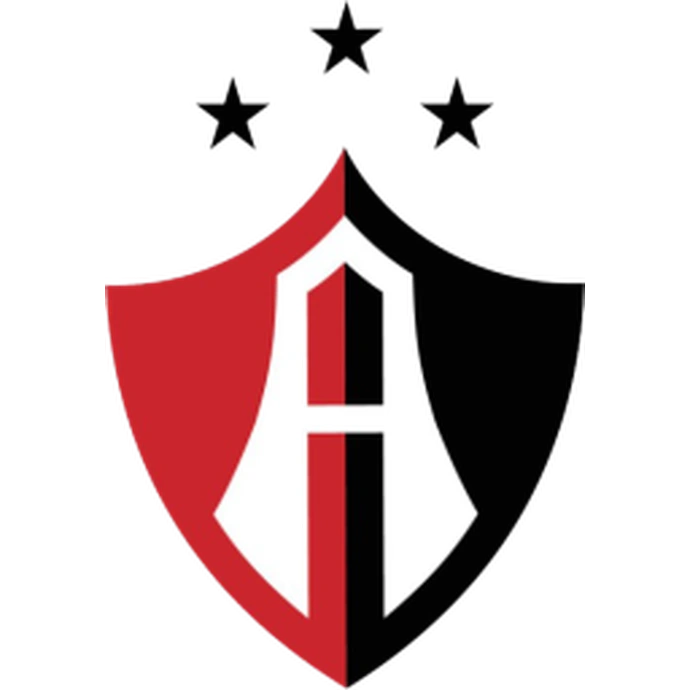
The modern 2022–present crest therefore features three stars above the shield, representing Atlas's three Mexican league championships: 1950–51, Apertura 2021 and Clausura 2022.
A special version with two stars was briefly used during 2022, reflecting the period after the Apertura 2021 title but before the club secured its third championship in the Clausura tournament.
Atlas FC Club History
Atlas Fútbol Club is a professional football club from Guadalajara, Jalisco, founded on 15 August 1916. The club was established by a group of young Mexicans who had encountered football while studying in England and brought their enthusiasm for the game back to Guadalajara.
Atlas quickly became an important part of football culture in Guadalajara. From its earliest years, the club became associated with technically skilled and attractive football. This emphasis on developing talented players eventually produced one of its best-known nicknames, La Academia, The Academy.
The club's traditional colours are red and black, producing the nickname Los Rojinegros, The Red and Blacks. Another famous nickname, Los Zorros, The Foxes, became closely associated with both the team and its supporters.
Atlas was one of the founding participants when Mexico's professional league was established in 1943. The club soon enjoyed one of the most successful periods in its history, winning the Copa México in 1946 and again in 1950.
The greatest achievement of this early era came in the 1950–51 season, when Atlas won its first Mexican league championship. The title was particularly memorable because the decisive result came against Guadalajara rival Chivas, adding another important chapter to the city's growing football rivalry.
The rivalry between Atlas and Chivas de Guadalajara became known as the Clásico Tapatío. Dating back to the amateur era, it is the oldest major city derby in Mexican football and represents one of the defining elements of Atlas's identity.
After the 1951 championship, however, Atlas experienced a remarkably long wait for another league title. The club remained an important presence in Mexican football but endured periods of inconsistency and several relegations and promotions.
During these decades, Atlas became particularly famous for its youth academy. The club developed numerous outstanding Mexican footballers, reinforcing the nickname La Academia. Players associated with the Atlas development system include Rafael Márquez, Andrés Guardado, Jared Borgetti and Oswaldo Sánchez.
One of the club's strongest modern teams emerged during the late 1990s under coach Ricardo La Volpe. A young, technically gifted Atlas side reached the final of the Verano 1999 championship against Toluca.
The final became one of the most memorable in Mexican football. After two closely contested matches, the championship was decided by penalties, with Toluca ultimately winning the title. Despite the defeat, the 1999 Atlas team remains highly regarded for its attacking style and the quality of its young players.
Atlas subsequently competed in the 2000 Copa Libertadores, reaching the quarter-finals. The campaign represented one of the club's most important international performances and introduced a talented generation of Atlas players to a wider South American audience.
The following two decades brought occasional strong seasons but no league championship. As the drought continued, the 1951 title became an increasingly important part of the club's mythology.
Everything changed in Apertura 2021. Atlas produced an outstanding campaign and reached the final against Club León. After the two-legged series finished level, the championship was decided by penalties.
Atlas won the shootout at the Estadio Jalisco, becoming Mexican champion for the first time in approximately 70 years. The scenes that followed represented one of the most emotional championship celebrations in the history of Mexican football.
Remarkably, the achievement was not isolated. Atlas remained among Mexico's strongest teams during the following tournament and reached another final in the Clausura 2022, this time against Pachuca.
Atlas defeated Pachuca over two legs to win a second consecutive championship. The victory gave the club its third league title overall and made Atlas only the third club in the short-tournament era to win consecutive Liga MX championships.
By winning both the Apertura 2021 and Clausura 2022 tournaments, Atlas also became Campeón de Campeones, completing the greatest sustained period of success in the club's modern history.
Atlas has traditionally played at the Estadio Jalisco, one of Mexico's most historic football grounds. Opened in 1960, the stadium has also hosted matches at the 1970 and 1986 FIFA World Cups and has become deeply connected with the identity of Los Rojinegros.
The defining rivalry remains the Clásico Tapatío against Chivas. While Chivas developed one of Mexico's largest national supporter bases, Atlas maintained a particularly strong identity within Guadalajara itself. The contrast between the two clubs has helped make their meetings among the most passionate fixtures in Mexican football.