Historical Crests SV Darmstadt 98
Name: SV Darmstadt 98
Nickname(s): Die Lilien (The Lilies)
Founded: 1898
Stadium: Merck-Stadion am Böllenfalltor (commonly known as the Böllenfalltor)
Capacity: 18,810
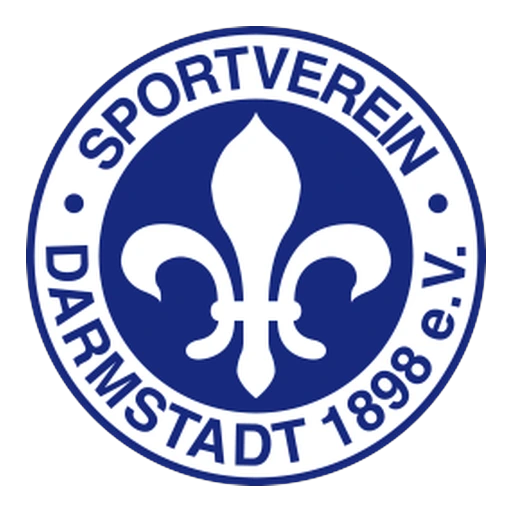
1971-2005
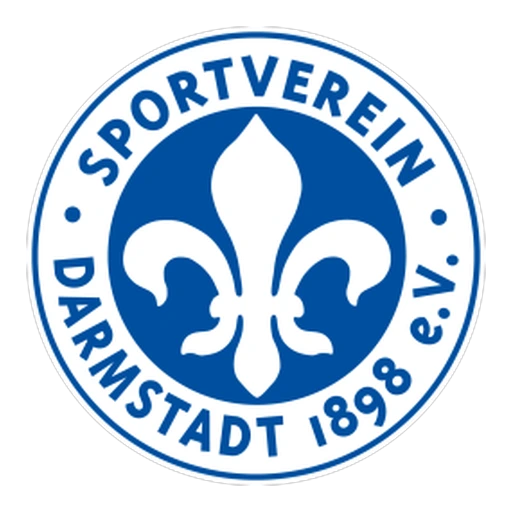
2005-2015
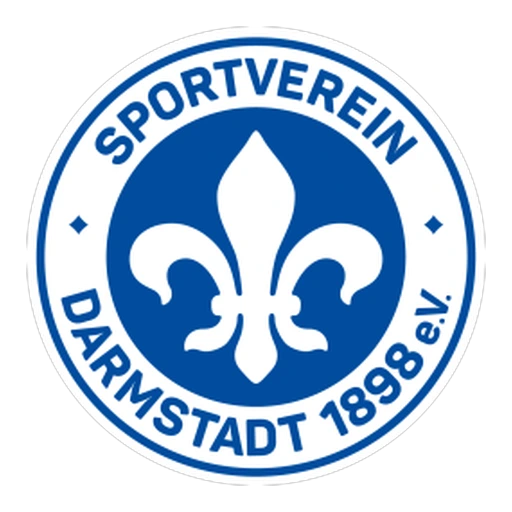
2015-Present
SV Darmstadt 98 Crest History
Founded in 1898, SV Darmstadt 98 has long been associated with the white lily (Lilie), the symbol from the city's coat of arms that inspired the club's nickname, Die Lilien. While earlier emblems existed throughout the club's history, the modern visual identity was established in the early 1970s and has remained remarkably consistent ever since.
In 1971, Darmstadt introduced a circular crest featuring a white lily on a blue background, surrounded by a white ring displaying the club's full name and founding year. Derived directly from the heraldic symbol of the city of Darmstadt, the lily immediately became the defining element of the club's identity, while the blue-and-white colour scheme reinforced its close connection to the city.
In 2005, the crest underwent its first significant refinement. The blue was brightened, the typography modernised and the proportions of the lily subtly adjusted to create a cleaner and more balanced appearance. Although the changes were modest, they improved the badge's clarity while preserving the traditional design that supporters had embraced for decades.
A further update followed in 2015, when the club introduced a more streamlined version of the crest. The circular border was simplified, the lettering refined and the lily redrawn with smoother, sharper lines to improve legibility across digital platforms and modern branding. Decorative dots separating the text were replaced with small diamond-shaped separators, giving the badge a cleaner and more contemporary appearance.
The current crest represents a careful evolution of the design first introduced in 1971. Featuring the iconic white lily, the traditional blue-and-white colour scheme and a simple circular layout, it successfully combines the city's historic heraldry with modern graphic design.
SV Darmstadt 98 Club History
Founded on 22 May 1898, SV Darmstadt 98 is one of Germany's oldest football clubs. Originally established as FC Olympia Darmstadt, the club merged with Darmstädter Sport Club 1905 in 1919 to form Sportverein Darmstadt 1898, adopting the name by which it is known today. Throughout its history, the club has proudly carried the nickname Die Lilien (The Lilies), derived from the white lily featured in both the club crest and the city's coat of arms.
For much of the twentieth century, Darmstadt competed in Germany's regional leagues, enjoying periods in the Oberliga Süd, then one of the country's highest competitions before the creation of the Bundesliga. Although the club established itself as a respected regional side, major national success remained elusive, and Darmstadt spent decades alternating between the second and third tiers of German football.
The club first reached the Bundesliga in 1978, earning promotion under manager Lothar Buchmann. Although the Lilies' first spell in the top flight lasted only one season, they returned in 1981 for another brief Bundesliga campaign. Despite relegation on both occasions, Darmstadt cemented its reputation as a competitive and resilient club capable of challenging more established opponents.
The most remarkable chapter in the club's history began in the 2010s. After financial difficulties had brought Darmstadt close to insolvency, the club embarked on an extraordinary rise under manager Dirk Schuster. Following promotion from the 3. Liga in 2014, the Lilies achieved back-to-back promotions by reaching the Bundesliga in 2015, completing one of the most unlikely success stories in modern German football. Against all expectations, Darmstadt secured survival in its first Bundesliga season before being relegated in 2017.
After several years in the 2. Bundesliga, the club once again earned promotion to the Bundesliga in 2023, reaffirming its status as one of Germany's most resilient football institutions. Although competing with one of the league's smallest budgets, Darmstadt has continued to earn admiration for its fighting spirit, strong team ethic and close relationship with its supporters.
Today, SV Darmstadt 98 plays its home matches at the historic Merck-Stadion am Böllenfalltor, affectionately known simply as the Bölle.
Darmstadt's fiercest rivalry is with Kickers Offenbach, while matches against Eintracht Frankfurt, 1. FSV Mainz 05 and Karlsruher SC also carry considerable regional significance, reflecting the club's long-standing place within the football landscape of Hesse and south-west Germany.
SV Darmstadt 98 Pins
Your Dynamic Snippet will be displayed here... This message is displayed because you did not provide enough options to retrieve its content.