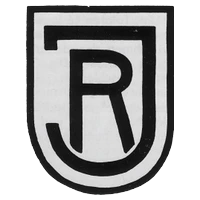
Founded in 1907 as Turnerbund Jahn Regensburg, the club initially used a simple monogram crest featuring the intertwined letters "J" and "R" inside a shield. Named after the German gymnastics pioneer Friedrich Ludwig Jahn, the badge reflected the club's origins as a multi-sport association and established the stylised "JR" monogram that would influence future designs.
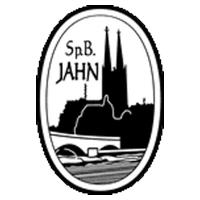
In 1924, the club adopted an oval crest displaying the skyline of Regensburg, including the city's famous cathedral towers, alongside the club name Sp.B. Jahn. The redesign placed greater emphasis on the club's civic identity while celebrating one of Bavaria's most historic cities.
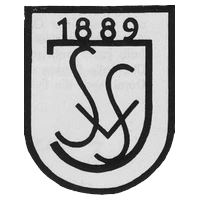
A further redesign followed in 1934, when the club introduced a simplified shield featuring the intertwined initials and the year 1889, acknowledging the heritage of the parent sporting association. This badge remained in use throughout the Second World War and reflected the broader reorganisation of German sports clubs during the period.
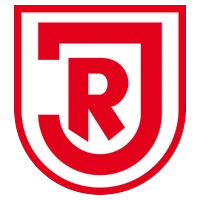
Following the war, the football department adopted a bold red-and-white shield centred on a stylised "R" monogram enclosed within a squared border. This clean, geometric design became one of the club's most recognisable symbols and remained largely unchanged for over fifty years, accompanying Jahn through numerous promotions and relegations.
Between 1996 and 2000, the club briefly experimented with a more elaborate crest featuring a football, banners displaying SSV Jahn and Regensburg, and references to the club's historic origins. Although richer in detail, the design proved short-lived and was eventually abandoned in favour of the traditional monogram.
In 2000, SSV Jahn returned to its classic red-and-white shield centred on the stylised "R", reaffirming the visual identity that supporters most closely associated with the club. A glossy, three-dimensional version followed in 2003, reflecting contemporary graphic trends while preserving the historic design.
Since 2014, the club has used a refined flat version of the traditional badge. The gradients and visual effects were removed, leaving a cleaner red-and-white shield with a simplified "R" monogram better suited to digital media and modern branding.
The current crest represents a successful return to simplicity. Featuring the iconic red-and-white shield and the distinctive "R" monogram, it preserves more than a century of the club's identity while combining its historic roots with a modern, minimalist design. The emblem remains one of the most recognisable symbols in Bavarian football.
SSV Jahn Regensburg Club History
Founded in 1907 as the football department of Turnerbund Jahn Regensburg, SSV Jahn Regensburg traces its origins to the city's long-standing gymnastics tradition inspired by Friedrich Ludwig Jahn, the "father of German gymnastics." The footballers became an independent section in 1924 as Sportbund Jahn Regensburg before merging with Sportverein 1889 Regensburg and Schwimmverein 1920 Regensburg in 1934, creating the multi-sport club Sport- und Schwimmverein Jahn Regensburg (SSV Jahn) that exists today. The professional football department later became organisationally independent in 2000 while remaining part of the wider club structure.
During the post-war years, Jahn established itself as one of Bavaria's strongest clubs outside the national elite. The club won several Bayernliga championships and earned promotion to the 2. Oberliga Süd, where it competed during the 1950s. Although promotion to the highest level proved elusive, Jahn became a respected force in Bavarian football and regularly challenged for regional honours.
The following decades were characterised by fluctuating fortunes between the Bayernliga, Regionalliga and lower divisions. Financial difficulties and frequent promotions and relegations made sustained progress difficult, but Jahn remained one of eastern Bavaria's most important football clubs and developed a reputation for resilience and strong local support.
A new era began in the early 2000s, when the club gradually re-established itself in professional football. Promotion to the 2. Bundesliga in 2003 marked the club's return to the second tier after more than twenty years, although relegation followed one season later. Jahn continued to rebuild and secured another promotion to the 2. Bundesliga in 2012, before once again returning to the 3. Liga after a single campaign.
The club's most successful modern period came under coach Heiko Herrlich, who guided Jahn to promotion from the Regionalliga Bayern to the 3. Liga in 2016, and then to the 2. Bundesliga just one year later after winning the promotion play-off against TSV 1860 München. Over the following seasons, Regensburg established itself as a competitive second-division club despite operating with one of the league's smallest budgets, earning widespread praise for its organisation, player development and attractive football.
Although relegated from the 2. Bundesliga in 2023, Jahn responded immediately by winning promotion back to the second tier in 2024. The return proved short-lived, however, and the club was relegated again after the 2024–25 season.
The club's traditional rivals include SpVgg Greuther Fürth, 1. FC Nürnberg, FC Ingolstadt 04 and TSV 1860 München, while local derbies against TSV 1861 Regensburg carry historical significance dating back to the club's earliest years. Renowned for its fighting spirit and strong regional identity, Jahn continues to occupy an important place in Bavarian and German football.