Historical Crests 1. FC Union Berlin
Name: 1. FC Union Berlin
Nickname(s): Die Eisernen (The Iron Ones)
Founded: 1966 (continuing the football tradition of SC Union Oberschöneweide, founded in 1906)
Stadium: Stadion An der Alten Försterei
Capacity: 22,012

1963-1966
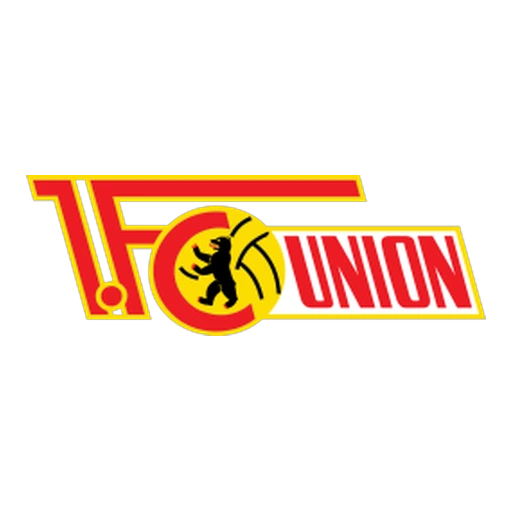
1966-Present
1.FC Union Berlin Crest History
Founded in 1966 as 1. FC Union Berlin, the club inherited more than sixty years of footballing tradition from its predecessors, most notably SC Union Oberschöneweide and TSC Berlin. Before the club adopted its current identity, TSC Berlin used a simple red badge displaying the initials "TSC" alongside the Berlin Bear, taken from the city's coat of arms. This emblem reflected the club's place within East Berlin's sporting system while maintaining a strong connection to the capital.
Following the foundation of 1. FC Union Berlin on 20 January 1966, the club introduced a completely new crest designed by Berlin graphic artist Peter Gribat after a public design competition failed to produce a suitable emblem. Rather than adopting a traditional shield, Gribat created a distinctive horizontal banner-shaped logo, one of the most unusual designs in German football. The badge featured the slanted inscription "1. FC Union" in red and white, outlined in yellow, giving the impression of a flag blowing in the wind.
Unlike many German clubs that have repeatedly modernised their visual identities, 1. FC Union Berlin has remained remarkably faithful to its original design. The current crest remains a careful refinement of Peter Gribat's original design. Featuring the traditional red, yellow, white and black colour scheme, the flowing "1. FC Union" lettering and the Berlin Bear within the football.
1.FC Union Berlin Club History
Founded on 20 January 1966, 1. FC Union Berlin continues a football tradition that dates back to 1906, when SC Olympia Oberschöneweide was established in the industrial district of Köpenick. Through a series of mergers and name changes, including SC Union Oberschöneweide, BSG Motor Oberschöneweide, SC Motor Berlin and TSC Berlin, the club eventually adopted its current name during the East German football reforms of 1966. From its earliest years, Union became known as the club of East Berlin's working class, earning the nickname Die Eisernen (The Iron Ones) and developing a fiercely loyal supporter base.
Union quickly established itself in the DDR-Oberliga, East Germany's top division, and celebrated its first major honour by winning the FDGB-Pokal in 1968, defeating FC Carl Zeiss Jena in the final. Although the club was often overshadowed by state-backed rivals such as BFC Dynamo, Union gained a reputation for resilience and became one of the most popular clubs in East Germany, with supporters embracing its identity as the people's club rather than a favoured political institution.
Following German reunification in 1990, Union Berlin faced severe financial and sporting challenges. The club spent much of the following two decades in the third and fourth tiers of German football, surviving largely through the dedication of its supporters. One of the defining moments in the club's history came in 2004, when fans launched the famous "Bluten für Union" (Bleed for Union) campaign, donating blood to raise money and help rescue the club from financial collapse. A few years later, thousands of supporters volunteered their own labour to renovate the Stadion An der Alten Försterei, further strengthening the unique bond between the club and its fanbase.
Union enjoyed a remarkable revival during the 2000s. After reaching the DFB-Pokal Final in 2001, the club won promotion to the 2. Bundesliga in 2009 before achieving the greatest success in its modern history by securing promotion to the Bundesliga for the first time in 2019. Under manager Urs Fischer, Union quickly established itself in Germany's top flight, qualifying for European competition before reaching the UEFA Champions League in 2023, completing one of the most remarkable rises in modern European football.
Its fiercest rivalry is with Hertha BSC in the Berlin Derby, while matches against former East German clubs such as 1. FC Magdeburg, Hansa Rostock and Dynamo Dresden also carry considerable historical significance, reflecting Union's roots in East German football.
FC Union Berlin Pin
Your Dynamic Snippet will be displayed here... This message is displayed because you did not provide enough options to retrieve its content.