Founded in 1903, 1. FC Saarbrücken initially competed under several predecessor clubs before establishing itself as one of the leading football institutions in the Saar region. Following the Second World War, the club's visual identity was rebuilt alongside the political reorganisation of the Saar Protectorate, leading to the introduction of a series of crests reflecting both regional and club identity.
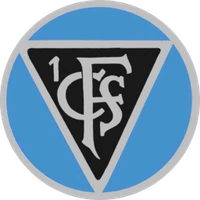
Between 1945 and 1947, Saarbrücken adopted a simple circular badge featuring a black triangle containing the intertwined "1. FCS" initials on a light blue background. The minimalist design reflected the post-war period and established the blue-and-black colours that would remain central to the club's identity.
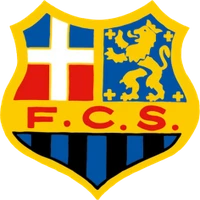
In 1947, the club introduced a completely new crest incorporating the Cross of Lorraine, symbolising the Saar Protectorate, alongside the Lion of Nassau, one of the region's historic heraldic emblems. Combined with the club's initials and blue-and-black stripes, the shield reflected Saarbrücken's unique political and sporting position during the years in which the Saar competed separately from Germany.
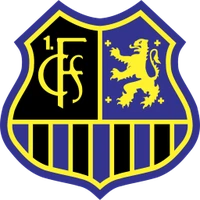
Following the Saar's reintegration into the Federal Republic of Germany in 1955, the club redesigned the crest once again. The Cross of Lorraine was removed, while the Lion of Nassau, the 1. FCS monogram and the blue-and-black striped lower section were retained. This version established the foundation of the modern badge and remained virtually unchanged for more than five decades.
In 2010, the crest underwent its first major refinement since the 1950s. Cleaner outlines, brighter colours and simplified typography modernised the shield while preserving its traditional composition. The lion, monogram and striped lower section remained unchanged, ensuring continuity with the club's historic identity.
Further refinements followed in 2017, when the colours were adjusted and the proportions subtly balanced to improve clarity across digital media and merchandising. The changes were minimal but produced a sharper and more contemporary appearance.
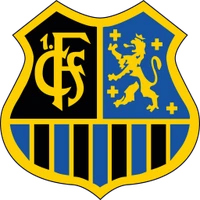
In 2022, 1. FC Saarbrücken introduced the current version of the crest. The outlines were strengthened, the black and blue colours deepened and the heraldic lion refined with greater detail. Although visually modernised, the badge remained faithful to the design introduced in 1955, preserving the symbols that supporters had identified with for generations.
The current crest represents a successful blend of regional heritage and football tradition. Featuring the iconic Lion of Nassau, the historic 1. FCS monogram and the club's distinctive blue-and-black stripes.
1.FC Saarbrücken Club History
Founded in 1903, 1. FC Saarbrücken traces its origins to FC Germania 1903 Malstatt-Burbach, one of several clubs established in the industrial districts of Saarbrücken during the early years of German football. Through a series of mergers and reorganisations, the club adopted the name 1. FC Saarbrücken in 1945, becoming the leading football representative of the Saar region.
The club emerged as one of Germany's strongest teams during the 1940s and 1950s. Following the Second World War, Saarbrücken occupied a unique position due to the political status of the Saar Protectorate. Excluded from the German league system, the club competed in the French second division during the 1948–49 season. Although Saarbrücken finished comfortably top of the table, French clubs voted against allowing a foreign team to win promotion, forcing the club to withdraw. Instead, Saarbrücken organised the Internationaler Saarlandpokal, an invitational competition featuring some of Europe's strongest clubs, earning widespread recognition across the continent.
Following the Saar's reintegration into West Germany in 1957, the club joined the Oberliga Südwest and quickly established itself as one of the region's leading sides. Saarbrücken reached the German Championship Final in 1952, finishing runners-up to VfB Stuttgart, and later became one of the 16 founding members of the Bundesliga in 1963. Although the club spent only one season in the inaugural Bundesliga before relegation, it remained a regular competitor in the Regionalliga and later the 2. Bundesliga.
Throughout the following decades, Saarbrücken enjoyed several promotions to the Bundesliga, appearing in the top flight during the 1976–77, 1985–86 and 1992–93 seasons. Despite these successes, the club often struggled to establish itself among Germany's elite and frequently alternated between the first, second and third divisions. Nevertheless, it retained one of the largest and most passionate fanbases in southwest Germany.
The club experienced a remarkable revival during the 2019–20 season. After winning promotion back to the 3. Liga, Saarbrücken became the first fourth-tier club in history to reach the DFB-Pokal semi-finals, defeating 1. FC Köln, Karlsruher SC, Fortuna Düsseldorf and Borussia Mönchengladbach before eventually losing to Bayer Leverkusen. The achievement restored the club's national profile and marked the beginning of a new period of stability.
The club's fiercest rivalry is with 1. FC Kaiserslautern in the Southwest Derby, while matches against SV Elversberg have become increasingly significant following Elversberg's rapid rise through the German leagues. Encounters with Karlsruher SC, SV Waldhof Mannheim and other clubs from southwest Germany also carry considerable historical importance.