Passa al contenuto

Historical Crests Wrexham AFC

Name: ​Wrexham AFC
Nickname(s): ​The Red Dragons, The Robins
Founded: 1864
Stadium: ​STōK Cae Ras – Racecourse Ground (Wrexham)
Capacity: 10,669 (during the redevelopment of the Kop Stand)

1969-1973
1973-2006
2006-2012
2012-2013
2014-2015
2015-Present

Wrexham AFC Crest History
During the club’s earliest decades, Wrexham AFC did not regularly wear a permanent crest on its shirts. As with many early football clubs, the identity of Wrexham was initially represented through the town’s civic heraldry rather than a specially designed football emblem.
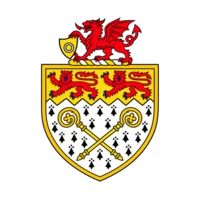
An embroidered version of the Wrexham Borough coat of arms began appearing on the club’s shirts during the late 1960s. The elaborate design featured a golden shield with an ermine-patterned background, two lions derived from Welsh heraldry and a red dragon carrying the astronomical symbol for Mars. The dragon represented Wales, while the Mars symbol referred to Wrexham’s historical connections with mining and heavy industry.
In 1973, Wrexham organised a competition through a local newspaper to create a distinctive new club crest. The competition was connected to what was then believed to be the club’s centenary, as Wrexham’s foundation was still incorrectly dated to 1873. The winning design was created by local supporter David Edwards Jones, who received a prize of £25.
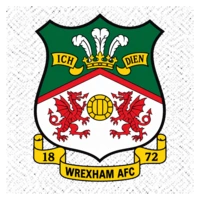
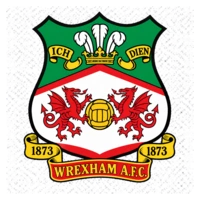
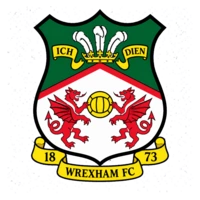
The new crest placed Wrexham’s Welsh identity at the centre of its design. Two red dragons face one another across a golden football, combining the national symbol of Wales with the sport represented by the club. The green and white sections were inspired by the colours of the Welsh flag.
At the top of the crest are the three feathers of the Prince of Wales, accompanied by a coronet and the motto “Ich Dien”, traditionally translated from German as “I serve”. Permission reportedly had to be obtained from Buckingham Palace before the royal device could be incorporated into the design.
Several variations of the crest appeared over the following decades. The principal design remained unchanged, but differences were introduced in the shape of the shield, colours, outlines, club name and stated foundation year. Some versions carried Wrexham FC, while others used the club’s full traditional name, Wrexham AFC.
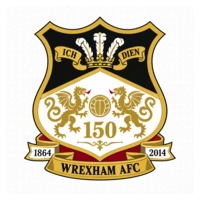
Historical research eventually established that the club had been founded in 1864, nine years earlier than previously believed. To mark Wrexham’s 150th anniversary, a special gold and black commemorative crest was introduced for the 2014–15 season, displaying the dates 1864–2014.
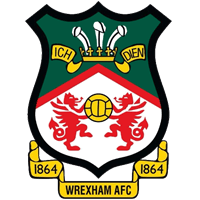
In 2015, Wrexham introduced the current version of its crest. It preserved David Edwards Jones’s much-loved 1973 design while replacing the incorrect foundation date with 1864. The two Welsh dragons, football, green and white fields and Prince of Wales feathers continue to connect the modern club with Wrexham’s heritage, Welsh identity and long football history.
Wrexham AFC Club History
Wrexham Association Football Club was founded in 1864, when members of Wrexham Cricket Club met at the Turf Hotel to discuss a sporting activity for the winter months. They chose the rapidly developing game of association football, creating what is now recognised as the oldest football club in Wales and the third-oldest professional football club in the world.
From its earliest days, Wrexham has been closely connected to the Racecourse Ground, traditionally known in Welsh as the Cae Ras and currently officially named the STōK Cae Ras. The ground is recognised as the world’s oldest international football stadium still in use and has staged Wales international matches since the nineteenth century. Its position near the centre of Wrexham and beside the railway station has made it an enduring symbol of both the club and the city.
The first major success arrived in 1878, when Wrexham won the inaugural Welsh Cup. The Red Dragons would go on to lift the trophy a record 23 times, establishing themselves as one of the most successful clubs in the history of Welsh domestic football. Although based in Wales, Wrexham gradually became part of the English football system and was elected to the Football League in 1921.
For much of the club’s early Football League history, Wrexham competed in the lower divisions. The first promotion came in 1962, when the club finished third in the Fourth Division. After being relegated two years later, Wrexham returned to the Third Division in 1970 and began building one of the strongest teams in its history.
The club’s golden era developed during the 1970s. Wrexham regularly competed in the European Cup Winners’ Cup through its success in the Welsh Cup and produced memorable performances against leading continental opposition. The Red Dragons reached the quarter-finals of the competition in 1975–76, where they were narrowly eliminated by eventual winners Anderlecht.
Under player-manager Arfon Griffiths, Wrexham enjoyed an outstanding 1977–78 season. The club won the Third Division championship, lifted the Welsh Cup and reached the quarter-finals of both the FA Cup and League Cup. Promotion took Wrexham into the second tier of English football for the first time, where the club remained for four seasons. This period is still remembered as one of the finest in the Red Dragons’ long history.
Financial difficulties and relegations followed during the 1980s, but Wrexham continued to build a reputation as dangerous cup opponents. One of the greatest moments in the club’s history came on 4 January 1992, when struggling Fourth Division Wrexham faced reigning English champions Arsenal in the FA Cup. A spectacular free kick from Mickey Thomas and a winning goal from Steve Watkin secured a famous 2–1 victory at the Racecourse Ground, creating one of the competition’s greatest-ever upsets.
The early 2000s brought one of the darkest periods in the club’s history. Controversial owner Alex Hamilton separated the club from the Racecourse Ground and planned to clear the stadium for redevelopment. Supporters fought to protect both Wrexham AFC and its historic home, but severe financial problems forced the club into administration in 2004. A ten-point deduction contributed to relegation, while years of instability eventually led to Wrexham losing its Football League status in 2008, ending an 87-year stay in the professional divisions.
The club’s supporters played a decisive role in securing its survival. In 2011, the Wrexham Supporters’ Trust took control of the club, restoring financial stability and strengthening the connection between Wrexham AFC and its community. Although promotion repeatedly proved elusive, the supporter-owned era produced several memorable moments. Wrexham collected 98 points in 2011–12 without winning promotion and lifted the FA Trophy at Wembley in 2013, defeating Grimsby Town on penalties.
A remarkable new chapter began in 2020, when Hollywood actors Ryan Reynolds and Rob McElhenney announced plans to purchase the club. After presenting their vision to the supporters, the takeover was approved by more than 98 per cent of voting Wrexham Supporters’ Trust members. Reynolds and McElhenney officially became owners in February 2021, promising to protect the club’s identity, remain at the Racecourse Ground and return Wrexham to the Football League.
The documentary series Welcome to Wrexham transformed the club into an international phenomenon. It introduced Wrexham’s history, supporters and community to a global audience, particularly in North America. Nevertheless, the revival was not merely a media story. Significant investment was made in the playing squad, club infrastructure and stadium, while experienced manager Phil Parkinson and prolific striker Paul Mullin became central figures in the club’s sporting transformation.
After narrowly missing out in 2021–22, Wrexham produced an extraordinary 2022–23 National League season. The Red Dragons collected a record-breaking 111 points, scored 116 league goals and defeated title rivals Notts County in a dramatic 3–2 match, remembered especially for Ben Foster’s stoppage-time penalty save. A 3–1 victory over Boreham Wood finally secured the championship, returning Wrexham to the Football League after fifteen years in non-League football.
The momentum continued immediately. Wrexham finished second in League Two in 2023–24, earning a second successive promotion, before securing another runners-up position in League One in 2024–25. A decisive 3–0 victory over Charlton Athletic confirmed promotion to the Championship, returning the club to the second tier for the first time since 1982. Wrexham thereby became the first club to achieve three consecutive promotions through the top five levels of the English football pyramid.
Despite its new worldwide profile, the club remains deeply connected to North Wales, its traditional red colours, the Welsh dragon and generations of supporters who protected the club during its most difficult years.
Wrexham’s principal rivals are Chester, located only a short distance away across the English–Welsh border. Meetings between the clubs are known as the Cross-Border Derby and reflect both football rivalry and the distinct identities of the neighbouring Welsh and English communities. The first official fixture between the clubs took place in 1888, and the rivalry has developed into one of the fiercest in lower-league football.