Founded in 1923 as Klubi Sportiv Flamurtari Vlorë, the club adopted a distinctive crest featuring a red diagonal stripe, a flag bearer carrying the Albanian flag and the founding year 1923. The design reflected the club's name, Flamurtari ("Flag Bearer"), while symbolising the city of Vlorë, where Albania declared its independence in 1912. The patriotic imagery established one of the most recognisable identities in Albanian football and remained closely associated with the club's early history.
After decades without major documented changes, Flamurtari introduced a completely redesigned crest in 2009. The new shield featured the club's traditional red, black and white vertical stripes, a large gold Gothic "F", and the founding year 1923. The cleaner, more modern design preserved the club's historic colours while creating a stronger and more contemporary visual identity suited to the professional era.
In 2019, the club briefly experimented with a bold black-and-gold oval crest as part of a wider rebranding initiative. The minimalist design centred on an ornate Gothic "F", accompanied by a golden eagle and the founding year 1923, with the initials F.F.C. displayed beneath. Inspired by the historic eagle of Vlorë, the badge aimed to project a more prestigious and premium image but proved to be a short-lived transitional identity.
A year later, in 2020, Flamurtari unveiled another completely new crest. The circular badge combined the Gothic "F" with a stylised black eagle set against a red-and-white background, surrounded by a ring displaying the club's name and accented by alternating red-and-black stripes. The redesign successfully blended elements of the club's historic symbolism with a modern composition and remained the club's official identity for five seasons.
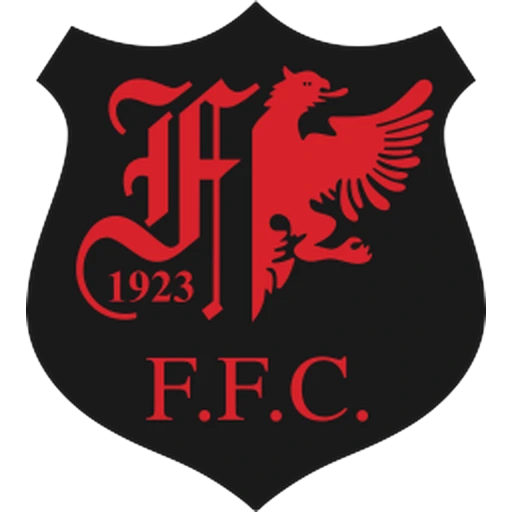
In 2025, Flamurtari adopted a simplified shield inspired by the successful Gothic branding introduced during the previous redesigns. The current crest features a striking black shield displaying a red Gothic "F", a stylised eagle, the founding year 1923 and the initials F.F.C. By removing decorative borders and unnecessary details, the club created a clean, contemporary emblem while preserving the patriotic symbolism that has defined Flamurtari throughout its history.
The current crest successfully combines tradition with modern design. Featuring the iconic Gothic "F", the historic eagle and the club's traditional red-and-black colours.
Flamurtari FC Club History
Founded in 1923, KF Flamurtari Vlorë is one of Albania's oldest and most historic football clubs. Based in the coastal city of Vlorë, where Albanian independence was proclaimed in 1912, the club adopted the name Flamurtari, meaning "Flag Bearer", reflecting the city's unique place in the nation's history. From its earliest years, Flamurtari became a symbol of local pride and patriotism, developing into one of the country's traditional football powers.
During the communist era, Flamurtari established itself as a consistent force in the Albanian National Championship. Although often competing against state-backed giants such as Dinamo Tirana, Partizani Tirana and 17 Nëntori Tirana (now KF Tirana), the club regularly challenged for honours and became renowned for its passionate supporters and strong home record at Flamurtari Stadium.
The club's greatest domestic success came in the 1980s. Flamurtari won its first Albanian Superliga title in 1991, having previously lifted several Albanian Cups during the 1980s. Under legendary coach Agim Murati and with players such as Sokol Kushta, Vasil Ruci and Kreshnik Çipi, Flamurtari became one of the strongest teams in Albanian football.
Flamurtari also earned international recognition through memorable performances in European competitions. During the 1987–88 UEFA Cup, the club eliminated Partizan Belgrade before facing FC Barcelona in the Round of 32. After holding the Spanish giants to a 0–0 draw in Vlorë, Flamurtari narrowly lost 4–1 at the Camp Nou. The following season, the club defeated Wismut Aue before once again drawing one of Europe's elite, Celtic, pushing the Scottish champions all the way over two legs. These performances remain among the finest European achievements by an Albanian club.
Following the fall of communism in the early 1990s, Flamurtari experienced fluctuating fortunes. Financial difficulties and the changing structure of Albanian football made it increasingly difficult to compete with the country's wealthier clubs. Although the team continued to challenge for domestic trophies and won additional Albanian Cups, periods of relegation and promotion interrupted its progress during the 2000s and 2010s.
In recent years, the club has undergone several ownership and organisational changes while working to restore its historic status. Despite spells outside the Kategoria Superiore, Flamurtari has remained one of Albania's best-supported clubs, with an exceptionally loyal fanbase and a reputation for producing talented local players.
The club's fiercest rivalry is with KF Tirana, while matches against Partizani Tirana, Dinamo City, Vllaznia Shkodër and Teuta Durrës are among the most significant fixtures in Albanian football.