Historical Crests Burnley FC
Name: Burnley FC
Nickname(s): The Clarets
Founded: 1882
Stadium: Turf Moor (Burnley)
Capacity: 21,944

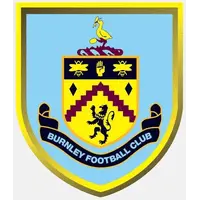
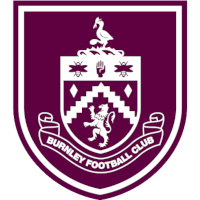
Burnley FC Crest History
Founded in 1882, Burnley Football Club has used a variety of badges throughout its history, but no crest has become more closely associated with the club than the heraldic design based on the coat of arms of the town of Burnley. Unlike many clubs whose identities revolve around a single animal or symbol, Burnley’s crest draws heavily from local history, industry and civic heritage, making it one of the most detailed and distinctive badges in English football.
The earliest crest associated with Burnley appeared in 1887 when the club wore shirts featuring the coat of arms of the Prince of Wales. The design commemorated a visit to Turf Moor by Prince Albert Victor, the first member of the Royal Family to attend a professional football match. These royal arms appeared regularly on Burnley shirts until the mid-1890s and briefly returned for the 1914 FA Cup Final.
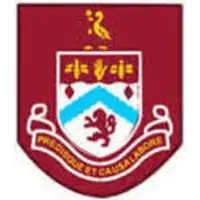
A significant development came in 1935 when Burnley first wore the town of Burnley’s coat of arms during an FA Cup semi-final. The civic crest returned for the 1947 FA Cup Final and became a regular feature following the club’s First Division title triumph in 1960. This established a strong connection between the football club and the town, a relationship that continues to shape Burnley’s identity today.
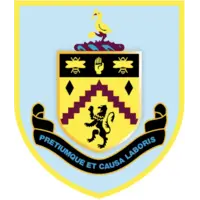
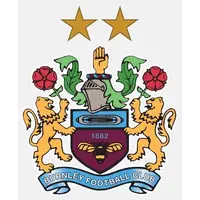
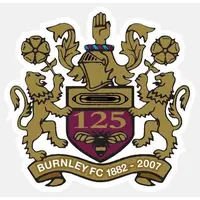
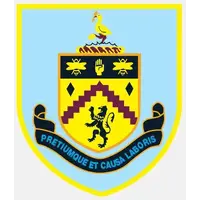
The club’s emblem is based on the town’s crest and incorporates numerous symbols that reflect Burnley’s heritage. Among its most recognisable features are the Lancashire roses, representing the club’s county roots, bees symbolising the town’s industrious character, and a weaving shuttle that pays tribute to Burnley’s historic cotton industry. The crest also includes heraldic elements linked to influential local families and the town’s civic history. Beneath the shield appears the Latin motto “Pretiumque et Causa Laboris,” which translates as “The Prize and the Cause of our Labour,” reflecting the values of hard work and achievement that have long been associated with both the town and the football club.
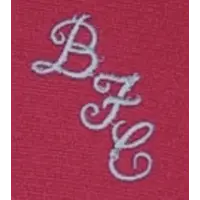
During the late 1960s and early 1970s, Burnley moved away from traditional heraldry and adopted a simple “BFC” monogram. Initially displayed vertically and later horizontally, the design reflected a growing trend among football clubs towards cleaner and more modern branding. While functional, the monogram lacked the character and local symbolism that supporters associated with the club.
In 1973, Burnley launched a competition to create a unique, copyright-protected club badge. The winning design incorporated many of the historic elements associated with the town’s coat of arms while creating a distinctive football crest. Although adopted as the club’s official badge in 1973, it first appeared on away kits in 1976 before being introduced on home shirts in 1979.
The heraldic crest was briefly replaced by a simplified “B.F.C.” monogram in 1983, but supporters never fully embraced the change. In 1987, Burnley reinstated the more traditional badge, restoring the rich symbolism that had become closely linked with the club’s identity.
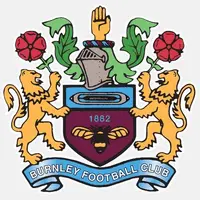
A major redesign arrived in 2009 to commemorate the fiftieth anniversary of Burnley’s 1959–60 First Division title. The club returned to a version of the town’s coat of arms, emphasising its civic roots and historical achievements. The following year, the Latin motto was replaced with the words “Burnley Football Club,” creating a clearer and more contemporary presentation while retaining the badge’s traditional character.
In 2023, Burnley introduced a refined version of its crest featuring a simplified claret-and-white colour scheme. While modernised for contemporary use, the design retained the historic elements that have defined Burnley’s identity for decades, including references to the town’s industrial heritage, local families and Lancashire roots.
Burnley FC Club History
Burnley Football Club was founded in 1882 when members of the local rugby club, Burnley Rovers, voted to switch from rugby to association football. The club quickly became one of the pioneers of the professional game, turning professional in 1883 and becoming one of the twelve founding members of the Football League in 1888, helping to shape the modern structure of English football.
The club has played its home matches at Turf Moor since 1883, making it one of the longest-serving stadium homes in English football. Burnley became known as “The Clarets” after adopting their famous claret-and-blue colours in 1910, a nickname that remains synonymous with the club today.
Burnley’s first major period of success came under manager John Haworth. The club won its first and only FA Cup in 1914, defeating Liverpool in the final, before securing its first Football League title in the 1920–21 season. During that championship-winning campaign, Burnley set an English record by going 30 league matches unbeaten.
A second golden era arrived during the late 1950s and early 1960s under manager Harry Potts. Built largely around homegrown talent developed through the club’s academy, Burnley won the First Division title in 1959–60 and followed it by winning the Charity Shield. At the time, Burnley became one of the smallest towns ever to produce a champion of England.
Following this success, Burnley experienced a gradual decline and spent much of the 1970s and 1980s moving between divisions. Financial difficulties and poor results brought the club close to disaster, and in 1987 Burnley narrowly avoided relegation from the Football League with a dramatic final-day victory over Orient. The match is widely regarded as one of the most important in the club’s history, preserving its league status and securing its future.
The club gradually rebuilt during the 1990s and 2000s, becoming one of only a handful of English clubs to win all four professional divisions of the Football League. Promotion to the Premier League was achieved in 2009, marking Burnley’s return to the top flight after a 33-year absence.
A new era of stability and success followed under manager Sean Dyche. Burnley earned promotion back to the Premier League in 2014 and again in 2016, establishing itself as a competitive top-flight club despite operating with one of the division’s smaller budgets. The club achieved a seventh-place Premier League finish in 2017–18, qualifying for European competition for the first time in more than fifty years.
Burnley’s principal rivalry is with Blackburn Rovers, a fixture known as the East Lancashire Derby and one of the oldest rivalries in English football. Matches between the two clubs are among the most fiercely contested in the country and reflect the deep footballing traditions of Lancashire.
Burnley FC Pin
Your Dynamic Snippet will be displayed here... This message is displayed because you did not provide enough options to retrieve its content.