Nickname(s):Tricolor Gaúcho (The Gaucho Tricolour), Imortal Tricolor (The Immortal Tricolour)
Founded:1903
Stadium:Arena do Grêmio
Capacity:55.562
1903-1904
1904-1918
1918-1945
1945-1949
1949-1968
1968-1970
1970-1981
1981-1983
1983-1986
1986-1995
1995-1996
1996-1997
1997-2001
2001-2012
2012-2017
2017-Present
Grêmio FBPA Crest History
The crest history of Grêmio Foot-Ball Porto Alegrense is characterised by an unusually consistent circular identity that has developed gradually since the club's foundation in 1903. Although lettering, proportions and decorative elements have changed considerably, the combination of blue, black and white has remained at the heart of Grêmio's visual identity for more than a century.
The original 1903–1904 crest was extremely simple. It consisted of a thin blue circular outline containing the letters and words G, FOOT-BALL and PA, referring to Grêmio Foot-Ball Porto Alegrense. The design was almost entirely typographic and lacked the black elements that would later become essential to the club's identity.
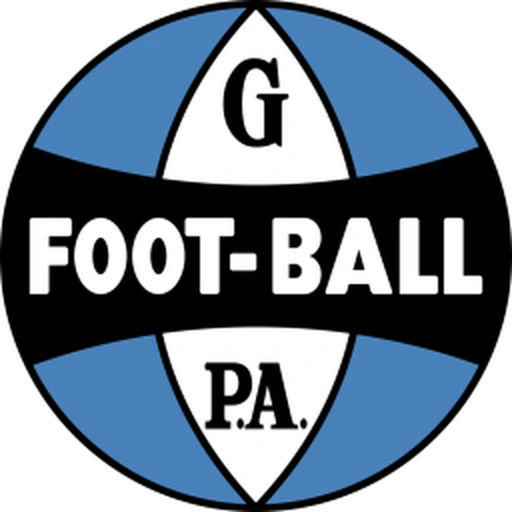
Between 1904 and 1918, Grêmio introduced the basic visual structure that would influence virtually every subsequent crest. The circular badge was divided into blue, black and white sections, with a broad black horizontal band carrying the words FOOT-BALL in white. A large G appeared in the white upper section, while PA. occupied the lower section.
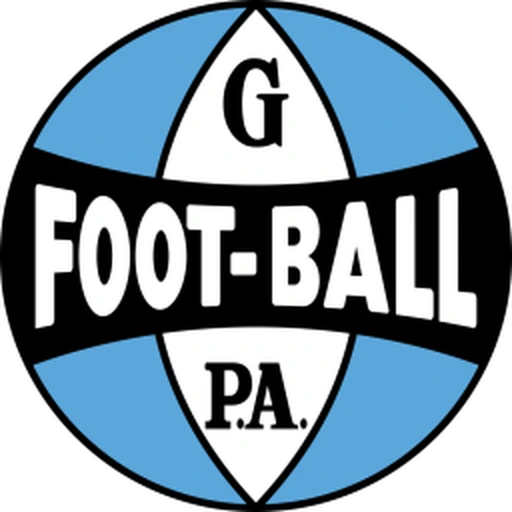
The 1918–1945 version retained the same composition but refined its proportions and lettering. The blue sections became brighter, the central black band remained dominant and FOOT-BALL was presented in larger, more expressive white lettering. The G and PA initials continued to identify the club above and below the central band.
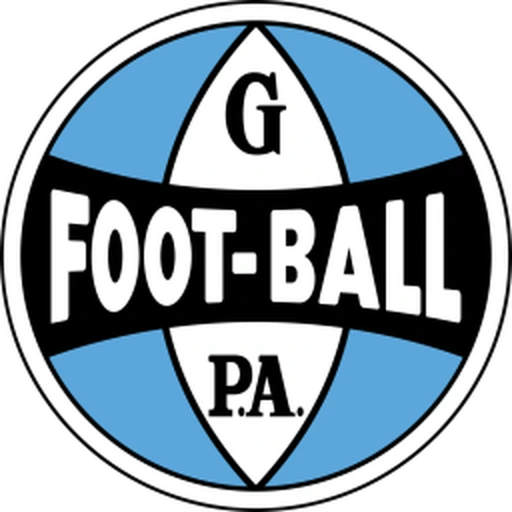
Between 1945 and 1949, a white outer ring was introduced around the circular emblem. The internal structure remained essentially unchanged, with the blue segments, central black FOOT-BALL band and the G and PA initials still forming the principal elements.
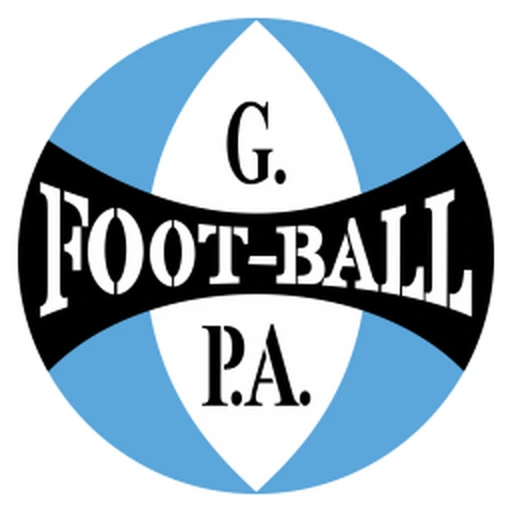
The 1949–1968 crest simplified the badge again. The external ring disappeared and the internal divisions became broader and cleaner. G. appeared in the upper white section and P.A. below, while FOOT-BALL continued to dominate the black horizontal band across the centre.
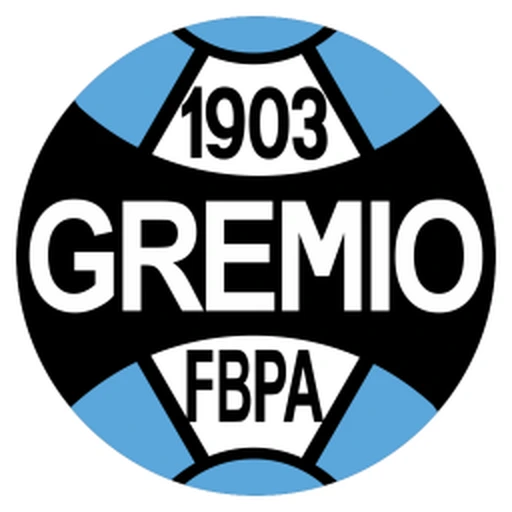
A major modernisation occurred between 1968 and 1970. For the first time, the word GRÊMIO replaced FOOT-BALL as the dominant inscription across the central black band. The foundation year 1903 appeared above it, while FBPA – representing Foot-Ball Porto Alegrense – appeared below. This redesign established the basic format of the modern Grêmio crest.
The 1970–1981 version refined this new identity. GRÊMIO became larger and more prominent across the centre, while 1903 and FBPA remained positioned in the upper and lower white sections. The blue, black and white segmented circular structure was preserved.
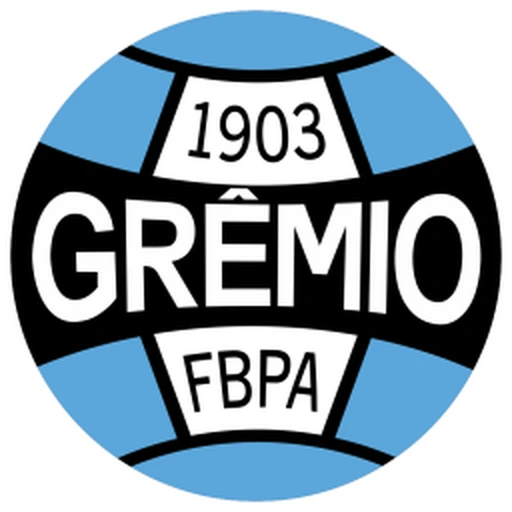
Between 1981 and 1983, the crest was slightly redesigned with stronger contrasts and altered proportions. The black central band became more dominant, while the blue sections were reorganised around the white areas containing 1903 and FBPA.
The 1983–1986 version continued this development with another adjustment to the internal geometry. The lettering became cleaner and the circular badge more balanced, bringing the emblem increasingly close to the visual form associated with Grêmio today.
From 1986 to 1995, the badge was presented in a lighter and more compact form. Three stars appeared above the crest, representing major achievements in the club's history. The stars were shown in different colours, while the familiar combination of 1903, GRÊMIO and FBPA remained unchanged within the badge.
The 1995–1996 version strengthened the outlines and restored a more traditional appearance. The three coloured stars remained above the crest, while the internal blue, black and white sections became more clearly defined.
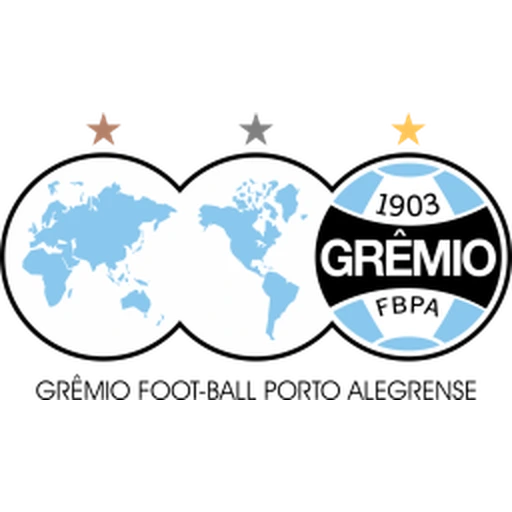
During 1996–1997, Grêmio briefly used a special graphic treatment that combined the traditional crest with a world map and the club's full name, GRÊMIO FOOT-BALL PORTO ALEGRENSE. This commemorative-style identity emphasised the club's international achievements rather than replacing the traditional badge permanently.
The 1997–2001 crest returned fully to the established circular design. The three stars remained above it, while GRÊMIO was displayed prominently across the black centre and the foundation year and FBPA initials occupied the white sections above and below.
Between 2001 and 2012, the emblem was refined with cleaner outlines, more regular typography and slightly adjusted proportions. The three stars continued to accompany the crest and became an established part of its presentation.
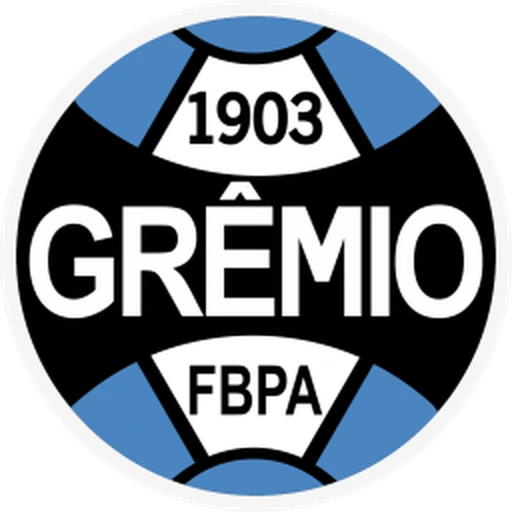
The 2012–2017 version introduced further subtle graphic refinements without fundamentally changing the design. The circular construction, blue segments, black central band, white lettering and the inscriptions 1903, GRÊMIO and FBPA all remained intact.
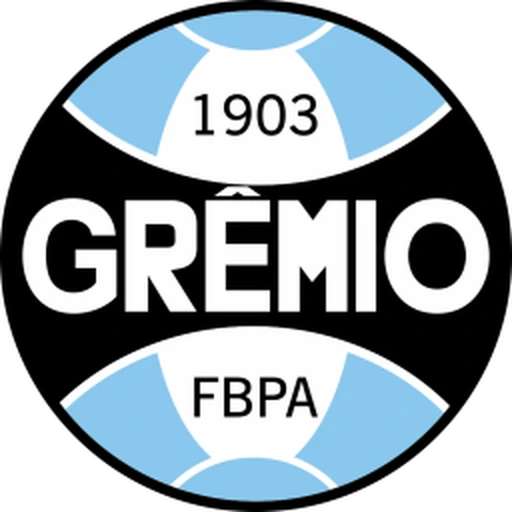
Since 2017, Grêmio has used another refined interpretation of its traditional badge. The typography and internal geometry have been simplified and balanced for modern applications, while the three stars continue to appear above the crest in many official presentations. Despite these refinements, the emblem remains immediately recognisable as a direct descendant of the design first introduced more than a century ago.
Grêmio FBPA Club History
Grêmio Foot-Ball Porto Alegrense was founded on 15 September 1903 in Porto Alegre, the capital of Rio Grande do Sul. The club emerged during the earliest years of organised football in southern Brazil and quickly became one of the leading sporting institutions of the region. Its distinctive blue, black and white colours would eventually become one of the most recognisable identities in Brazilian football.
Grêmio's early development was closely connected with the growth of football in Porto Alegre. The club began playing competitive matches soon after its foundation and became one of the pioneers of organised football in Rio Grande do Sul. Success in local competitions established Grêmio as an important force long before the creation of Brazil's modern national championship.
The defining rivalry in Grêmio's history began in 1909, when the club played the newly founded SC Internacional for the first time. Grêmio won that inaugural meeting 10–0, but Internacional soon developed into its great city rival. Their encounters became known as the Grenal, combining the names Grêmio and Internacional, and developed into one of the fiercest and most celebrated football rivalries in South America.
Grêmio became a dominant force in the Campeonato Gaúcho, winning numerous state championships throughout the twentieth century. Particularly successful periods established the club alongside Internacional as one of the two great powers of football in Rio Grande do Sul, with the struggle for state supremacy becoming an essential part of both clubs' identities.
For much of its early history, Grêmio played at the Estádio da Baixada, before moving to the newly constructed Estádio Olímpico Monumental in 1954. The Olímpico became one of Brazil's famous football grounds and would serve as Grêmio's home during many of the greatest moments in the club's history.
As Brazilian football developed into a national competition, Grêmio gradually established itself beyond Rio Grande do Sul. A major breakthrough came in 1981, when the club won its first Campeonato Brasileiro Série A title. Grêmio defeated São Paulo in the decisive final, announcing its arrival among the leading national powers of Brazilian football.
An even greater achievement followed in 1983. Grêmio won its first Copa Libertadores, defeating Peñarol of Uruguay in the final. The triumph took the club to the Intercontinental Cup in Tokyo, where Grêmio defeated European champions Hamburger SV 2–1 after extra time, with Renato Portaluppi scoring both goals. Grêmio were crowned world champions, creating one of the most celebrated chapters in the club's history.
Grêmio remained a major force during the following years and won the inaugural Copa do Brasil in 1989. The competition would become particularly important in the club's history, with Grêmio developing a reputation as one of Brazil's great knockout specialists.
The early 1990s included a difficult period, including relegation from the Brazilian top division, but Grêmio recovered rapidly. Under coach Luiz Felipe Scolari, the club entered another golden era. Grêmio won the Copa do Brasil in 1994 before conquering its second Copa Libertadores in 1995, defeating Atlético Nacional of Colombia in the final.
The Libertadores victory was followed by another appearance in the world championship match, where Grêmio faced Ajax in the 1995 Intercontinental Cup. After a goalless draw, the Brazilian side was defeated in a penalty shoot-out. Despite missing a second world title, the campaign confirmed Grêmio's return to the highest level of South American football.
Success continued in 1996, when Grêmio captured its second Campeonato Brasileiro Série A championship. Further Copa do Brasil victories followed in 1997 and 2001, strengthening the club's reputation for performing particularly well in elimination tournaments.
Grêmio suffered one of the most difficult moments in its history with relegation to Série B in 2004. The response produced one of the club's most legendary matches. In the decisive game of the 2005 Série B, Grêmio faced Náutico in Recife and had four players sent off. Despite being reduced to seven men and seeing Náutico awarded a late penalty, Grêmio survived and immediately scored through Anderson to win 1–0. The extraordinary match became known as the Batalha dos Aflitos (Battle of the Aflitos) and secured Grêmio's return to Série A.
Back in the top flight, Grêmio quickly returned to continental competition and reached the 2007 Copa Libertadores final, where the club finished runner-up to Boca Juniors. The campaign demonstrated how rapidly Grêmio had recovered from the difficulties of only a few seasons earlier.
A major change occurred in 2012, when Grêmio left the Olímpico Monumental and moved to the newly constructed Arena do Grêmio. The modern stadium became the club's new home and marked the beginning of another chapter in its history.
Under coach Renato Portaluppi, one of the greatest figures in Grêmio's history, the club returned to major trophy success by winning the 2016 Copa do Brasil. It was Grêmio's fifth victory in the competition and ended a lengthy period without a major national title.
The following year brought an even greater achievement. Grêmio won its third Copa Libertadores in 2017, defeating Argentina's Lanús in the final. The triumph placed Grêmio among the select group of Brazilian clubs to have won South America's premier competition three times.
As South American champions, Grêmio competed in the 2017 FIFA Club World Cup and reached the final against Real Madrid. The Brazilian side was defeated 1–0, but the tournament reinforced Grêmio's position among the internationally recognised giants of South American football.
Grêmio added another continental trophy by winning the Recopa Sudamericana in 2018, while also continuing to collect Campeonato Gaúcho titles. However, another difficult period eventually resulted in relegation from Série A in 2021. As it had done previously, the club recovered quickly and earned promotion from Série B in 2022.
The rivalry with Internacional remains central to Grêmio's identity. The Grenal is far more than a local derby: it divides Porto Alegre and much of Rio Grande do Sul between the blue, black and white of Grêmio and the red of Internacional. Meetings between the clubs have decided state championships, influenced national campaigns and produced generations of memorable confrontations.