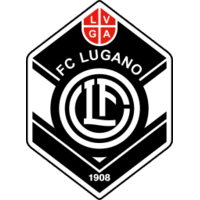
The crest of FC Lugano has always reflected the club's elegant and minimalist identity, with its famous black-and-white colours serving as the defining feature. While the badge has been modernised several times, each version has retained the iconic "LC" monogram, symbolising the club's proud heritage in the Italian-speaking region of Ticino.
The crest used between 1990 and 2018 featured a distinctive hexagonal shield in black and white. At its centre stood the classic LC monogram, while the club's name, FC Lugano, and founding year 1908 were incorporated into the design. A small red section at the top displayed the initials LVGA, a historical reference to the city of Lugano's Latin name. This badge became closely associated with the club's return to the Swiss Super League and its re-emergence as a competitive force in Swiss football.
In 2018, FC Lugano introduced a completely redesigned crest centred around a bold circular black-and-white monogram. By removing additional text and decorative elements, the club adopted a cleaner and more contemporary visual identity while preserving the traditional LC initials that had represented Lugano for decades.
A further refinement arrived in 2025, when the club simplified the badge even more. The updated crest features a sharper, more balanced version of the iconic LC monogram, enclosed within a bold black circle. The minimalist design reflects FC Lugano's modern ambitions while remaining faithful to the club's historic identity and timeless black-and-white colours.
FC Lugano Club History
Founded in 1908, FC Lugano is one of Switzerland's oldest and most respected football clubs. Based in the Italian-speaking city of Lugano in the canton of Ticino, the club has long been regarded as the region's leading football institution. Wearing its traditional black and white colours, Lugano is affectionately known as the "Bianconeri" (The Black-and-Whites).
Lugano established itself as one of Switzerland's strongest clubs during the 1930s and 1940s, winning its first Swiss championship in 1938. The club added further league titles in 1941 and 1949, while also enjoying success in the Swiss Cup, becoming one of the country's most successful teams during this period.
Following its golden era, Lugano remained a regular presence in the Swiss top flight but experienced alternating periods of success and decline. Despite several cup triumphs and appearances in European competitions, the club struggled to maintain the dominance it had enjoyed in the post-war years.
Financial difficulties eventually led to bankruptcy in 2002, forcing FC Lugano to restart in the lower divisions under the name AC Lugano. Thanks to determined rebuilding efforts, the club steadily climbed back through the Swiss football pyramid and reclaimed the historic FC Lugano name, restoring one of Switzerland's traditional football institutions.
Promotion back to the Swiss Super League in 2015 marked the beginning of a new era. Since then, Lugano has become a consistent challenger in Swiss football, regularly qualifying for European competitions and establishing itself among the country's leading clubs once again.
A historic moment arrived in 2021–22, when FC Lugano won the Swiss Cup for the first time in 29 years, defeating St. Gallen in the final. The triumph secured qualification for European football and confirmed the club's successful revival. In recent seasons, Lugano has regularly competed in the UEFA Europa League and UEFA Europa Conference League, earning valuable international experience and enhancing its reputation across Europe.
The club's principal rivalry is with FC Chiasso in the Ticino Derby, while matches against FC Luzern, FC Basel, and BSC Young Boys have become increasingly significant due to their regular battles for European qualification.