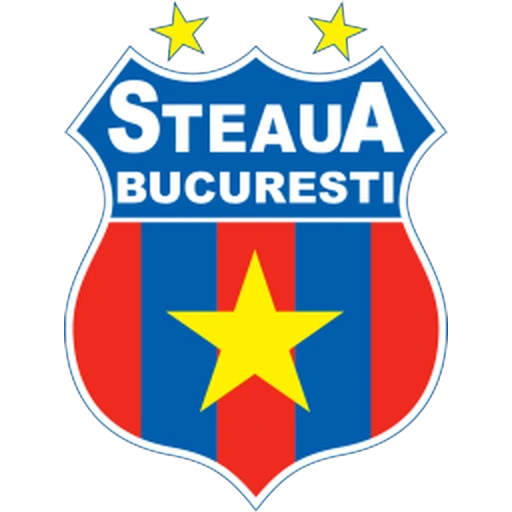
CSA Steaua București Crest History
The crest history of CSA Steaua București reflects the club's military origins and its evolution into one of Eastern Europe's most successful football institutions. Throughout its history, the red star has remained the club's defining symbol, representing both its army heritage and its identity as Romania's most decorated football club.
The club's first emblem, used between 1947 and 1948, was a simple black "ASA" monogram, standing for Asociația Sportivă a Armatei (Army Sports Association). This minimalist design reflected the club's formation immediately after the Second World War as the official football team of the Romanian Army.
In 1948, following the club's renaming to CSCA (Clubul Sportiv Central al Armatei), a new crest was introduced featuring a large red five-pointed star inside a blue circle. The star quickly became the club's most recognisable symbol and has remained central to every Steaua badge ever since.
A further redesign followed in 1950, when the club became CCA București (Casa Centrală a Armatei). The badge featured a red star surrounded by a golden laurel wreath bearing the initials CCA, reflecting the military traditions and prestige of the club during Romania's communist era.
When the club adopted the name Steaua București in 1961, a completely new shield-shaped crest was unveiled. It combined the famous golden star, the red-and-blue club colours, laurel branches and a football, with the words "C.S. Steaua București." This badge remained in use until 1972 and became closely associated with the club's emergence as Romania's dominant football force.
In 1972, Steaua introduced a cleaner and more modern shield. The football and laurel branches disappeared, leaving a simple red-and-blue striped shield with the iconic golden star at its centre and the words "Steaua București." This design became one of the most recognisable crests in Eastern European football and accompanied the club during its greatest successes, including the historic 1986 European Cup triumph.
Following the fall of communism, the crest was updated in 1991 with a more contemporary shield and an eagle representing the Romanian Football Federation. Although the design changed, the red star remained the focal point of the emblem.
After legal disputes between the football club and the Romanian Army, FCSB lost the right to use the Steaua name and crest. In 2017, CSA Steaua București officially reintroduced a modernised version of the classic 1972 badge, featuring the traditional red-and-blue shield with the golden star and two championship stars above it. This crest proudly represents the club's historic identity and its continuing link with the original Steaua tradition.
CSA Steaua București Club History
Founded in 1947 as Asociația Sportivă a Armatei (ASA București), CSA Steaua București is one of the most successful and historic football clubs in Romanian and European football. Established by the Romanian Ministry of National Defence, the club quickly became the official football team of the Romanian Army. During its early years, it competed under the names ASA București, CSCA București, and CCA București, before adopting the famous name Steaua București in 1961.
Throughout the 1950s, 1960s and 1970s, Steaua established itself as one of Romania's dominant clubs, winning numerous league championships and domestic cups. Supported by the army sports system, the club attracted many of the country's finest players and became a symbol of Romanian football excellence.
The club reached the pinnacle of European football in 1986, when Steaua defeated FC Barcelona in the European Cup Final after a dramatic penalty shoot-out in Seville. Goalkeeper Helmuth Duckadam became a club legend by saving all four Barcelona penalties, securing the first and, to date, only European Cup won by a Romanian club. Steaua followed this achievement by winning the 1986 UEFA Super Cup against Dynamo Kyiv and reached another European Cup final in 1989, losing to AC Milan.
Following the fall of communism in 1989, Romanian football underwent major structural changes. In 1998, the football section separated from the military sports club and was transferred to a privately managed organisation. This entity continued to compete as FC Steaua București, while CSA Steaua remained the parent multi-sports club under the Ministry of National Defence.
The relationship between the two organisations eventually became the subject of a lengthy legal dispute. Beginning in the 2010s, Romanian courts ruled that the Steaua name, crest and trademarks belonged to CSA Steaua București, as they had never been legally transferred to the private football company. As a result, the professional club was forced to stop using the Steaua name and, in 2017, officially adopted the name FCSB.
Meanwhile, CSA Steaua București re-established its football section in 2017, starting in the lower amateur divisions and quickly earning successive promotions back into professional football. The club reclaimed the historic Steaua crest, colours and identity, while continuing to play at the newly rebuilt Stadionul Steaua, inaugurated in 2021.
The split between CSA Steaua București and FCSB remains one of the most controversial issues in European football. CSA Steaua considers itself the original club founded in 1947, retaining the historic name, crest and military heritage. FCSB, on the other hand, is recognised by UEFA as the sporting continuation of the team that competed in European competitions, including the 1986 European Cup-winning side. As a result, the ownership of parts of the club's historical honours remains the subject of legal interpretation and ongoing debate among supporters, historians and football authorities.
CSA Steaua București's greatest rivalry is with Dinamo București in the legendary Eternal Derby (Derby-ul Etern), one of the oldest and fiercest football rivalries in Eastern Europe. Dating back to the late 1940s, the fixture symbolises the historic rivalry between the Romanian Army, represented by Steaua, and the Ministry of Internal Affairs, represented by Dinamo. Another long-standing rivalry exists with Rapid București, whose passionate encounters have become an integral part of Bucharest football culture. Since the re-establishment of the football section in 2017, CSA Steaua has also developed a unique rivalry with FCSB. Although the clubs have rarely met on the pitch, their ongoing legal dispute over the Steaua name, crest and historical honours has created one of the most unusual and controversial rivalries in European football, with both clubs and their supporters claiming to represent the true legacy of the original Steaua București.
Today, CSA Steaua București continues to represent the traditions of the original army club. Playing in the modern Stadionul Steaua, The Army Men remain one of Romania's most iconic sporting institutions.