The crest of Vitória Sport Clube has undergone several transformations since the club's foundation, reflecting its growth from a local football team into one of Portugal's most historic clubs. While early badges varied considerably, the modern identity has become firmly associated with the statue of King Afonso Henriques, symbolising the club's deep connection to the birthplace of Portugal.
The club's earliest emblem, introduced in 1922, consisted simply of an artistic monogram formed by the intertwined initials of Vitória Sport Clube. This elegant design reflected the style of the era and represented the newly founded club during its first season.
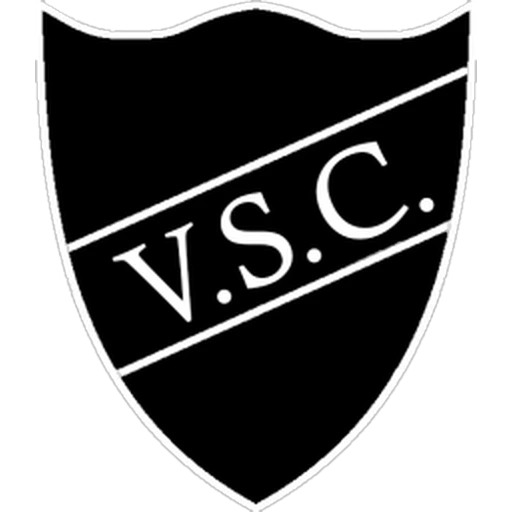
In 1923, Vitória adopted its first shield-shaped crest. The badge featured a black-and-white divided shield with the initials "VSC", establishing the club's traditional colours and providing a clearer sporting identity. A simplified variation appeared briefly in 1927, with the initials placed diagonally across the shield.
Between 1934 and 1947, the club moved away from the shield altogether, using a bold standalone letter "V" as its official symbol. Although highly distinctive, the minimalist design proved temporary as the club searched for an emblem that better reflected its heritage.
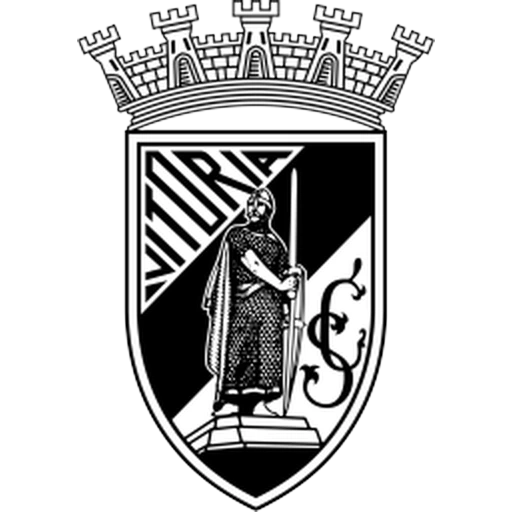
A major milestone came in 1954, when Vitória introduced a crest inspired by the coat of arms of Guimarães. The new badge featured the statue of King Afonso Henriques, Portugal's first king, together with the city's mural crown and black-and-white shield. This emblem firmly linked the club to Guimarães, widely regarded as the birthplace of Portugal, and quickly became one of the most recognisable symbols in Portuguese football.
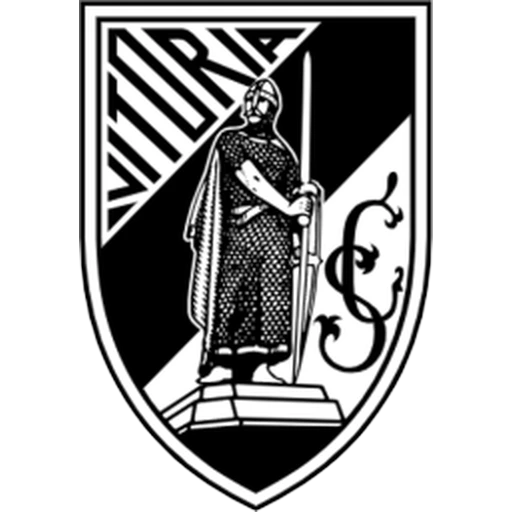
In 1999, the crest was modernised while preserving its historic concept. The artwork of the statue, shield and lettering was simplified, proportions were refined, and cleaner lines were introduced to improve visibility across modern media. Despite these updates, the badge retained every important historical element and remains the club's official emblem today.
Vitória SC Club History
Founded in 1922, Vitória Sport Clube is one of Portugal's most historic and passionately supported football clubs. Based in the city of Guimarães, widely regarded as the birthplace of Portugal, Vitória has built a proud identity rooted in tradition, regional pride and fierce loyalty. Wearing its iconic black and white colours, the club is affectionately known as "Os Conquistadores" (The Conquerors) in honour of Portugal's first king, Afonso Henriques.
Although league titles have remained elusive, Vitória has enjoyed considerable success in domestic cup competitions. The club lifted its first major trophy by winning the Taça de Portugal in 1962–63, defeating Benfica in the final. Fifty years later, Vitória claimed its second Portuguese Cup in 2012–13, beating city rivals S.C. Braga in one of the most memorable finals in the club's history.
Vitória has also become a familiar name in European football. The club has regularly competed in the UEFA Cup, UEFA Europa League and UEFA Europa Conference League, earning memorable victories against respected European opponents. These campaigns have strengthened Vitória's reputation as one of Portugal's leading clubs outside the traditional "Big Three."
One of the defining features of Vitória Sport Clube is its extraordinary support. The club consistently attracts some of the highest attendances in Portuguese football, with the Estádio D. Afonso Henriques renowned for its passionate atmosphere.
The club's fiercest rivalry is with neighbouring Sporting Clube de Braga in the Derby do Minho, one of Portugal's most intense and emotionally charged fixtures. The rivalry extends beyond football, reflecting the historic competition between the cities of Guimarães and Braga. Matches against F.C. Porto, Benfica, and Sporting CP also carry significant importance due to Vitória's long-standing ambition to challenge Portugal's traditional elite.