Founded in 1895 as Fußball- und Cricket Club Eintracht Braunschweig, the club's first official crest featured the red Brunswick Lion enclosed within a simple circular border. Derived directly from the historic coat of arms of the Duchy of Brunswick, the lion immediately established itself as the defining symbol of the club and reflected its close connection to the city and surrounding region.
In 1906, Eintracht adopted a circular badge displaying the full club name, Braunschweiger F.C. Eintracht, around the traditional red lion. The redesign strengthened the club's identity while preserving the historic heraldic emblem that had become synonymous with Braunschweig.
Following the formation of Braunschweiger Sportverein Eintracht in 1920, the crest was updated to reflect the club's new name. The badge incorporated a gold shield bearing the Brunswick Lion within a blue outer ring, introducing the club's traditional blue and yellow colours, which have remained central to Eintracht's identity ever since.
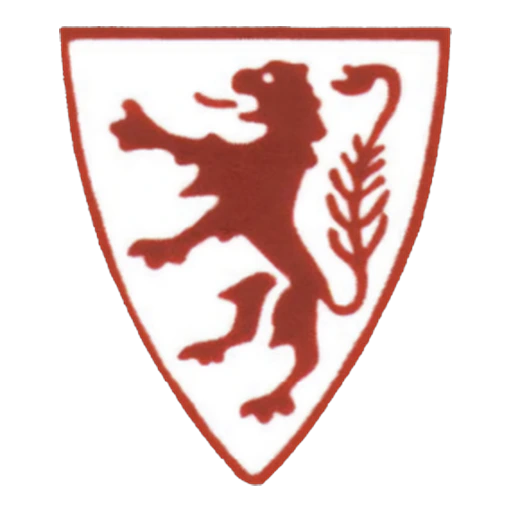
During the 1930s and 1940s, several simplified versions of the lion were introduced. Between 1938 and 1945, the club adopted a striking circular badge featuring a black lion on a white field, while the immediate post-war years saw a minimalist shield displaying only the red Brunswick Lion. Although these designs varied in shape and colour, the heraldic lion remained the unmistakable centrepiece of the club's visual identity.
From 1949 onwards, Eintracht returned to a circular crest combining the blue-and-yellow colour scheme with the Brunswick Lion at its centre. Throughout the 1950s, 1960s and 1970s, the badge underwent several refinements, including updated typography, improved proportions and variations commemorating the club's 1967 German Championship. Despite these changes, the lion continued to dominate the design, reinforcing the club's historic connection to the city of Braunschweig.
A significant redesign arrived in 1986, when Eintracht introduced a modern diamond-shaped crest featuring the red Brunswick Lion on a white shield surrounded by blue and yellow borders. The simplified geometric design provided a cleaner and more contemporary appearance while preserving the club's traditional colours and heraldic symbolism. Minor refinements followed in 2009, improving the proportions and colour balance without altering the overall concept.
In 2012, the club returned to a circular badge inspired by its historic post-war crests, combining the blue outer ring, gold inner border and central white shield bearing the red Brunswick Lion. A special commemorative crest celebrating the 50th anniversary of the 1967 Bundesliga title was worn during the 2016–17 season before Eintracht reinstated the modern circular badge in 2017.
The current crest represents a careful refinement of the club's historic identity. Featuring the traditional blue-and-yellow colours and the iconic Brunswick Lion, it successfully combines more than a century of heraldic tradition with a clean contemporary design.
Eintracht Braunschweig Club History
Founded on 15 December 1895 as Fußball- und Cricket Club Eintracht Braunschweig, Eintracht Braunschweig is one of Germany's oldest football clubs. Originally established as a cricket and football club, football soon became its principal sport, and Eintracht quickly developed into one of the strongest teams in northern Germany. The club adopted the Brunswick Lion as its symbol from its earliest years, reflecting its close connection to the city of Braunschweig, while its blue and yellow colours became synonymous with the club's identity.
During the first half of the twentieth century, Eintracht established itself as one of the leading clubs in northern Germany, winning numerous regional championships and regularly competing for national honours. Following the introduction of the Bundesliga in 1963, the club became one of the league's sixteen founding members and quickly emerged as one of its strongest sides.
The greatest achievement in the club's history came during the 1966–67 season, when Eintracht Braunschweig won its only German Championship, finishing ahead of TSV 1860 Munich to become Bundesliga champions. Under manager Helmuth Johannsen, the team built its success on outstanding defensive organisation, while striker Lothar Ulsaß and captain Klaus Gerwien played key roles in securing the title. Eintracht also became the first German club to display a shirt sponsor when it famously replaced the traditional Jägermeister deer logo with the company's stag emblem in 1973, helping pioneer commercial sponsorship in German football.
Throughout the 1970s and early 1980s, Eintracht remained a competitive Bundesliga club and regularly represented Germany in European competition. The club reached the UEFA Cup quarter-finals in 1977, defeating several established opponents before being eliminated by eventual finalists FC Barcelona. However, financial difficulties and inconsistent performances eventually led to relegation from the Bundesliga in 1985, beginning a prolonged period outside Germany's top flight.
Over the following decades, Eintracht Braunschweig alternated between the 2. Bundesliga, the 3. Liga and the Regionalliga, while remaining one of Germany's best-supported traditional clubs. Promotion back to the 2. Bundesliga in 2011 marked the beginning of a revival, and two years later the club returned to the Bundesliga for the first time in 28 years. Although its stay in the top flight lasted only one season, Eintracht continued to establish itself as a competitive club in Germany's professional leagues.
Today, Eintracht Braunschweig remains one of Germany's most historic football institutions. Playing at the Eintracht-Stadion, the club enjoys passionate support throughout Lower Saxony. Its fiercest rivalry is with Hannover 96 in the Lower Saxony Derby (Niedersachsenderby), one of German football's oldest and most fiercely contested regional rivalries. Matches against VfL Wolfsburg and 1. FC Magdeburg also carry considerable significance, reflecting the club's long-standing place in northern German football.