Borussia Mönchengladbach Crest History
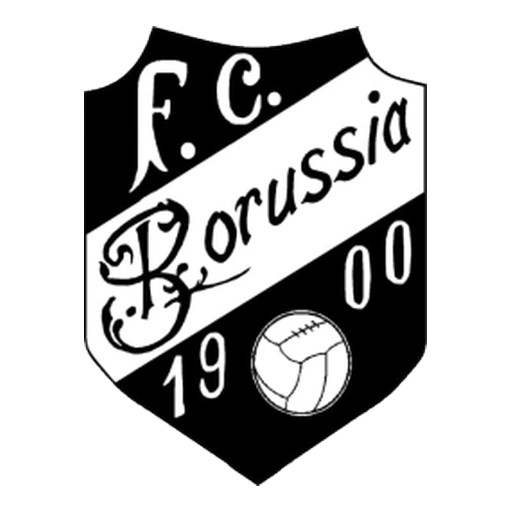
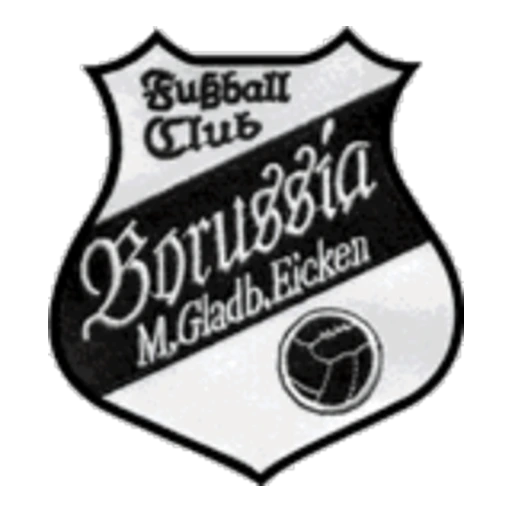
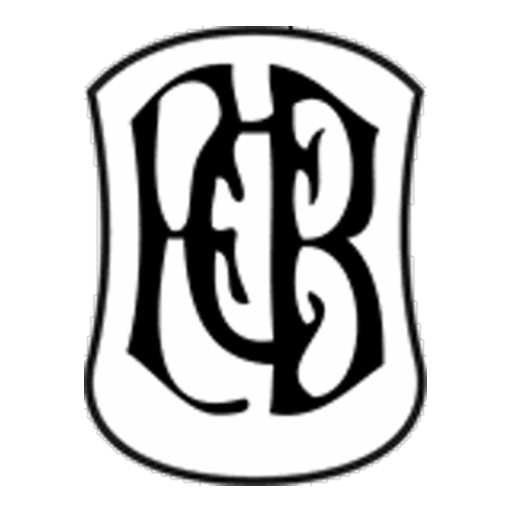
Following the club's foundation in 1900 as FC Borussia, the earliest club emblems were simple monograms featuring the intertwined initials FCB.
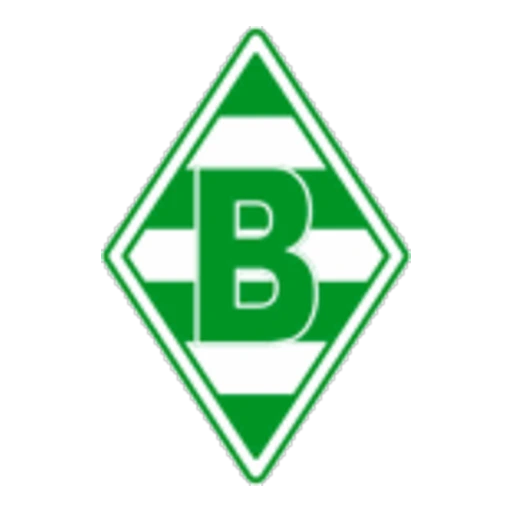
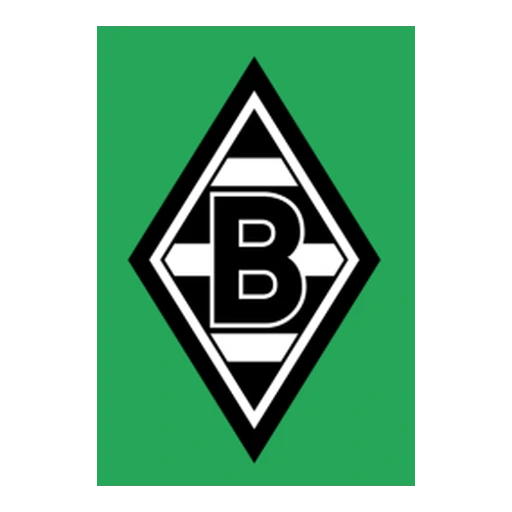
A major redesign arrived in 1961, when Borussia Mönchengladbach introduced a striking green-and-white diamond-shaped crest. Featuring horizontal white bands across a green diamond with a bold green "B" at its centre, this badge placed greater emphasis on the club's colours than any previous design. It became closely associated with Borussia's rise during the 1960s, as the club established itself among the strongest teams in West Germany under the guidance of legendary manager Hennes Weisweiler.
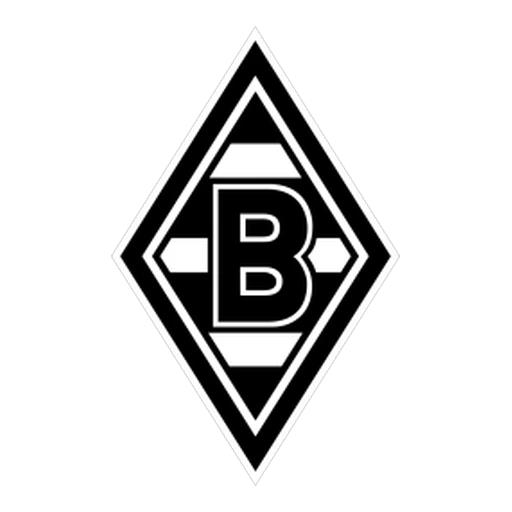
Another significant milestone came in 1970, when Borussia adopted the now-famous black-and-white diamond crest. The green stripes were removed and replaced by a clean white background surrounded by a bold black border, with the large black "B" becoming the central focus of the badge. The minimalist redesign created one of the most distinctive and recognisable crests in European football and accompanied Borussia throughout the most successful period in the club's history, including five Bundesliga titles, a DFB-Pokal triumph and two UEFA Cup victories.
In 1999, Borussia Mönchengladbach introduced a refined version of the diamond crest that remains in use today. The updated design features cleaner lines, improved symmetry and a more balanced interpretation of the iconic "B", making it better suited to modern branding and digital media while remaining faithful to the historic badge.
Borussia Möchengladbach Club History
Borussia Mönchengladbach was founded on 1 August 1900 as FC Borussia in the Eicken district of Mönchengladbach. The club's name was inspired by the Latin word Borussia, meaning Prussia, a popular choice among German football clubs at the time. Borussia played at several local grounds during its early years before establishing itself as one of the strongest clubs in western Germany. Since 2004, the club has played its home matches at Borussia-Park, having previously spent more than 85 years at the historic Bökelbergstadion, where many of its greatest successes were achieved.
Although Borussia enjoyed regional success during the first half of the twentieth century, the club's rise to national prominence began in the 1960s under legendary manager Hennes Weisweiler. Promoting talented young players and playing an exciting attacking style of football, Borussia earned the nickname "Die Fohlen" (The Foals) because of the team's youthful squad and energetic performances.
The 1970s marked the greatest era in Borussia Mönchengladbach's history. Under managers Hennes Weisweiler and later Udo Lattek, the club won five Bundesliga titles (1970, 1971, 1975, 1976 and 1977), becoming one of Germany's dominant forces. Borussia also lifted the DFB-Pokal in 1973 and twice won the UEFA Cup, triumphing in 1975 and 1979. During this golden period, the club featured legendary players including Günter Netzer, Jupp Heynckes, Berti Vogts, Rainer Bonhof, Allan Simonsen, and Herbert Wimmer, many of whom became icons of German football.
Borussia also enjoyed considerable success in the European Cup, reaching the 1977 European Cup Final against Liverpool. Although defeated 3–1 in Rome, the club established itself as one of Europe's elite teams during the decade. The attacking, entertaining football played by the "Foals" earned admiration across the continent and remains one of the defining periods in German football history.
Following the successes of the 1970s, Borussia remained a competitive Bundesliga club throughout the 1980s and 1990s, regularly qualifying for European competitions. The club enjoyed another major success by winning the DFB-Pokal in 1995, defeating VfL Wolfsburg 3–0 in the final to claim its third major domestic cup.
The late 1990s and early 2000s proved more challenging. Borussia suffered relegation from the Bundesliga in 1999, ending an uninterrupted stay of more than 30 years in Germany's top flight. After earning promotion back to the Bundesliga in 2001, the club stabilised and, in 2004, moved into the newly built Borussia-Park, marking the beginning of a new era.
Borussia experienced a remarkable revival during the 2010s under Lucien Favre. After narrowly avoiding relegation in 2011, the club quickly re-established itself among Germany's leading teams, regularly qualifying for the UEFA Champions League and Europa League. Players such as Marco Reus, Granit Xhaka, Marc-André ter Stegen, Thorgan Hazard, and Lars Stindl became central figures during this successful period.
Borussia's fiercest rivalry is with 1. FC Köln, a fixture known as the Rheinland Derby, one of the oldest and most fiercely contested rivalries in German football. The club also shares competitive rivalries with nearby sides such as Bayer Leverkusen and Fortuna Düsseldorf, reflecting the rich football culture of the Rhineland.