Nickname(s):Die Zebras (The Zebras), Meidericher Jungs (The Boys from Meiderich)
Founded:1902
Stadium:Schauinsland-Reisen Arena
Capacity:31,500
1902-1905
1905-1908
1923-1951
1951-1967
1967-1980
1980-1996
1996-2017
2017-2022
2022-2023
2023-Present
MSV Duisburg Crest History
MSV Duisburg Crest History
Following the club's foundation in 1902 as Meidericher Spielverein, the earliest club emblems were simple circular monograms featuring the initials MSV. These early badges reflected the style of German football clubs during the early twentieth century, using straightforward typography rather than elaborate crests or symbols.
After merging with Sportclub Viktoria Meiderich in 1905, the club briefly adopted the name Meidericher Sportverein. During this period, the crest was updated to reflect the new initials while retaining the traditional circular design and blue-and-white colour scheme. When the club reverted to Meidericher Spielverein in 1908, the monogram was again revised, but the overall identity remained largely unchanged.
Throughout the 1920s to the 1960s, the badge evolved gradually as the typography became cleaner and more balanced. Several variations appeared over the decades, with refinements to the lettering, outlines, and proportions, but the club consistently maintained its distinctive blue-and-white circular emblem.
A significant milestone came in 1967, when the club officially changed its name to MSV Duisburg to represent the entire city rather than the district of Meiderich. The crest was modernised to reflect the new identity while preserving the familiar circular badge and stylised MSV monogram that supporters had recognised for generations.
During the 1980s and 1990s, further refinements simplified the typography and improved the proportions of the emblem. These changes created a cleaner, more versatile badge that reproduced more effectively on playing shirts, merchandise, and printed material while maintaining the club's traditional appearance.
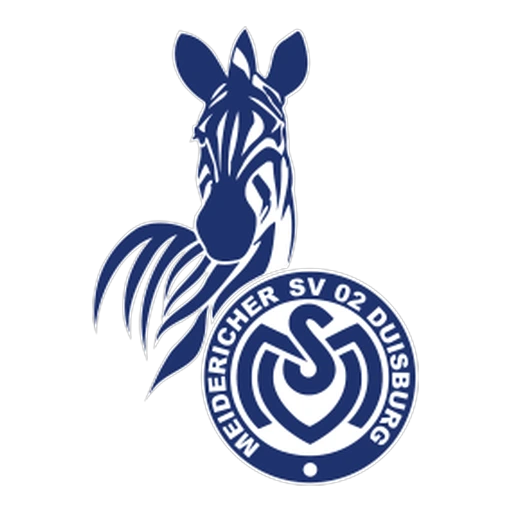
The most recognisable transformation arrived in 1996, when MSV Duisburg introduced the famous zebra into its visual identity. Inspired by the club's long-standing nickname, "Die Zebras," the stylised zebra head was combined with the traditional circular crest, creating one of the most distinctive badges in German football.
In 2017, the zebra crest was refined with cleaner lines, updated colours, and improved proportions to better suit modern digital media while preserving the club's established identity. For the 2022–23 season, MSV Duisburg introduced a special 120th anniversary crest, combining historic design elements to celebrate the club's rich heritage. Following the anniversary celebrations, the club returned to an updated version of its traditional zebra crest, which remains in use today.
MSV Duisburg Club History
MSV Duisburg was founded on 17 September 1902 in the Duisburg district of Meiderich as Meidericher Spielverein. Originally formed by local football enthusiasts, the club steadily established itself as one of the strongest teams in western Germany. In 1967, the club officially adopted the name MSV Duisburg, reflecting its ambition to represent the entire city while maintaining its proud roots in Meiderich.
The club became one of the 16 founding members of the Bundesliga in 1963 and immediately enjoyed the greatest league campaign in its history. Under coach Rudi Gutendorf, MSV finished runners-up in the inaugural Bundesliga season (1963–64), an achievement that remains the club's highest-ever league finish. The team earned widespread admiration for competing successfully against Germany's biggest clubs despite having a relatively modest squad.
During the 1960s and 1970s, MSV Duisburg established itself as a respected Bundesliga club. The Zebras reached the DFB-Pokal finals in 1966 and 1975, narrowly missing out on their first major trophy. The club also represented Germany in European competition, reaching the semi-finals of the 1978–79 UEFA Cup, the deepest European run in its history.
One of the most iconic figures in the club's history is Bernard Dietz, who captained MSV throughout much of the 1970s before leading West Germany to victory at UEFA Euro 1980. Dietz remains one of the greatest players ever to wear the blue-and-white shirt and is regarded as a symbol of the club's determination and fighting spirit.
Following relegation from the Bundesliga in 1982, MSV Duisburg entered a period of fluctuating fortunes. Over the following decades, the club regularly moved between the Bundesliga, 2. Bundesliga and later the 3. Liga. Despite these challenges, MSV remained one of Germany's best-supported traditional clubs and continued to attract passionate crowds.
The club enjoyed several memorable promotions during the 1990s and 2000s under managers including Friedhelm Funkel and Norbert Meier. MSV also reached the 1998 DFB-Pokal Final and, in 2011, reached the final again, although they were defeated on both occasions. These cup runs provided supporters with some of the club's most memorable modern moments.
In recent years, MSV Duisburg has experienced one of the most challenging periods in its history. Financial difficulties and inconsistent performances led to relegation from the 3. Liga in 2024, ending the club's long spell in professional football. The Zebras responded impressively by winning the Regionalliga West at the first attempt, securing an immediate return to the 3. Liga and demonstrating the resilience that has long defined the club.
MSV Duisburg supporters are renowned for their loyalty and unwavering backing. Nicknamed "Die Zebras" because of the club's famous blue-and-white striped shirts, the fanbase creates an impressive atmosphere at the Schauinsland-Reisen-Arena. Deeply rooted in the industrial heritage of the Ruhr region, the club proudly represents the city of Duisburg and its strong working-class traditions.
The club's fiercest rivalry is with Rot-Weiss Essen, one of the oldest and most passionate rivalries in German football. MSV also shares strong rivalries with fellow Ruhr clubs including VfL Bochum and FC Schalke 04, reflecting the rich footballing culture of Germany's industrial heartland.