The earliest known crest of Red Star FC, used from 1907 to 1920, was a simple red five-pointed star containing the white initials RS. The badge reflected the club's name and became the foundation of one of the most recognisable identities in French football. The red star itself has remained the defining symbol of the club throughout its history and is said to have been inspired by the decorative badge worn by Jenny, the English governess of founder Jules Rimet. The emblem predates any political associations with the red star and has always represented the club's identity rather than ideology.
After the Second World War, in 1946, Red Star adopted a circular badge featuring a red star at its centre, surrounded by a green ring. The initials R, S, O, and A appeared around the star, referencing the club's then official name, Red Star Olympique Audonien. Green became firmly established alongside red as the club's traditional colour, a combination that has remained ever since.
Between 1978 and 1984, the club briefly introduced one of its most unusual crests. The badge depicted a smiling red star wearing a green-and-white winter hat and scarf, giving the club a more playful and distinctive visual identity. Although popular with some supporters, it was short-lived and remains one of the most unique logos ever used by a French professional club.
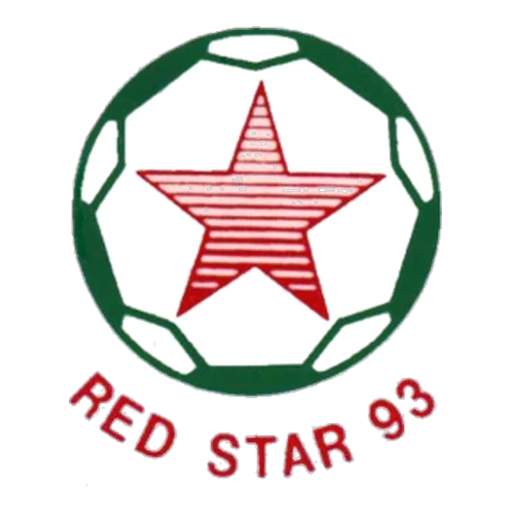
In 1984, Red Star returned to a more traditional design. The new crest placed a red striped star inside a stylised football, with the words "Red Star 93" beneath it. The addition of "93" referred to the department of Seine-Saint-Denis, reinforcing the club's connection to its local community while modernising its image.
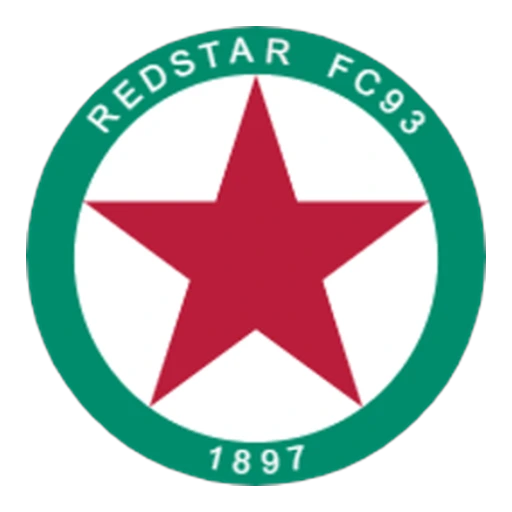
A major redesign followed in 2003. The football motif disappeared in favour of a clean circular badge with a large red star at its centre, surrounded by a green ring bearing the inscription "Red Star FC 93" and the founding year 1897. The simplified emblem reflected the club's historic identity while embracing a contemporary style.
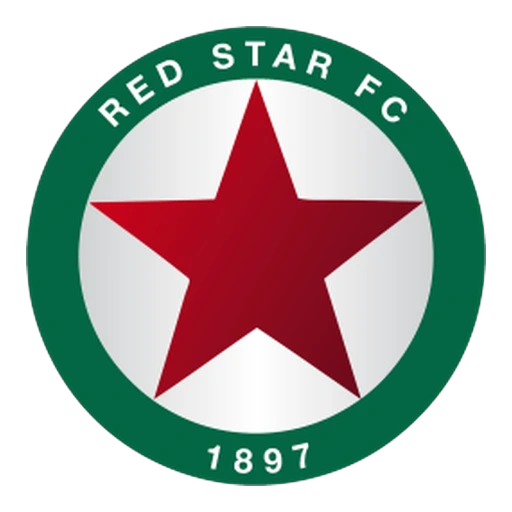
In 2012, the club made only minor refinements to the badge. The wording was updated from "Red Star FC 93" to "Red Star FC", removing the departmental reference while retaining the familiar circular design, central red star, green border, and founding year.
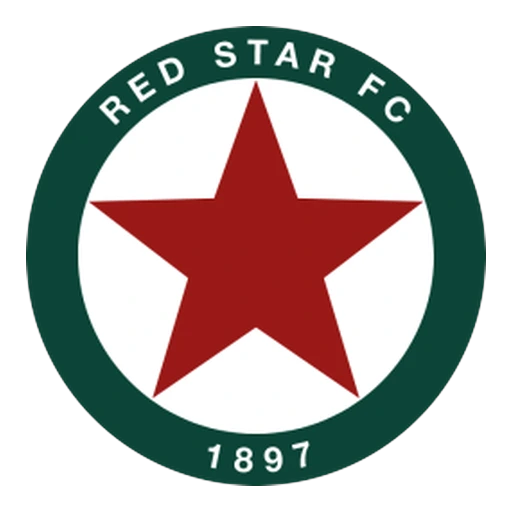
Since 2014, Red Star FC has used a slightly modernised version of this emblem. The typography, colours, and proportions were refined, but the badge continues to feature the iconic red star within a green circular border above the founding year 1897.
Red Star FC Club History
Founded in 1897, Red Star Football Club is one of the oldest football clubs in France. It was established in Paris by Jules Rimet and his brother Modeste Rimet, together with a group of friends. Jules Rimet would later become one of the most influential figures in football history as president of FIFA and the creator of the FIFA World Cup. The club adopted the name "Red Star", reportedly inspired by the red star worn by Rimet's English governess, Jenny, although the exact origin remains debated. From its earliest years, Red Star became known for promoting sporting values, inclusivity, and amateur football. (redstar.fr)
After moving to Saint-Ouen-sur-Seine in the early 20th century, Red Star developed into one of France's strongest clubs. The team became professional in 1932, joining the inaugural French professional championship. During the 1920s and 1940s, the club enjoyed its greatest successes, winning the Coupe de France on five occasions (1921, 1922, 1923, 1928, and 1942). Red Star remains one of the competition's most successful clubs, with only a handful of teams having won the trophy more often. Throughout this period, the club earned a reputation for attractive football and a strong working-class identity rooted in the northern suburbs of Paris.
Following the Second World War, Red Star remained a respected club but gradually lost its place among France's elite. The second half of the 20th century was marked by frequent promotions and relegations between the top three divisions, as well as several changes of name, including Red Star Olympique Audonien and Red Star 93. Despite financial difficulties and sporting inconsistency, the club maintained a loyal supporter base and became renowned for one of the most distinctive football cultures in France.
The club experienced a revival in the 2010s, returning to the Championnat National before winning promotion to Ligue 2 in 2015. Although relegated after one season, Red Star continued to rebuild and secured another promotion in 2024, returning to Ligue 2 after six years. Alongside its sporting progress, the club has remained deeply connected to the historic Stade Bauer, one of France's most iconic football grounds, which has undergone extensive renovation while preserving its traditional character.
Red Star's principal rivalry is with Paris FC, a fixture often referred to as the Paris Derby outside of PSG. Local matches against US Créteil-Lusitanos and FC Versailles 78 also carry regional significance, while encounters with Paris Saint-Germain remain rare due to the clubs spending most of their histories in different divisions.