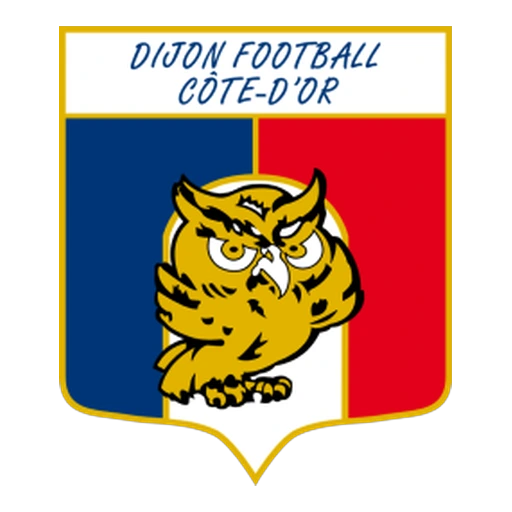
Dijon Football Côte-d'Or adopted its first official crest in 1998, following the club's formation through the merger of Dijon FC and Cercle Dijon. The shield incorporated the blue, white and red colours of the French flag and featured the club's full name across the top. At its centre was a golden owl, the historic symbol of the city of Dijon, while the Guillaume Gate (Porte Guillaume), one of the city's best-known landmarks, appeared in the background. By combining civic symbols with the national colours, the crest established a strong connection between the new club and the city it represented.
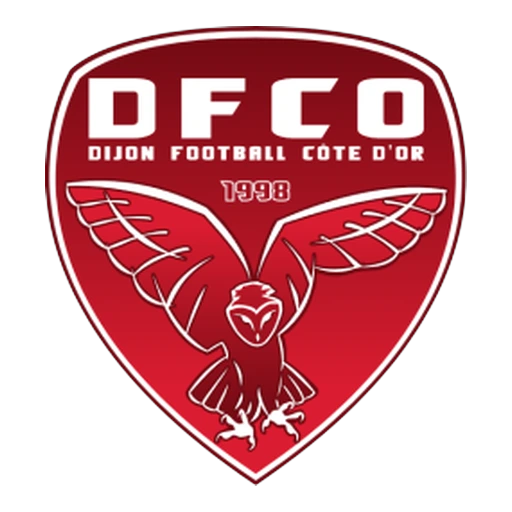
In 2006, Dijon FCO introduced a completely redesigned crest centred around a modern red shield. The owl was retained but transformed into a stylised bird with its wings fully spread, symbolising strength, ambition and victory. The Guillaume Gate disappeared, giving way to a clean red background that reflected the club's home colours. The initials DFCO appeared prominently at the top, accompanied by the club's full name in smaller lettering, while 1998, marking the club's foundation, was placed between the owl's wings. The redesign created a cleaner, more dynamic identity while preserving the city's iconic owl as the club's defining symbol.
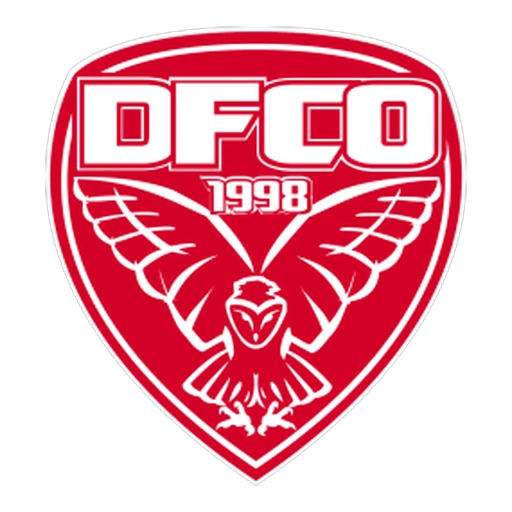
In 2014, Dijon FCO refined the 2006 design rather than replacing it. The shield retained its familiar shape, the flying owl and the DFCO initials, but the gradient effects were removed in favour of a flat red-and-white colour scheme. The club's full name was also removed, leaving only DFCO and 1998 to create a cleaner and more contemporary appearance.
Dijon FCO Club History
Founded in 1998, Dijon Football Côte-d'Or (DFCO) was created through the merger of Cercle Dijon and Dijon FC, bringing together the city's two principal football clubs with the aim of establishing a sustainable professional team. Although the club officially dates from 1998, organised football in Dijon stretches back to the early twentieth century, with several local clubs contributing to the city's football heritage before the merger. Beginning life in the Championnat de France Amateur (CFA), the newly formed club quickly set its sights on climbing the French football pyramid.
Progress came rapidly. Dijon earned promotion to the Championnat National in 2000 before appointing Rudi Garcia as head coach in 2002, a decision that transformed the club's fortunes. During the 2003–04 season, DFCO enjoyed a remarkable Coupe de France run, defeating clubs including Saint-Étienne, Lens, Reims and Amiens before reaching the semi-finals, where they were eliminated by Châteauroux. That same season, the club secured promotion to Ligue 2, marking its arrival in professional football.
After establishing itself in Ligue 2, Dijon achieved another historic milestone by winning promotion to Ligue 1 for the first time in 2011 under Patrice Carteron. Although the club was immediately relegated after its debut top-flight campaign, it rebuilt under Olivier Dall'Oglio, whose attractive, attacking style guided DFCO back to Ligue 1 in 2016. The club remained in the top division for five consecutive seasons, recording its highest-ever league finish of 11th in 2017–18. During this period, Dijon became known for developing players such as Benjamin Mendy, Eric Junior Dina Ebimbe, and Mama Baldé, while earning memorable victories, including a famous 2–1 home win over Paris Saint-Germain in 2019.
The club's fortunes declined in the early 2020s. Relegation from Ligue 1 in 2021 was followed by another drop to the Championnat National in 2023, ending DFCO's 19-year stay in the professional divisions. Despite these setbacks, the club has continued to invest in its academy and infrastructure, with new ownership taking over in 2024 to lead a long-term rebuilding project aimed at returning Dijon to the upper levels of French football. Playing at the Stade Gaston Gérard, Dijon FCO remains the leading football club in Burgundy and continues to pursue a return to professional football.
Dijon FCO's principal rivalry is with AJ Auxerre in the Burgundy Derby, the most prominent football rivalry in the Bourgogne region. Matches against FC Sochaux-Montbéliard and AS Nancy-Lorraine have also become competitive fixtures through frequent meetings in Ligue 2, but the clashes with Auxerre remain the club's most significant regional contest.