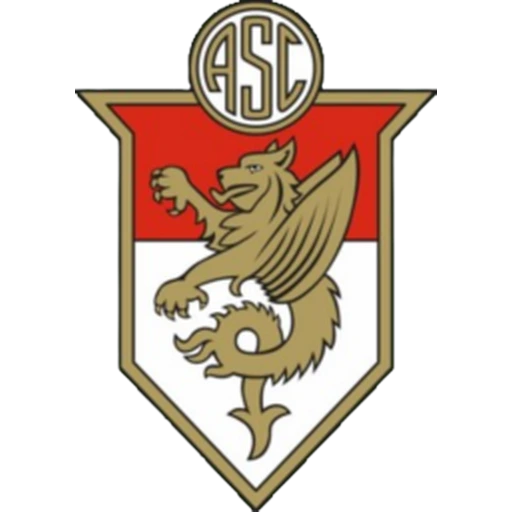
The first widely recognised modern crest of AS Cannes, introduced in 1960, featured a classic shield in the club's traditional red and white colours. At its centre stood a heraldic griffin, symbolising strength, vigilance and courage, while a circular ASC monogram crowned the top of the badge. The crest reflected the club's historic identity and followed the heraldic style common among French football clubs during the mid-twentieth century.
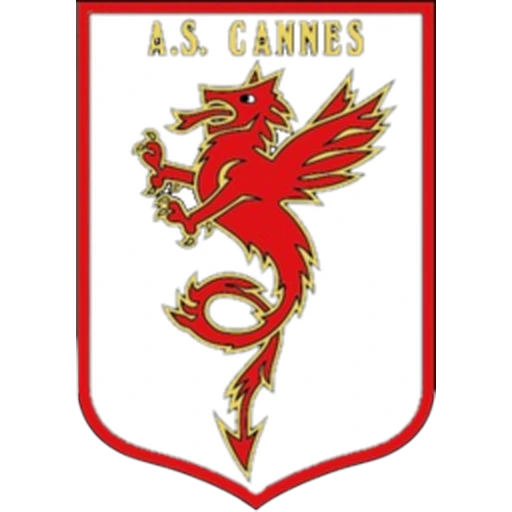
In 1970, AS Cannes adopted a completely new identity centred on the dragon, the symbol that would become inseparable from the club. The griffin disappeared, replaced by a large red dragon positioned within a white shield outlined in red. The club name "A.S. Cannes" appeared across the top, while the cleaner composition gave greater prominence to the dragon, reflecting the club's long-standing nickname, Les Dragons (The Dragons).
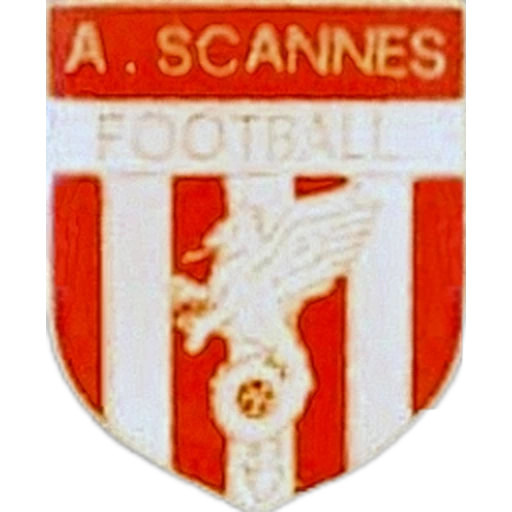
A decade later, in 1980, the badge was redesigned once more. The shield adopted the club's familiar vertical red-and-white stripes, with a white dragon placed over the central stripe beneath the inscription "A. SCANNES Football." The striped background strengthened the connection to the club's traditional playing colours, while the dragon remained the dominant element of the visual identity.
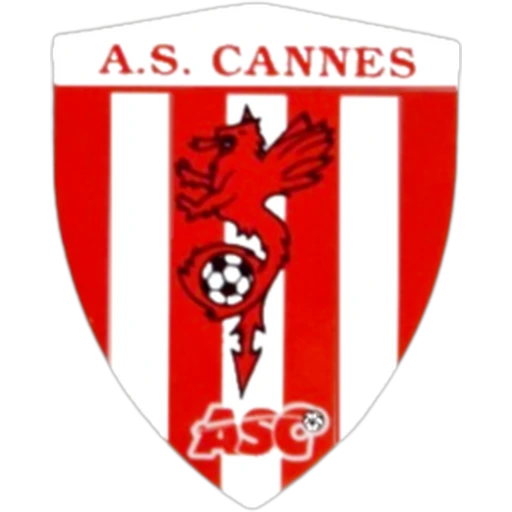
In 1990, the crest was refined rather than reinvented. The striped shield was retained, but the dragon returned to red, now holding a football, while the club initials ASC were added near the bottom of the badge. The redesign simplified the artwork and created a more balanced composition without departing from the identity established during the previous decade.
Another modernisation arrived in 1995. The shield became cleaner and predominantly white, with a bold red border. The dragon remained at the centre, while a large stylised ASC wordmark occupied the upper section of the badge. This redesign embraced the minimalist branding trends of the 1990s while preserving the dragon as the club's defining symbol.
In 2009, AS Cannes introduced a more contemporary interpretation of the 1995 design. The shield gained a double red outline, the initials ASC became larger and more prominent, and the words "Cannes 1902" were added above the badge to highlight the club's origins. The dragon was also redrawn with sharper, more dynamic lines, giving the crest a stronger and more modern appearance.
Since 2017, AS Cannes has used a refined version of the previous crest. The shield remains almost entirely white with a bold burgundy-red outline, while "AS Cannes" is displayed prominently across the top and "1902" is positioned at the base. The dragon has been simplified with cleaner, more elegant lines, creating a timeless identity that honours the club's history while adapting its visual identity for the modern era.
AS Cannes Club History
Founded on 4 August 1902 by English sportsman Herbert Lowe and a group of local enthusiasts, Association Sportive de Cannes is one of the oldest football clubs in France. Originally established as a multi-sport club, it quickly embraced football and adopted its now-famous red-and-white striped colours following a merger with Club Sportif de Cannes in 1905. During the 1920s, AS Cannes became one of the strongest clubs in southeastern France, regularly competing in the Ligue du Sud-Est and establishing itself as a major force before the advent of professionalism.
AS Cannes was among the founding members of professional French football in 1932 and enjoyed immediate success by winning the 1932 Coupe de France, defeating RC Roubaix in the final. The following season, the club finished runner-up in the inaugural Division 1 championship, narrowly missing out on becoming France's first professional league champions. Throughout the 1930s and 1940s, Cannes remained a respected top-flight club before spending much of the post-war period alternating between the first and second divisions.
The club experienced a remarkable revival during the late 1980s and early 1990s under president Francis Borelli and later Alain Pedretti. Promotion back to Division 1 in 1987 marked the beginning of a successful era in which AS Cannes became renowned for its outstanding youth academy. The club launched the careers of future stars including Zinédine Zidane, Patrick Vieira, Johan Micoud, Sébastien Frey, Gaël Clichy and Jonathan Zebina, earning a reputation as one of France's finest developer clubs. Cannes also enjoyed memorable UEFA Cup campaigns during this period, reaching the Round of 16 on two occasions.
Financial problems during the late 1990s brought an end to the club's golden era. Relegation from Ligue 1 in 1998 was followed by a gradual decline, culminating in the loss of professional status in 2004. Over the following years, AS Cannes competed in the lower divisions of French football while working to rebuild both on and off the pitch. Despite these setbacks, the club has retained its historic identity and remains one of the most respected names in French football thanks to its rich history and celebrated academy. In recent years, Cannes has enjoyed a resurgence, highlighted by deep runs in the Coupe de France and renewed ambitions to return to the professional ranks.
AS Cannes' biggest rivalry is with OGC Nice in the Derby de la Côte d'Azur, one of the oldest regional rivalries in French football. The fixture reflects the long-standing sporting competition between the neighbouring cities of Cannes and Nice and dates back to the clubs' early years in the regional championships. Matches against Olympique de Marseille have also historically carried significance, particularly during the era when all three clubs regularly competed in the French top flight.