Nickname(s):Peixe (The Fish), Alvinegro Praiano (The Black and White of the Beach)
Founded:1925
Stadium:Estádio Urbano Caldeira (Vila Belmiro)
Capacity:16,068
1912
1912 (2)
1912-1913
1912-1913 (2)
1913-1915
1915-1940
1940-1948
1948-1965
1965-1968
1968-1984
1984-1991
1991-2002
1991-2010
2002
2009
2010-2012
2011
2012-2023
2012
2025-Present
Santos FC Crest History
The crest history of Santos Futebol Clube reflects the development of one of Brazil's most famous football institutions. Although Santos is now inseparably associated with its black-and-white striped shield, the club experimented with several very different identities during its earliest years. From ornate monograms and globe-based emblems to the classic S.F.C. shield, the crest evolved alongside Santos's transformation from a local club into a global football name.
The first 1912 emblem consisted of an elaborate intertwined SFC monogram inside a blue circle. One version used gold lettering, while another presented the monogram in white. These early badges were considerably different from the black-and-white identity that would later define the club.
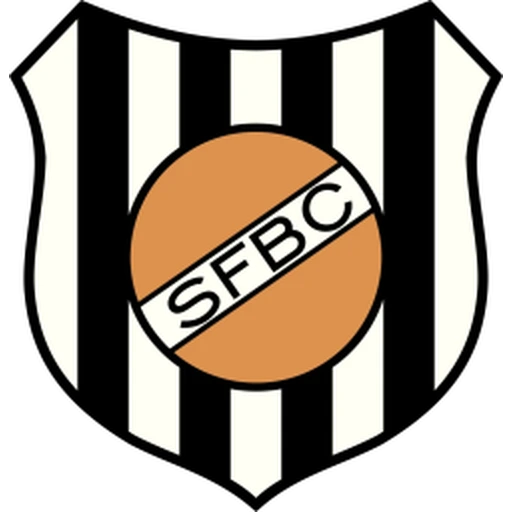
During 1912–1913, Santos experimented with its first striped shield. Vertical black-and-white stripes filled the background, while a brown football crossed by a white band containing SFBC appeared in the centre. The initials referred to the club's original full name, Santos Foot-Ball Club.
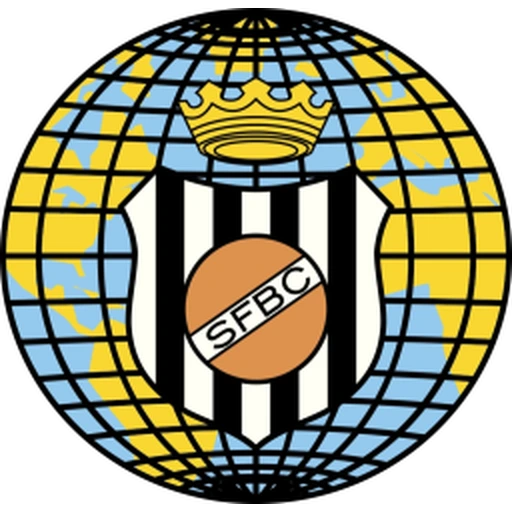
An alternative 1912–1913 emblem placed this striped shield inside an elaborate globe, topped by a crown. Blue and gold were prominent in the surrounding design, making it one of the most decorative crests ever associated with Santos.
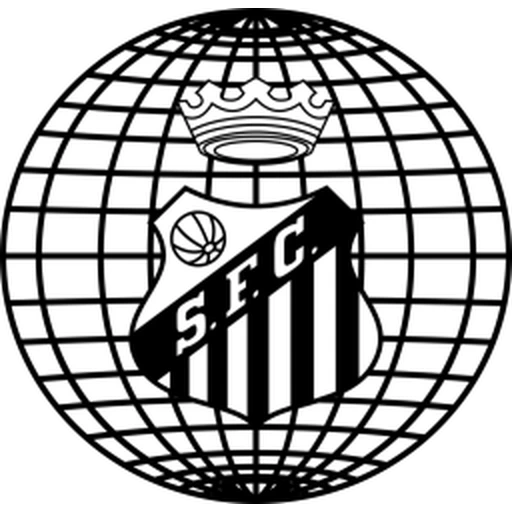
The 1913–1915 version retained the globe concept but simplified the colour palette to predominantly black and white. The striped Santos shield remained at its centre, while the globe and crown continued to give the badge an unusually elaborate appearance.
Between 1915 and 1940, the club temporarily competed under the name União Foot-Ball Club and used a completely different black shield. A diagonal white band carrying UNIÃO F.C. crossed the otherwise plain emblem. This identity was connected with Santos temporarily changing its name for participation in local competition rather than representing a permanent abandonment of the Santos name.
From 1940 to 1948, the club returned to a monogram-based design. A white shield contained a large intertwined black SFC monogram. The badge was simple and elegant, but it would soon give way to the visual identity that remains associated with Santos today.
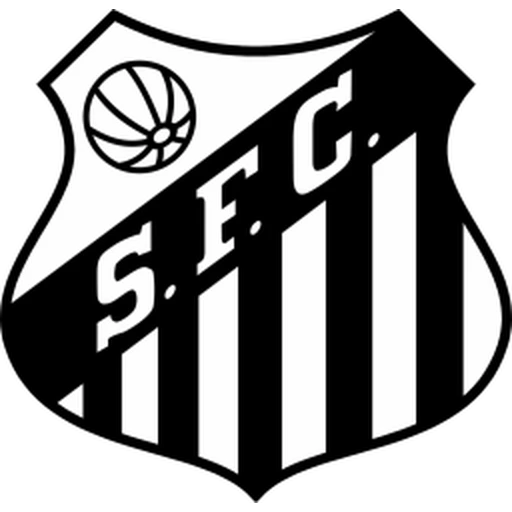
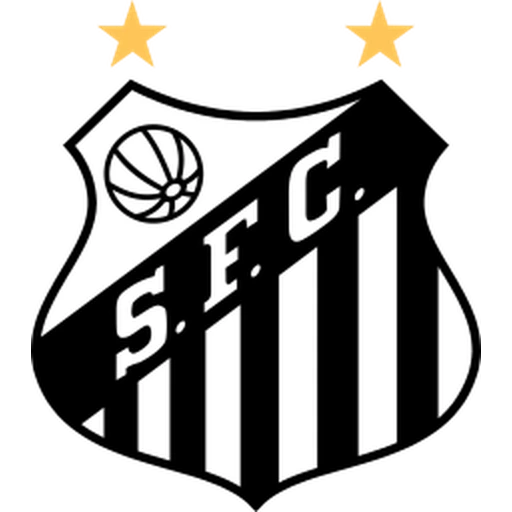
The decisive change came in 1948. The 1948–1965 crest introduced the classic Santos shield: vertical black-and-white stripes, a diagonal black band carrying S.F.C., and a football in the upper-left white section. This established the fundamental structure that has survived, with relatively minor modifications, into the twenty-first century.
Between 1965 and 1968, a gold star appeared above the traditional shield. By this period Santos had become one of the world's most celebrated clubs, led by Pelé and a generation that had accumulated major Brazilian and international honours.
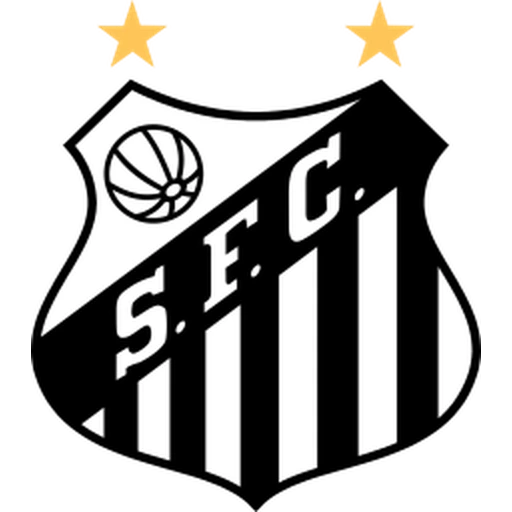
The 1968–1984 version displayed two gold stars above the crest, commemorating Santos's two world titles won in 1962 and 1963. The shield itself remained fundamentally unchanged, reinforcing how firmly the striped S.F.C. design had become established.
From 1984 to 1991, the crest continued with two stars while receiving subtle adjustments to its proportions and lettering. The football, diagonal S.F.C. band and vertical stripes remained the essential elements.
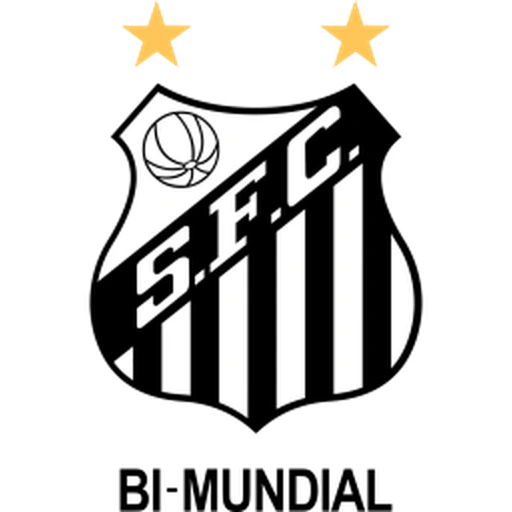
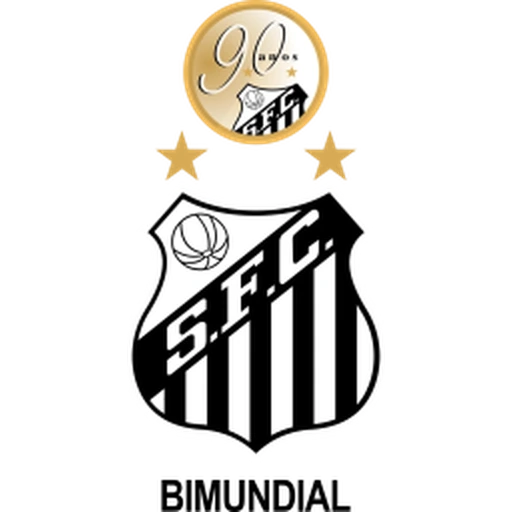
The 1991–2002 versions further refined the badge. The shield became slightly cleaner and more compact, while the two gold stars continued to represent the club's status as a two-time world champion, often expressed through the designation Bi-Mundial.
In 2002, Santos used a special commemorative presentation of the crest following another major championship-winning season. The traditional shield remained at the centre, accompanied by celebratory elements and the BIMUNDIAL designation beneath it.
A special 2009 emblem revived the historic circular SFC monogram from the club's earliest years. Presented in blue and gold, it served as a heritage-inspired alternative rather than replacing the established black-and-white shield as Santos's permanent identity.
Between 2010 and 2012, the traditional Santos crest continued with its two gold stars. The design remained remarkably close to the form first established in 1948, demonstrating the longevity of the club's core visual identity.
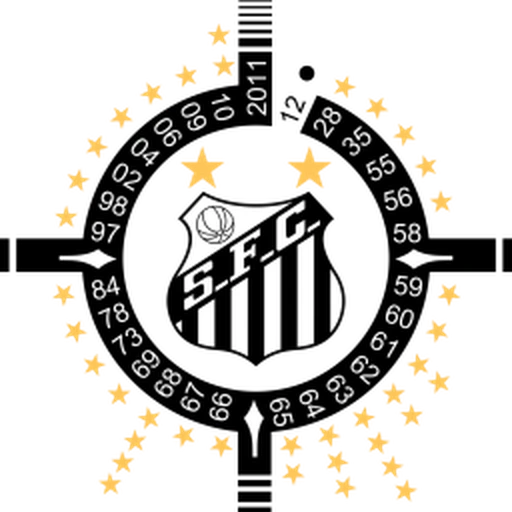
Santos introduced a special commemorative emblem in 2011, celebrating the club's extraordinary history and achievements. The traditional shield was surrounded by an elaborate graphic composition referencing important years and honours, creating one of the most complex commemorative designs in the club's history.
The club's centenary in 2012 produced another special presentation. The familiar shield was accompanied by 1912–2012, a crown and the two gold stars, commemorating one hundred years since the foundation of Santos Futebol Clube.
From 2012 to 2023, Santos returned to a clean version of its traditional shield with two gold stars above it. The black-and-white stripes, football and diagonal S.F.C. band remained essentially unchanged, preserving one of the most recognisable crests in South American football.
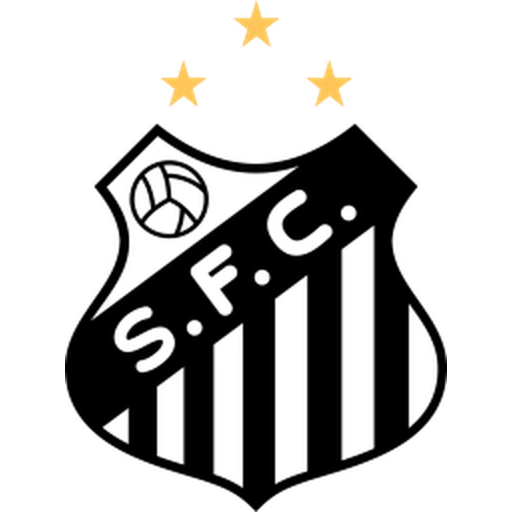
Since 2023, the crest has incorporated a gold crown above the shield, positioned between the two stars. The crown was introduced in honour of Pelé, who died in December 2022 and whose career is inseparably connected with Santos. It symbolically recognises O Rei — The King — while leaving the historic S.F.C. shield itself intact.
Santos FC Club History
Santos Futebol Clube was founded on 14 April 1912 in the port city of Santos, in the state of São Paulo. Created by a group of local sportsmen who wanted the city to have a strong football club of its own, Santos adopted black and white as its colours and gradually became known as the Peixe (The Fish) because of its close association with the coastal city.
Santos spent its early decades developing within São Paulo football, becoming a regular participant in the Campeonato Paulista. The club won its first major state championship in 1935, establishing itself among the leading teams of São Paulo, although its greatest period would not arrive until two decades later.
The transformation began during the 1950s. Santos won the Campeonato Paulista in 1955 and 1956, and in 1956 a teenage Pelé joined the first team. His emergence coincided with the development of one of the greatest generations in football history, alongside players such as Pepe, Zito, Coutinho, Gilmar and Mauro Ramos.
Between the late 1950s and the mid-1960s, Santos became the dominant force in Brazilian football. The club won numerous Campeonato Paulista titles and captured the Taça Brasil five consecutive times from 1961 to 1965, establishing an extraordinary level of domestic supremacy.
Santos's greatest international achievements came in 1962 and 1963. In 1962, the club won its first Copa Libertadores, defeating Peñarol, before overcoming Benfica in the Intercontinental Cup. Pelé famously scored a hat-trick in the second leg in Lisbon as Santos became world champion for the first time.
The achievement was repeated in 1963. Santos successfully defended the Copa Libertadores against Boca Juniors and then defeated AC Milan in the Intercontinental Cup. Consecutive South American and world titles established Santos as one of the most celebrated clubs on the planet.
During this period, Santos travelled extensively around the world, playing exhibition matches in Europe, Africa, Asia and the Americas. The combination of Pelé's international fame and the team's attacking style transformed Santos from a Brazilian club into a global football attraction. Few club sides of the era enjoyed comparable international recognition.
Santos continued winning major honours during the remainder of the 1960s, including the 1968 Torneio Roberto Gomes Pedrosa, one of the competitions later recognised as part of Brazil's national championship history. However, the departure and eventual retirement of members of the legendary generation brought the extraordinary golden era to an end.
The following decades were more inconsistent, although Santos continued producing outstanding footballers. The club won important state titles and reached the 1983 Brazilian championship final, losing to Flamengo. Despite periods without major national trophies, Santos retained its reputation for developing technically gifted attacking players.
A major revival occurred at the beginning of the twenty-first century. A young team featuring Robinho and Diego captured the 2002 Campeonato Brasileiro, ending a long wait for a major national championship. Santos won the Brazilian title again in 2004, confirming its return to the forefront of the domestic game.
Another exceptional generation emerged around Neymar. Together with players such as Ganso, Neymar helped Santos win the 2010 Copa do Brasil and the 2011 Copa Libertadores, defeating Peñarol in the final. It was the club's third Libertadores title and its first since the Pelé era.
Winning the Libertadores took Santos to the 2011 FIFA Club World Cup, where it reached the final against Barcelona. Santos was defeated 4–0, but the campaign confirmed the club's return to the highest level of international competition. The Neymar generation also won three consecutive Campeonato Paulista titles between 2010 and 2012 and the 2012 Recopa Sudamericana.
Santos's most historic rivalry is with Corinthians, a fixture known as the Clássico Alvinegro, reflecting the black-and-white colours shared by both clubs. The rivalry has produced numerous decisive encounters in São Paulo and national football. Santos also contests major classics with Palmeiras in the Clássico da Saudade and with São Paulo in the San-São. Together, these rivalries form an important part of the traditional four-club landscape of São Paulo football.
The club entered a difficult period during the early 2020s. Financial problems, instability and disappointing performances culminated in 2023, when Santos was relegated from Brazil's top division for the first time in its history. It was an extraordinary moment for a club that had previously been one of the few Brazilian giants never to have suffered relegation.
The response was immediate. Santos competed in Série B in 2024, won the championship and secured promotion at the first attempt. The achievement returned the Peixe to Série A for 2025, beginning another chapter in the club's long history.