Belgian Football Matricule Numbers
How a number became the heart and indentity of a football club
Why Matricule Numbers Matter in Belgian Football
In Belgian football, a club is more than its name, colours, stadium or collection of trophies. Behind every club stands a matricule number: a unique registration number that can survive name changes, mergers, relocations and financial crises.
To outsiders, it may appear to be little more than an administrative detail. To Belgian football supporters, however, a matricule can represent history, legitimacy and belonging.
The lower the number, the older and more prestigious it is considered to be. Losing it can feel like losing the club itself.
More Than Just a Number
Every football club affiliated with the Royal Belgian Football Association receives its own matricule number.
The system is unusual because the number does not simply identify the organisation administratively. Over time, it has become closely connected to the club’s sporting rights, history and perceived identity.
A club can change its name, redesign its crest, move to another stadium or absorb another organisation while continuing under the same matricule. In the eyes of many supporters, the number forms the unbroken legal line connecting the modern club to its past.
When a matricule disappears, that continuity is broken.
This is why discussions about Belgian football history can become surprisingly emotional. Two clubs may use similar names, colours and crests, yet supporters can still argue that they are not the same club because they do not share the same number.
The Birth of the Matricule System
Matricule numbers were introduced in 1926 by the Belgian Football Association. The first official list appeared in La Vie Sportive on 21 December 1926 and contained 869 affiliated organisations. The system was developed under Alfred Verdyck, secretary-general of the Belgian Football Association and a former player, coach and administrator at Royal Antwerp Football Club.
The existing clubs were numbered according to the date on which they had registered with the association. Royal Antwerp received matricule number 1, Club Brugge number 3 and RFC Liège number 4.
The numbers were not based purely on the dates on which the clubs claimed to have been founded. Several early sporting associations had existed before creating a football section, while historical registration records were not always complete. Nevertheless, the new system established an official hierarchy. The lowest numbers became highly visible symbols of seniority.
Why Royal Antwerp Wears Number 1
Royal Antwerp Football Club is generally recognised as Belgium’s oldest surviving football club and was awarded matricule number 1.
The club’s origins date to 1880, although its football section developed several years later. Because Antwerp was the first surviving club registered with the national association when the numbers were distributed, it received the most prestigious number.
The connection between Antwerp and number 1 became especially powerful. The club incorporated it into its identity and supporters continue to take great pride in being the country’s “Great Old”.
There has been historical debate over whether football was played earlier by clubs or sporting associations in Brussels. But the matricule system created an official version of history, and within that system Royal Antwerp stands first.
When a Number Determines a Club’s Future
A matricule traditionally represented more than heritage. It also determined the sporting position from which a club could compete. When two clubs merged, the new organisation normally had to select one of their matricule numbers. The chosen number continued, together with its competition rights, while the other was usually surrendered.
This meant that sporting history could disappear through what appeared to be a simple administrative decision.
In other cases, clubs adopted the number of another organisation to gain access to a higher division or preserve a historic identity. Matricules could effectively become valuable football assets. The result was a uniquely Belgian mixture of tradition, administration and negotiation.
Number Lost through Mergers
Several of Belgium’s earliest matricule numbers disappeared because of mergers.
Matricule 2 originally belonged to Daring Club de Bruxelles. In 1973, Daring merged with Racing White to form Racing White Daring Molenbeek. The new club continued under Racing White’s matricule 47, while the historic number 2 disappeared.
Royal Uccle Sport’s number 15 was lost when the club became part of Léopold. Matricule 17 disappeared when the original RFC Seraing was absorbed by Standard de Liège in 1996.
Tilleur’s historic number 21 vanished following an unsuccessful merger process involving RFC Liège. Matricule 23, carried by another club that later used the RFC Seraing name, disappeared in 2014.
In each case, a club name could later return. The supporters, colours and stadium might also survive. But without the original matricule, the question remained: was it still the same club?
The Curious Journey of Matricule 6
One of the most remarkable stories concerns matricule 6.
The number originally belonged to Racing Club de Bruxelles, one of the leading clubs during the early years of Belgian football. When Racing prepared to merge with White Star in 1963, the new organisation decided to continue under White Star’s matricule 47.
Instead of allowing number 6 to disappear, it was transferred to K. Sport Sint-Genesius-Rode, which previously held matricule 1274.
Through later mergers and name changes, the number eventually became associated with KFC Rhodienne-De Hoek.
The modern club has no direct geographical connection to the original Racing Club de Bruxelles, yet it carries one of the oldest numbers in Belgian football. It demonstrates how the administrative history of a matricule can follow a different path from the sporting and cultural history of a club.
Beerschot and the Battle for Number 13
Few matricule debates have produced as much emotion as the story of Beerschot.
The original Beerschot carried matricule 13 and won seven Belgian league championships. It was closely connected to the Olympisch Stadion, better known as ’t Kiel, and developed one of the most distinctive identities in Belgian football.
In 1999, the historic club disappeared following financial problems. Germinal Ekeren moved to the Kiel, adopted the Beerschot name and continued under matricule 3530.
When that organisation also collapsed in 2013, supporters helped build another successor around KFCO Wilrijk. The club adopted the Beerschot name, colours and stadium, but initially played under Wilrijk’s matricule 155.
For some supporters, Beerschot had returned. For others, the historic connection remained incomplete.
That changed when the club acquired the original matricule 13. From 1 July 2019, Beerschot once again played under the number associated with its historic predecessor.
Administratively, the number had returned. Emotionally, many supporters felt that an essential part of the club had finally come home.

Oud-Heverlee Leuven Reclaims Number 18
Oud-Heverlee Leuven provides another example of a recovered matricule.
The club was created in 2002 through the merger of Stade Leuven, Daring Club Leuven and Zwarte Duivels Oud-Heverlee. The new organisation initially continued under the latter club’s matricule 6142.
Stade Leuven, however, had carried the historic number 18.
After sixteen years under matricule 6142, OH Leuven reclaimed number 18 in July 2018. The decision allowed the modern merger club to reconnect itself with the oldest strand of Leuven’s football history.
It also showed that a matricule could be more than a legal registration. It could be used deliberately to strengthen a club’s identity and historical narrative.
At club level, English teams later enjoyed remarkable European success, particularly during the late 1970s and early 1980s.
But serious problems were developing away from the pitch.

The Return of Matricule 2
The most recent remarkable development concerns one of the oldest numbers of all.
Matricule 2 had disappeared in 1973 when Daring Club de Bruxelles merged into Racing White Daring Molenbeek. For more than half a century, one of Belgium’s most prestigious numbers was absent from competitive football.
In 2025, the number was brought back into use by the Brussels club now known as RWDM Brussels.
Its return reconnects the modern organisation with the history of Daring and the wider football tradition of Molenbeek. It also changes the historical overview of Belgium’s oldest matricules: number 2 can no longer be presented simply as a lost number.
Like numbers 13 and 18, it has been given a new chapter.
Does the Matricule Define the Club?
The Belgian system raises a difficult question: what truly defines a football club? Is it the legal organisation and its registration number? Or is it the name, colours, stadium, supporters and collective memory?
Beerschot supporters continued to gather at the Kiel even when the club carried a different number. The emotional identity remained recognisable, despite the administrative breaks.
The same applies to many Belgian clubs that have experienced mergers, bankruptcies and restarts. Supporters frequently preserve traditions that no official document can fully capture.
A matricule provides a legal and historical line, but a football club also exists through people. Its identity is carried in songs, stories, symbols and memories passed between generations.
That is why arguments about matricules rarely produce one definitive answer. They combine facts with emotion.
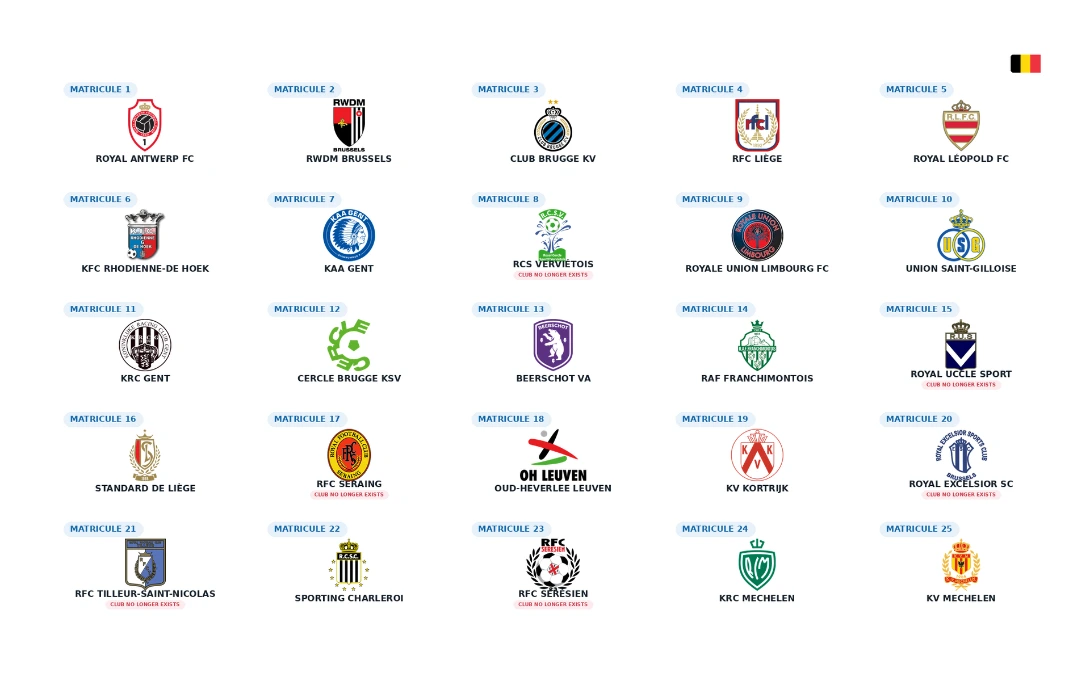
The 25 Oldest Belgian Matricule Numbers
The first 25 numbers tell a condensed history of Belgian football.
They include famous champions such as Royal Antwerp, Club Brugge, Union Saint-Gilloise, Standard de Liège and KV Mechelen. They also include smaller clubs that preserve an extraordinary link to the earliest years of the organised game.
Other numbers belong to clubs that disappeared through bankruptcy, dissolution or merger.
In the overview below, each active matricule is represented by the current logo of its holder. When a club no longer exists, its last known crest is shown together with the label Club No Longer Exists.
The competition in which a club currently plays is deliberately omitted. Divisions change from season to season; the matricule is intended to tell a much longer story.
More Than Administration
Belgian matricule numbers were created to organise football clubs. Almost a century later, they have become part of the culture of the game.
They determine historical continuity, survive changes of name and inspire debates that can last for generations. Some are proudly displayed inside stadiums, on shirts, scarves, crests and pin badges. Others remain attached to clubs that have long since disappeared.
A low matricule does not automatically make a club more successful. Nor can a number alone preserve everything a football club represents.
But in Belgian football, it carries something few administrative numbers possess: emotion. It can represent a beginning, a connection to the past and a claim to authenticity. Because sometimes, a football club’s entire history can be contained in a single number.
Collect a Piece of Belgian Football History
Every football badge tells a story. Discover our collection of Belgian football pin badges, featuring clubs from across the Belgian football pyramid, from famous national champions to historic lower-league and local clubs.