Historical Crests Venezia FC
Name: Venezia FC
Nickname(s): I Leoni Alati (The Winged Lions)
Founded: 1907 (Refounded 2005, 2009, 2015)
Stadium: Pier Luigi Penzo (Venezia)
Capacity: 11,150
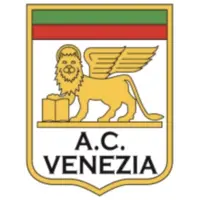
1989-2005
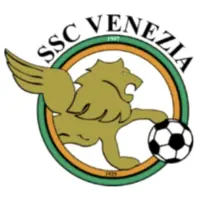
2005-2009
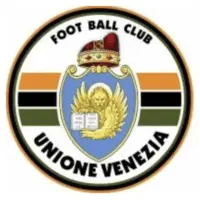
2009-2011
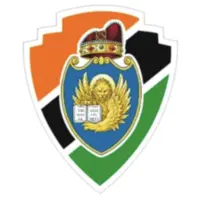
2011-2013
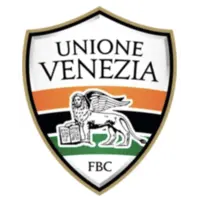
2013-2015
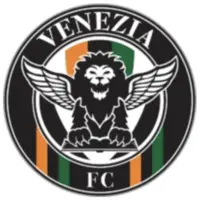
2015-2022

2022-Present
Venezia FC Crest History
Throughout its history, Venezia's crest has been defined by one of the most iconic civic symbols in Europe: the Winged Lion of Saint Mark. The lion, representing both the Republic of Venice and Saint Mark the Evangelist, has appeared in various forms on the club's badges for decades and remains inseparable from the identity of both the club and the city.
A major transformation occurred in 1987 when Venezia merged with mainland club AC Mestre. The merger introduced orange to the club's traditional black-and-green palette, creating the famous arancioneroverdi (orange-black-green) colours that remain synonymous with the club today. Subsequent crests incorporated all three colours alongside the Winged Lion, symbolising the union of Venice and Mestre.
Throughout the 1990s and 2000s, Venezia used a series of circular and shield-shaped badges featuring increasingly detailed versions of the Winged Lion. These crests generally displayed the lion in gold or white together with the club name and the black, green and orange colours. During this period, the lion became firmly established as the club's primary symbol.
A redesigned crest was introduced in 2015 following the club's rebirth after financial difficulties. The badge adopted a circular shape featuring a stylised Winged Lion positioned above a prominent orange-and-green letter V. The design successfully combined traditional Venetian symbolism with a modern football identity and quickly became associated with the club's return to prominence.
The most radical redesign in the club's history arrived in 2022. Venezia abandoned the traditional circular badge and introduced a minimalist V-shaped crest. The new logo integrated a modern interpretation of the Lion of Saint Mark directly into the shape of the letter V, creating a distinctive and highly contemporary identity.
The lion returned to a prominent gold colour, while the upper orange and green elements represented Venetian banners and flags. The horizontal lines forming the lion's wings were also designed to evoke the shape of the iron prow, or ferro, found on traditional Venetian gondolas. The result was a crest that blended football, architecture, maritime history and modern graphic design into a single symbol.
Venezia FC Club History
Founded on 14 December 1907, Venezia Football Club was created through the merger of two Venetian sporting societies, Palestra Marziale and Costantino Reyer. From its earliest days, the club adopted the colours black and green, which would remain central to its identity for decades. Representing one of the world's most famous cities, Venezia quickly became the leading football club of the Venetian lagoon.
The greatest achievement in the club's history came during the 1940–41 season, when Venezia won the Coppa Italia, defeating Roma in the final. The triumph remains the club's most important major trophy and secured Venezia's place in Italian football history.
The following season proved equally remarkable. In 1941–42, Venezia finished third in Serie A, the highest league finish in club history. Led by legendary figures such as Valentino Mazzola, who would later become a star of Grande Torino, Venezia established itself among the strongest teams in Italy.
Throughout the 1960s and 1970s, Venezia experienced several promotions and relegations. Although success became less frequent, the club maintained a loyal following and continued to represent the unique identity of Venice within Italian football.
A major turning point arrived in 1987, when Venezia merged with mainland club AC Mestre. The union introduced the colour orange to the traditional black-and-green palette, creating the famous arancioneroverdi colours that continue to define the club today. The merger also strengthened the club's connection to both Venice and the mainland communities surrounding the city.
The 1990s brought renewed success. Under the ownership of Maurizio Zamparini, Venezia returned to Serie A in 1998 after more than three decades away from the top flight. The promotion marked the beginning of one of the most memorable periods in modern club history.
During this era, Venezia featured notable players such as Álvaro Recoba, Filippo Maniero, Arturo Di Napoli and Massimo Taibi. Recoba, on loan from Inter, became particularly beloved by supporters thanks to a series of spectacular performances that helped Venezia avoid relegation during the 1998–99 season.
Despite moments of success, financial instability became a recurring problem. The club experienced multiple bankruptcies, restructurings and changes of ownership throughout the early twenty-first century. Several times, Venezia was forced to restart from lower divisions while fighting to preserve its identity and traditions.
A significant rebirth occurred in 2015, when a new ownership group revitalised the club. Venezia adopted a modern vision that combined football, culture and design, helping the club attract international attention while steadily progressing on the pitch.
Success followed quickly. The club won promotion from Serie D to Serie C, then to Serie B, and eventually secured a return to Serie A in 2021 after defeating Cittadella in the promotion play-off final. The achievement represented one of the most remarkable recoveries in modern Italian football.
Another historic moment arrived in 2024, when Venezia secured promotion back to Serie A, demonstrating the club's ability to compete despite limited resources compared to many of its rivals.
Venezia plays its home matches at the Stadio Pier Luigi Penzo, located on the island of Sant'Elena within the Venetian lagoon. Opened in 1913, it is one of the oldest stadiums in Italy and one of the most unique football venues in the world, accessible primarily by boat and surrounded by the waters of Venice.
Historically, Venezia's fiercest rivalry is with Hellas Verona in the Derby del Veneto, one of the most important regional rivalries in northern Italy. Strong rivalries also exist with Padova, Treviso, Vicenza and Mestre, reflecting decades of competition within the Veneto region.
Venezia FC Pins
Your Dynamic Snippet will be displayed here... This message is displayed because you did not provide enough options to retrieve its content.