Historical Crests UC Sampdoria
Name: UC Sampdoria
Nickname(s): I Blucerchiati (The Blue-circled)
Founded: 1946
Stadium: Stadio Luigi Ferraris (Genua)
Capacity: 36,536

1946-1947
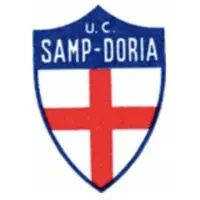
1947-1949
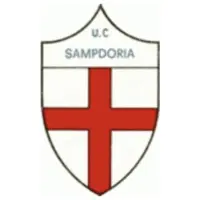
1949-1953
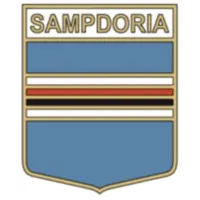
1953-1961

1961-1962
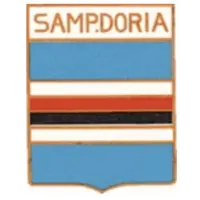
1962-1965
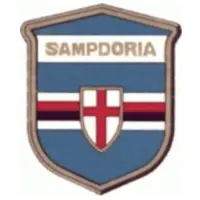
1965-1966
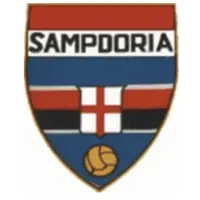
1966-1971

1971-1977
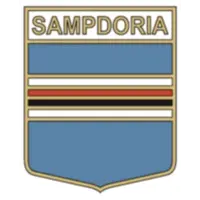
1977-1980
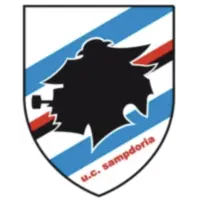
1980-1997

1997-Present
UC Sampdoria Crest History
Throughout its history, Sampdoria's crest has been one of the most distinctive and instantly recognisable in world football. Sampdoria built its identity around the image of Baciccia, a stylised profile of a traditional Genoese sailor. Combined with the club's famous blucerchiati colours, the sailor has become one of the most unique symbols in Italian football.
The club was founded in 1946 through the merger of Sampierdarenese and Andrea Doria, and the first badges naturally reflected the identities of the two predecessor clubs. Early emblems incorporated the colours inherited from both sides: the white and blue of Andrea Doria together with the red, black and white elements of Sampierdarenese.
A major breakthrough arrived during the late 1970s and early 1980s, when Sampdoria introduced the symbol that would define the club for generations: Baciccia. The figure depicts a bearded Genoese sailor smoking a pipe, shown in profile wearing a traditional seafarer's cap. The design reflected Genoa's maritime history and gave the club an identity unlike any other in football.
The most iconic version of the crest emerged during the 1980s, coinciding with the most successful era in the club's history. The badge featured the black silhouette of Baciccia placed within a shield displaying the club's famous blue, white, red and black horizontal stripes. This design accompanied Sampdoria through its golden age and became inseparable from the achievements of that period.
Throughout the late 1980s and early 1990s, the crest became internationally recognised as Sampdoria established itself among Europe's elite clubs. The badge was worn during the club's Serie A title-winning season in 1990–91, its four Coppa Italia triumphs during the decade, and its run to the 1992 European Cup Final at Wembley.
Unlike many clubs that repeatedly modernised their identities, Sampdoria chose continuity. During the 1990s and 2000s, only minor refinements were made to the crest. The proportions of the shield, typography and graphic details were occasionally adjusted, but Baciccia remained the undisputed centrepiece of the club's visual identity.
UC Sampdoria Club History
Founded on 12 August 1946, Unione Calcio Sampdoria was created through the merger of two historic Genoese clubs: Sampierdarenese and Andrea Doria. The new club inherited the colours of both predecessors, creating the famous blucerchiati shirt, a unique blue jersey featuring white, red and black horizontal bands across the chest. This distinctive design remains one of the most iconic kits in world football.
Based in the port city of Genoa, Sampdoria quickly established itself as an important force in Italian football. The club plays its home matches at the Stadio Luigi Ferraris, which it shares with city rivals Genoa CFC. Matches between the two sides are known as the Derby della Lanterna, named after Genoa's famous lighthouse and considered one of Italy's most passionate and historic rivalries.
The first major trophy in the club's history arrived in 1985, when Sampdoria won the Coppa Italia. This success marked the beginning of the greatest era the club has ever experienced. Under president Paolo Mantovani, Sampdoria assembled a talented squad featuring players such as Roberto Mancini, Gianluca Vialli, Pietro Vierchowod, Toninho Cerezo, Attilio Lombardo and later Gianluca Pagliuca.
Throughout the 1980s and early 1990s, Sampdoria became one of Italy's strongest clubs. The team won multiple Coppa Italia titles and established itself among the elite of European football. The partnership between Mancini and Vialli, known as "The Goal Twins," became one of the most celebrated attacking duos of the era.
The pinnacle of Sampdoria's history came during the 1990–91 season, when the club won its first and only Serie A title under legendary coach Vujadin Boškov. The Scudetto remains the greatest achievement in the club's history and secured Sampdoria's place among the champions of Italian football.
Following the league triumph, Sampdoria continued to compete at the highest level. In 1992, the club reached the European Cup Final at Wembley Stadium, facing FC Barcelona. Although Sampdoria lost 1–0 after extra time to a Ronald Koeman free kick, reaching the final represented the greatest European achievement in the club's history.
The club added another major honour in 1994 by winning the Coppa Italia, bringing its total to four victories in the competition during its golden era. These successes established Sampdoria as one of the most admired teams in Europe during the late twentieth century.
After the departure of many key players and the death of president Paolo Mantovani, the club gradually declined during the second half of the 1990s. Relegation from Serie A followed in 1999, ending a remarkable period that had transformed Sampdoria into one of Italy's most successful clubs.
The early 2000s were spent rebuilding. Promotion back to Serie A was achieved in 2003, and Sampdoria quickly re-established itself in the top flight. During this period, players such as Francesco Flachi, Fabio Quagliarella, Antonio Cassano and Giampaolo Pazzini became fan favourites.
One of the club's most memorable modern seasons came in 2009–10, when Sampdoria finished fourth in Serie A and qualified for the UEFA Champions League for the first time in its history. However, the success proved difficult to sustain, and the club suffered relegation the following season.
Sampdoria returned to Serie A in 2012 and spent the next decade competing primarily in the top division. Despite occasional financial difficulties and ownership changes, the club remained one of the most recognised names in Italian football.
A major crisis emerged in the early 2020s, as financial instability and sporting struggles culminated in relegation from Serie A in 2023. New ownership subsequently arrived, providing stability and helping preserve the future of the club.
UC Sampdoria Pins
Your Dynamic Snippet will be displayed here... This message is displayed because you did not provide enough options to retrieve its content.