The crest history of İstanbul Başakşehir FK reflects the club's transformation from a municipal sports organisation into an independent and successful professional football club. Its visual identity changed dramatically in 2014, when the former orange-and-blue municipal emblem was replaced by the distinctive shield and stylised "B" associated with Başakşehir today.
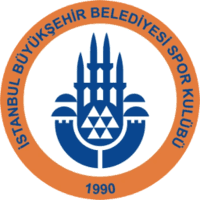
Between 1991 and 2014, when the club competed as İstanbul Büyükşehir Belediyesi Spor Kulübü (İstanbul BB), it used a circular orange, white and blue crest. The full municipal club name surrounded the badge, while the centre contained a stylised representation of Istanbul, including mosque minarets and architectural elements. The year 1990, referring to the club's foundation, appeared at the bottom.
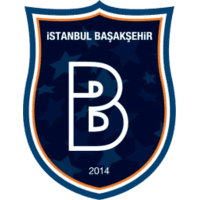
A major transformation took place in 2014 when the football section separated from its former municipal identity and was reorganised as İstanbul Başakşehir Futbol Kulübü. A completely new crest accompanied the change. The circular municipal badge disappeared and was replaced by a modern dark-blue shield with orange trim.
At the centre of the new badge was a distinctive intertwined "B" monogram, representing Başakşehir. The words "İstanbul Başakşehir" appeared across the top, while 2014 was placed at the bottom. Importantly, 2014 represents the beginning of the club's Başakşehir FK identity, rather than its original historical foundation.
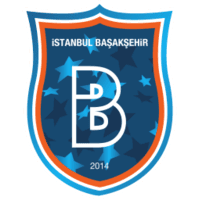
In 2016, the crest received a visual refinement. The basic shield and monogram remained unchanged, but the colours became brighter, with turquoise-blue tones introduced alongside the traditional dark blue and orange. A subtle pattern of stars was also incorporated into the background, giving the badge a more contemporary appearance.
Istanbul Başakşehir FK Club History
Founded in 1990, İstanbul Başakşehir FK is one of the youngest clubs to establish itself among the leading teams in Turkish football. The club originated as İstanbul Büyükşehir Belediyesi Spor Kulübü, representing the Istanbul Metropolitan Municipality, and spent its early decades progressing through the Turkish football pyramid before developing into a regular top-flight competitor.
The club first reached the Süper Lig in 2007 under the name İstanbul Büyükşehir Belediyespor. Unlike Istanbul's traditional giants Galatasaray, Fenerbahçe and Beşiktaş, the municipal club had a relatively small supporter base, but developed a reputation for strong organisation and for being a difficult opponent for Turkey's established powers.
After several seasons in the Süper Lig, the club was relegated in 2013. It responded immediately, winning promotion from the TFF First League in 2013–14 and returning to the top division after only one season.
A major turning point came in 2014. The football operation was reorganised and renamed İstanbul Başakşehir Futbol Kulübü, creating a new identity centred on the rapidly developing Başakşehir district of Istanbul. The club adopted its distinctive orange and blue colours and moved into the newly built Başakşehir Fatih Terim Stadium. Although the modern identity dates from 2014, the club traces its institutional history back to the municipal club founded in 1990.
Başakşehir rapidly emerged as a serious challenger to Turkey's traditional football hierarchy. Under coach Abdullah Avcı, the club consistently finished near the top of the Süper Lig and qualified regularly for European competition. In 2016–17, Başakşehir finished second in the league and also reached the Turkish Cup final, confirming its position among the country's leading teams.
The greatest achievement in the club's history came during the 2019–20 season. Managed by former Turkish international Okan Buruk, Başakşehir won its first Süper Lig championship, breaking the dominance of Turkey's traditional giants. The achievement made Başakşehir only the sixth club in Turkish football history to become national league champion.
The championship earned the club direct qualification for the 2020–21 UEFA Champions League group stage. Başakşehir faced Paris Saint-Germain, RB Leipzig and Manchester United, recording a famous 2–1 home victory over Manchester United, one of the most memorable European results in the club's history.
A number of internationally recognised players have represented Başakşehir during its rise, including Emre Belözoğlu, Edin Višća, Demba Ba, Emmanuel Adebayor, Gaël Clichy, Martin Škrtel and Robinho. Long-serving Bosnian winger Edin Višća became particularly associated with the club's transformation into a championship contender.
Unlike Istanbul's historic clubs, Başakşehir does not possess a century-old traditional rivalry. Matches against Galatasaray, Fenerbahçe and Beşiktaş nevertheless became increasingly important as Başakşehir began competing directly with the Big Three for league titles and European places.