Historical Crests Sheffield Wednesday FC
Name: Sheffield Wednesday FC
Nickname(s): The Owls
Founded: 1867
Stadium: Hillsborough (Sheffield)
Capacity: 39,732
Sheffield Wednesday FC Crest History
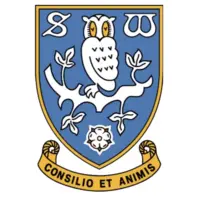
Reflecting the club’s nickname, “The Owls,” the bird has featured prominently on Sheffield Wednesday crests for more than a century and remains the defining emblem of the club today.
The origins of the owl symbol lie in the club’s long association with the Sheffield suburb of Owlerton, where the team played for many years. Over time, supporters began referring to the club as “The Owls,” and the bird naturally became an important part of the club’s visual identity.
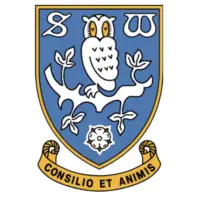
The first widely recognised Sheffield Wednesday crest featured a stylised owl perched on a branch. Introduced during the mid-twentieth century, the design established the owl as the club’s primary symbol and created an identity that supporters quickly embraced.
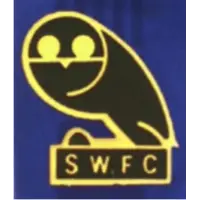
The first owl crest appeared in 1957, establishing the bird as the central symbol of Sheffield Wednesday. In 1970, the club introduced one of the most distinctive badges in English football, a minimalist owl designed by local art student Tom Blackshear. The modern design became closely associated with Sheffield Wednesday throughout the 1970s and 1980s.
A major redesign followed in 1995 when the club adopted a more traditional heraldic-style crest featuring a detailed owl within a shield. The badge was refined again in 1997, creating the version that became familiar during Sheffield Wednesday's Premier League years and remained in use for almost two decades.
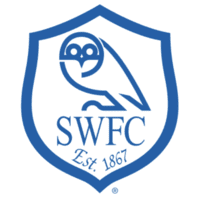
In 1999, Sheffield Wednesday revived the iconic minimalist owl badge first introduced in 1970. The design was placed within a shield and accompanied by the club initials and foundation year, 1867. This version remained the club's primary crest until 2016 and became one of the most recognisable badges in Sheffield Wednesday's modern history.
A significant change came in 2016 when Sheffield Wednesday announced a return to a modernised version of the classic owl crest. Inspired by the famous 1973 badge, the redesign simplified the artwork and restored the owl as the dominant visual element. The updated crest successfully blended tradition and modernity while reconnecting the club with one of the most popular symbols in its history.
Sheffield Wednesday FC Club History
Sheffield Wednesday Football Club is one of the oldest football clubs in the world. Formed in 1867 as an offshoot of The Wednesday Cricket Club, the club was originally created to provide sporting activity for cricketers during the winter months. The football club was officially established at a meeting held at the Adelphi Hotel in Sheffield on 4 September 1867 and was known simply as “The Wednesday” until adopting the name Sheffield Wednesday in 1929.
During its early years, Wednesday became one of the pioneers of organised football. The club won the Cromwell Cup in 1868, one of the earliest football competitions ever held, and later became a founding member of the Football Alliance in 1889 before joining the Football League in 1892.
Sheffield Wednesday quickly established itself as one of England’s leading clubs. The Owls won their first FA Cup in 1896 and enjoyed a golden era during the early twentieth century. Between 1903 and 1930, the club won four First Division titles and added further FA Cup victories in 1907 and 1935. These successes helped establish Wednesday as one of the most successful clubs of the pre-war era.
The club played at several grounds during its early history before moving to Owlerton in 1899. The stadium later became known as Hillsborough and remains Sheffield Wednesday’s home today. The move to the Owlerton district also gave rise to the club’s famous nickname, “The Owls,” which has remained part of its identity ever since.
Following the Second World War, Wednesday continued to compete at the highest levels of English football, although major honours became less frequent. The club remained a prominent force during the 1950s and early 1960s, spending much of the period in the First Division and maintaining its reputation as one of England’s traditional clubs.
The modern era has brought a mixture of promotions, relegations and memorable cup runs. Sheffield Wednesday was a founding member of the Premier League in 1992 and reached both domestic cup finals in 1993, finishing runners-up in the FA Cup and League Cup. Although silverware proved elusive, the club remained one of the most respected names in English football.
Throughout its history, Hillsborough has remained one of the most iconic stadiums in the country. The ground has hosted FA Cup semi-finals, international matches and some of the most important fixtures in English football history. It remains at the heart of Sheffield Wednesday’s identity and supporter culture.
The club’s fiercest rivalry is with Sheffield United. Matches between the two clubs are known as the Steel City Derby and are among the oldest and most passionate rivalries in English football. Wednesday also shares strong rivalries with Leeds United and Barnsley, but no fixture carries greater significance than the battle for supremacy within Sheffield itself.
Sheffield Wednesday FC
Your Dynamic Snippet will be displayed here... This message is displayed because you did not provide enough options to retrieve its content.