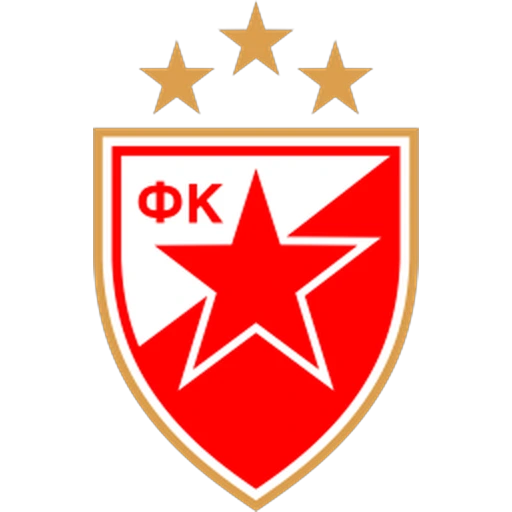
The crest of FK Red Star Belgrade has remained one of the most recognisable symbols in European football. Throughout the club's history, the iconic red five-pointed star has always been the centrepiece of the badge, representing both the club's name and its rich sporting tradition. While the design has been modernised over the decades, the famous red star has remained unchanged as the defining symbol of Red Star.
The club's first crest, used between 1945 and 1950, featured a red star combined with the figure of an athlete inside a circular emblem. Introduced immediately after the club's foundation, the badge reflected the ideals of the newly established sports society and symbolised strength, unity and progress in post-war Yugoslavia.
In 1950, Red Star adopted the classic shield-shaped crest that would become one of the most iconic emblems in European football. The badge featured a large red star inside a red-and-white shield bordered in gold, together with the Cyrillic initials "ФК" (FK). This design accompanied the club through decades of domestic dominance and international success.
A more modern interpretation appeared in 1995, introducing a blue circular background surrounding the traditional shield. Although the overall appearance changed significantly, the central red star and shield remained intact, preserving the club's historic identity during a new era of Serbian football.
In 2010, the club returned to the traditional shield while adding two gold stars above the crest to commemorate 20 national league championships. The redesign celebrated Red Star's historic achievements while restoring the classic appearance associated with the club's greatest successes.
Following continued domestic dominance, a third gold star was added in 2019, recognising the club's 30th national league title. The current crest retains the timeless red-and-white shield with the famous red star at its centre, now proudly topped by three gold stars, symbolising Red Star's status as Serbia's most successful football club.
FK Red Star Belgrade Club History
Founded in 1945, FK Red Star Belgrade (Crvena zvezda) is the most successful football club in Serbian history and one of the greatest clubs ever produced by Eastern Europe. Established shortly after the Second World War as part of the Red Star Sports Society, the club quickly became a symbol of Belgrade and Yugoslav football. Wearing its famous red and white colours, Red Star is affectionately known as "Crveno-beli" (The Red-Whites).
From its earliest years, Red Star established itself as one of the dominant forces in Yugoslav football, winning numerous league championships and domestic cups. Together with Partizan Belgrade, the club formed one of Europe's fiercest rivalries in the legendary Eternal Derby (Večiti derbi), a fixture that has defined Serbian football for generations.
During the 1970s and 1980s, Red Star became a regular contender in European competitions, building one of the strongest squads in the continent. The club's greatest triumph came in 1991, when Red Star defeated Olympique de Marseille in the European Cup Final in Bari after a dramatic penalty shoot-out, becoming the first and only Serbian club to win Europe's most prestigious club competition. Later that year, Red Star defeated Colo-Colo to win the Intercontinental Cup, officially becoming world club champions.
Following the breakup of Yugoslavia, Red Star remained the dominant force in Serbian football despite political instability, economic difficulties and international sanctions during the 1990s. The club continued to win domestic honours while rebuilding its reputation on the European stage.
Red Star has long been renowned for producing outstanding footballers through its youth academy. Club legends such as Dragan Džajić, Vladimir Petrović, Dejan Savićević, Robert Prosinečki, Dejan Stanković, Nemanja Vidić, and Aleksandar Kolarov all began or developed their careers at the club before achieving international success.
In recent years, Red Star has firmly re-established itself in European football. The club returned to the UEFA Champions League group stage in 2018, ending a 26-year absence from Europe's elite competition. Since then, Red Star has become a regular participant in the Champions League and Europa League, consistently representing Serbia at the highest level.
The club plays its home matches at the iconic Rajko Mitić Stadium, universally known as the Marakana because of its resemblance to Brazil's famous Maracanã Stadium. Home to one of Europe's most passionate supporter groups, the Delije, the stadium is renowned for its intimidating atmosphere and spectacular displays.
Red Star's greatest rivalry is with FK Partizan Belgrade in the Eternal Derby, one of the fiercest and most passionate rivalries in world football. Matches between the two clubs divide the Serbian capital and regularly attract enormous national and international attention.