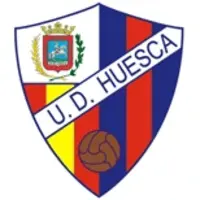
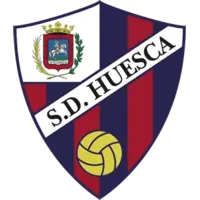
The earliest versions of the crest of SD Huesca featured a traditional shield design divided into sections that combined the club's blue-and-maroon colours with symbols associated with the city of Huesca. The most distinctive element was the mounted horseman, derived from the historic coat of arms of Huesca. This figure traces its origins to ancient representations connected to the city's Roman and Iberian past and has remained one of the most recognisable civic symbols in Aragón. By incorporating the horseman into its badge, SD Huesca immediately established a strong local identity rooted in the history of the city rather than solely in football tradition.
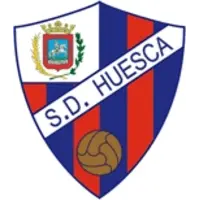
Throughout the latter decades of the twentieth century, the crest underwent a series of refinements rather than radical redesigns. As the club developed through the regional and lower national divisions, adjustments were made to the shield's proportions, typography and detailing. The fundamental structure, however, remained largely unchanged. The blue-and-maroon stripes continued to represent the club's colours, while the horseman remained the dominant symbol. This consistency helped distinguish Huesca from many clubs that repeatedly altered their visual identity during the same period.
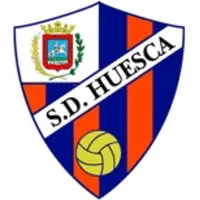
A notable update arrived around 1990, when the badge was modernised with cleaner lines and a more balanced composition. The redesign improved the clarity of the horseman and streamlined several heraldic details while preserving the traditional shield format. The changes reflected broader trends in football branding at the time, as clubs sought crests that reproduced more effectively across merchandise, publications and television broadcasts.
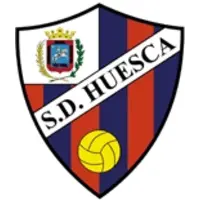
In 2015, the club unveiled a refreshed version of the crest that remains in use today. The update simplified several graphic details, enhanced the visibility of the horseman and improved the overall balance of the shield. The blue-and-maroon stripes became more prominent, and the lettering was refined to create a cleaner and more professional appearance. Despite these modernisations, the club deliberately preserved the core symbolism that had defined the badge for decades.
SD Huesca Club History
Sociedad Deportiva Huesca, S.A.D., is rooted in the historic city of Huesca, located in the autonomous community of Aragón. As early as 1903, Huesca was home to a pioneering football society known as Foot-ball Oscense, reflecting the city's long-standing connection to the game and establishing a footballing tradition that predates many clubs in Spain.
The modern club was founded on 29 March 1960 following the disappearance of earlier football institutions in the city, most notably Club Deportivo Huesca. SD Huesca inherited the footballing legacy of its predecessors and adopted the traditional blue-and-maroon colours that had become associated with football in the city. The club established its home at the Estadio El Alcoraz, a ground that would become central to its identity and remain its home throughout its history.
For much of the second half of the twentieth century, Huesca competed in Spain's regional divisions and lower national leagues.
A significant milestone arrived in 2008 when the club achieved promotion to the Segunda División for the first time in its history. Under the management of Antonio Calderón, Huesca secured a place in Spain's second tier and began competing regularly against some of the country's largest historic clubs. The achievement marked the beginning of a transformative period that elevated the club from regional obscurity to national prominence.
Following several seasons in the Segunda División, Huesca experienced both promotions and relegations, but continued to establish itself as a competitive professional club. The most important chapter in the club's history came during the 2017–18 season under manager Rubi. Playing an attractive and attacking style of football, Huesca finished second in the Segunda División and secured promotion to La Liga for the first time ever, becoming the smallest city represented in the Spanish top flight at the time.
The club's debut season in La Liga during 2018–19 was a landmark moment for both Huesca and Aragón. Although relegation followed after a single season, the experience significantly raised the club's profile. Huesca demonstrated resilience by earning promotion again in 2019–20 under Míchel, returning to the top division as Segunda División champions. The achievement confirmed that the club's first promotion had not been a one-off success but the result of sustained sporting growth.
The club's principal rivalry is with Real Zaragoza. Matches between the two sides are known as the Derbi Aragonés and represent the most important football rivalry in Aragón. Encounters with CD Teruel and other regional opponents also carry significance, but Zaragoza remains Huesca's traditional rival due to its status as the region's largest and most successful club.