Nickname(s):Armagoñak / Los Armeros (The Gunsmiths)
Founded:1940
Stadium:Estadio Municipal de Ipurúa (Eibar)
Capacity:8,164
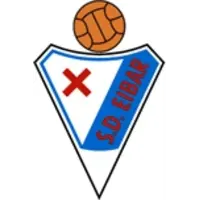
1941-1953
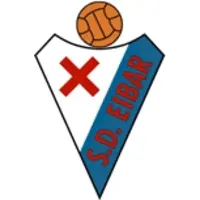
1953-1990
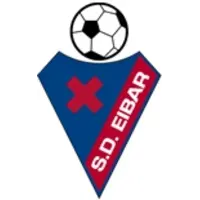
1990-1997
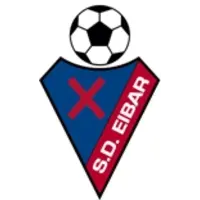
1997-2015
2015-Present
SD Eibar Crest History
Eibar’s crest has always emphasized its strong local identity and connection to the Basque community it represents.
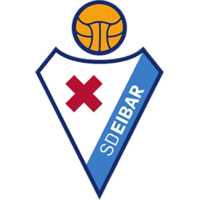
The earliest versions of the crest drew heavily from the coat of arms of Eibar. At the heart of the design was the Cross of Saint Andrew (San Andrés), one of the most recognizable symbols associated with the town. The red diagonal cross, inherited from the city’s heraldry, quickly became the defining element of the club’s badge and remains central to its identity today.
As the club developed during the mid-twentieth century, the crest evolved into a more formal shield design. The Cross of Saint Andrew was incorporated within a heraldic framework and combined with the club’s traditional blue-and-claret colours, which had been inspired by FC Barcelona and adopted shortly after the club’s formation. These colours became synonymous with Eibar and helped distinguish the badge from those of other Basque clubs.
A notable modernization arrived as Eibar entered the professional era and expanded its presence within Spanish football. The badge was simplified and standardized, featuring cleaner lines and more consistent proportions. These refinements improved the crest’s adaptability across merchandising, broadcasting and digital media without altering its historic identity.
Today, the badge remains one of the most authentic crests in Spanish football. The Cross of Saint Andrew, inherited from the city of Eibar, continues to occupy a central role, while the club’s blue-and-claret colours reinforce its historic identity. Together, these elements symbolize the town, the supporters and the values of humility, resilience and community spirit that have defined SD Eibar since its foundation.
SD Eibar Club History
SD Eibar was founded in 1940 in the town of Eibar, located in the province of Gipuzkoa in Spain’s Basque Country. The club was created through the merger of Deportivo Gallo and Unión Deportiva Eibarresa, two local teams that sought to establish a stronger football institution capable of representing the town at a higher level. Initially known as Eibar Fútbol Club, the organization later adopted the name Sociedad Deportiva Eibar, which it continues to use today.
From its earliest days, the club adopted its distinctive claret-and-blue colours, a tribute to FC Barcelona. According to club tradition, the uniforms were gifted to Eibar during its formative years, and the colours have remained an important part of the club’s identity ever since.
A major breakthrough for the club came in 1988, when Eibar achieved promotion to the Segunda División for the first time in its history. The club remained in Spain’s second tier for an impressive period, regularly competing against larger and more established opponents despite operating with one of the smallest budgets in professional football.
The defining chapter in Eibar’s history arrived in 2014, when the club secured promotion to La Liga for the first time. The achievement was widely regarded as one of the greatest underdog stories in modern football. Representing a town of fewer than 30,000 inhabitants, Eibar became the smallest municipality ever to have a club competing in Spain’s top division.
One of the most distinctive aspects of SD Eibar is its ownership structure. The club remains a fan-owned institution, with approximately 8,000 shareholders from 48 different countries. This model reflects the club’s commitment to community values and distinguishes it from many modern professional clubs controlled by private investors or corporations.
The club plays its home matches at the Ipurua Municipal Stadium, one of the smallest stadiums in Spanish professional football. Its intimate atmosphere reflects the close relationship between the team and the town it represents.
As the only professional football club from the town of Eibar, SD Eibar occupies a unique position within Basque football. The club regularly contests passionate Basque derbies against regional rivals such as Real Sociedad, Athletic Club, Deportivo Alavés and CA Osasuna.