Historical Crests SC Heerenveen
Name: SC Heerenveen
Nickname(s): The Super Frisians
Founded: 1920
Stadium: Abe Lenstra Stadium (Heerenveen)
Capacity: 26,400
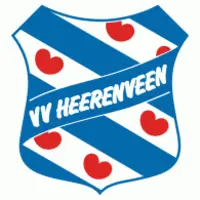
1920-1977
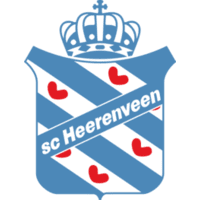
1977-1990
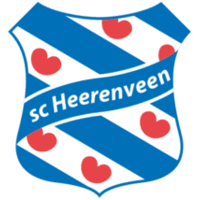
1990-2020
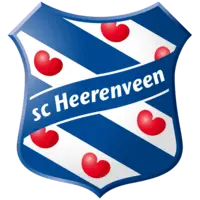
2020-Present
SC Heerenveen Crest History
The club's early emblems were relatively simple and primarily focused on the club name and traditional football symbolism. As SC Heerenveen grew in stature, however, the desire to emphasise its Frisian roots became increasingly important. The club sought a visual identity that would represent not only Heerenveen itself but the wider province of Friesland.
The defining feature of the modern crest is the direct incorporation of the Frisian flag. The badge features the famous diagonal blue-and-white stripes together with the red shapes that have become synonymous with both Friesland and SC Heerenveen. These symbols are often mistaken for hearts, but they are actually stylised yellow water-lily leaves, known in Frisian heraldry as pompeblêden.
The design originates from the historic coat of arms of Friesland, dating back to the fifteenth century. The stripes and water-lily leaves represent the historical districts of Friesland and symbolise the province's unity and cultural identity. By incorporating these elements directly into its crest, Heerenveen positioned itself as the football representative of the entire region.
During the second half of the twentieth century, the club refined and modernised the badge while carefully preserving the Frisian symbolism. Various versions appeared featuring different shield shapes and typography, but the blue-and-white stripes and red water-lily leaves always remained at the centre of the design.
As football branding evolved during the 1990s and 2000s, Heerenveen introduced updated versions of the crest with cleaner lines and improved proportions. These refinements enhanced the badge's appearance across merchandise, media and digital platforms while maintaining complete fidelity to the traditional Frisian imagery.
The current crest continues to feature the traditional blue-and-white stripes and the red pompeblêden derived from the Frisian flag. The design remains virtually unchanged in concept from earlier versions, reflecting the club's commitment to its regional heritage.
SC Heerenveen Club History
Founded on 20 July 1920, SC Heerenveen began life under the name Athleta. The club changed its name twice in its early years, first becoming Spartaan and later adopting the name VV Heerenveen in 1922. From these modest beginnings, the club would grow into one of the most successful and recognisable football institutions in the Netherlands.
During the amateur era, Heerenveen became one of the dominant clubs in Dutch football. The club enjoyed remarkable success in the 1940s and 1950s, led by legendary striker Abe Lenstra, who remains the greatest icon in the club's history. Under Lenstra's leadership, Heerenveen won numerous regional championships and became one of the strongest teams in the country.
Despite its success in the amateur game, the club initially struggled to establish itself among the leading professional clubs after the introduction of professional football in 1954. For many years, Heerenveen competed outside the highest level of Dutch football while working to rebuild its position.
A major turning point arrived in 1990, when the club reached the Eredivisie for the first time. Promotion marked the beginning of a new era and transformed Heerenveen from a regional club into a permanent fixture in Dutch top-flight football.
The greatest league achievement in club history came in 2000, when Heerenveen finished runners-up in the Eredivisie, behind champions PSV Eindhoven. The second-place finish secured qualification for the UEFA Champions League and remains the highest league position ever achieved by the club.
Heerenveen built a reputation as one of the best talent-developing clubs in Europe. Among the most famous players to represent the club are Ruud van Nistelrooy and Klaas-Jan Huntelaar, both of whom used Heerenveen as a platform to launch outstanding international careers. Numerous other Dutch and international stars have also passed through the club.
Another major milestone arrived in 2009, when Heerenveen won the KNVB Cup for the first time in its history. The triumph represented the club's first major national trophy and remains one of the proudest moments in its existence.
The club plays its home matches at the Abe Lenstra Stadion, named after the legendary forward whose influence on Frisian football remains unmatched. Since opening in 1994, the stadium has become one of the most recognisable football venues in the Netherlands.
One of Heerenveen's most unique traditions is the playing of the Frisian national anthem before every home match. Supporters proudly sing the anthem, creating an atmosphere unlike anywhere else in Dutch football and reinforcing the club's identity as the representative of Friesland.
Heerenveen's fiercest rivalry is with SC Cambuur in the Frisian Derby. The rivalry is fuelled by the short distance between the two clubs and the competition for football supremacy within Friesland. Supporters of both clubs often refer to the other simply as DKV (Dertig Kilometer Verderop – "Thirty Kilometres Away"), avoiding the use of their rival's name.
Another important rivalry exists with FC Groningen in the Northern Derby. Interestingly, relations between the clubs were historically relatively friendly, and the rivalry is based largely on geography rather than deep-rooted hostility. Because Cambuur has traditionally been Heerenveen's main rival, matches against Groningen are often described as a surrogate derby. Nevertheless, the winner earns the coveted title of "Pride of the North," ensuring that these fixtures remain highly significant.
SC Heerenveen
Your Dynamic Snippet will be displayed here... This message is displayed because you did not provide enough options to retrieve its content.