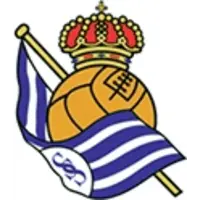
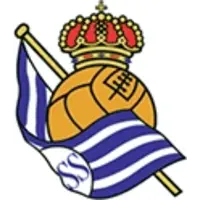
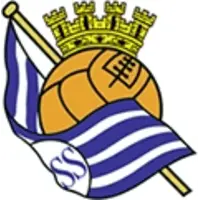
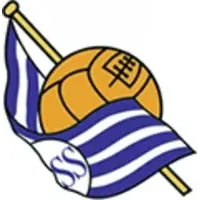
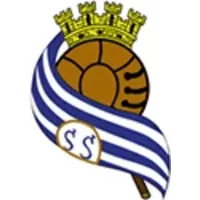
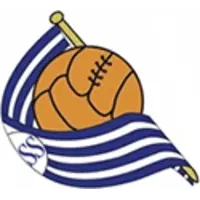
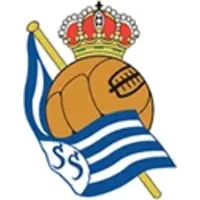
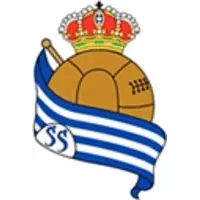
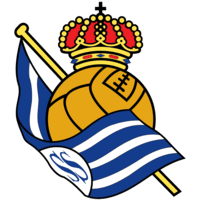
Historical Crests Real Sociedad
Name: Real Sociedad
Nickname(s): Txuri-Urdin (The White and Blues)
Founded: 1909
Stadium: Reale Arena (San Sebastian
Capacity: 39,500
Real Sociedad Crest History
Real Sociedad has maintained one of the most distinctive and traditional crests in Spanish football.
The earliest emblems used by the club during its formative years were relatively simple and reflected the football traditions of the early twentieth century. As the club established itself in Spanish football, it sought a visual identity that represented both the city of San Sebastián and the growing prestige of the institution.
A major milestone came in 1910, when King Alfonso XIII granted the club royal patronage. As a result, the club adopted the title “Real”, meaning “Royal,” and became Real Sociedad de Fútbol. The royal distinction was immediately reflected in the crest through the addition of a crown, a feature that has remained central to the club’s identity for most of its history.
During the following years, the club developed the emblem that would become synonymous with Real Sociedad. The badge combined a football with the blue-and-white flag of San Sebastián wrapped around it, creating a design unlike any other in Spanish football. The flag prominently displayed the intertwined letters “SS”, representing San Sebastián, while the crown above the ball symbolized the club’s royal status.
The blue-and-white colours incorporated into the flag reflected the club’s traditional kit and reinforced its connection to the city. These colours would later inspire the club’s famous nickname, txuri-urdin, meaning “white-blue” in the Basque language. Alongside the nickname Erreala (“The Royal One”), these identities became inseparable from the club’s culture and visual image.
Like many Spanish clubs that enjoyed royal patronage, Real Sociedad’s crest was affected by the political changes of the Second Spanish Republic (1931–1939). During this period, royal titles and monarchical symbols were prohibited, leading to the temporary removal of the crown from the badge. The club also competed without the title “Real” until the end of the period.
Following the Spanish Civil War and the restoration of royal symbols, the crown returned to the crest, and the club resumed its historic name. The reinstated emblem restored the traditional combination of the football, the San Sebastián flag and the royal crown that supporters had come to associate with the club.
A number of modernizations were introduced during the late twentieth and early twenty-first centuries to improve the crest’s clarity and adaptability. Colours became more vibrant, outlines were sharpened and graphic elements were standardized for use across digital and commercial platforms. Despite these refinements, the club deliberately avoided radical redesigns, choosing instead to preserve the emblem that had represented Real Sociedad for generations.
Real Sociedad Club History
Real Sociedad de Fútbol was founded on 7 September 1909 in the city of Donostia-San Sebastián, in Spain’s Basque Country. Known affectionately as Erreala or Reala in Basque and La Real in Spanish, the club has developed into one of the most respected institutions in Spanish football while maintaining a strong connection to its Basque roots and identity.
The origins of the club can be traced to the early twentieth century, when football was rapidly growing in popularity throughout the Basque region. A group of local players and enthusiasts formed Sociedad de Fútbol de San Sebastián, which quickly established itself as one of the leading clubs in northern Spain. In 1910, King Alfonso XIII granted royal patronage to the club, allowing it to adopt the title “Real” and become Real Sociedad de Fútbol, a name that reflected its growing prestige.
The club was among the founding members of La Liga in 1929, helping to establish Spain’s top division and securing a place among the country’s most historic football institutions.
A significant chapter in the club’s history unfolded following the establishment of the Second Spanish Republic in 1931. As royal titles were abolished, the club temporarily changed its name to Donostia Club de Fútbol, adopting the Basque name for San Sebastián. Following the end of the Spanish Civil War in 1939, the club regained its royal designation and once again became Real Sociedad.
For much of the twentieth century, Real Sociedad adhered to a player recruitment policy similar to that of its great Basque rival, Athletic Club. The club primarily signed and developed Basque players, creating teams that strongly reflected the culture and identity of the region. This philosophy helped establish Real Sociedad as one of the most important symbols of Basque football.
The club’s greatest period of success arrived during the late 1970s and early 1980s. Under the guidance of a generation of talented local players, Real Sociedad won back-to-back La Liga titles in 1980–81 and 1981–82, becoming one of only a handful of clubs to break the traditional dominance of Spain’s biggest teams. The side also won the Supercopa de España and established itself as one of the strongest teams in the country.
Throughout this era, players such as Jesús María Zamora, Roberto López Ufarte and Luis Arconada became club legends and helped define one of the most successful periods in Real Sociedad’s history.
A major shift occurred in 1989, when the club ended its long-standing policy of signing only Basque players by recruiting Republic of Ireland striker John Aldridge. The move marked a significant evolution in the club’s philosophy and opened the door to a more diverse squad while preserving the club’s commitment to Basque identity.
One of the club’s greatest strengths has been its renowned youth academy, Zubieta. Widely regarded as one of the finest academies in Spain, it has produced numerous elite footballers, including Xabi Alonso and Antoine Griezmann, both of whom developed their talents within the Real Sociedad system before achieving international success.
The club experienced a resurgence during the early twenty-first century. In 2002–03, Real Sociedad came close to winning La Liga, finishing as runners-up after a memorable title challenge. The team later returned to European competition and re-established itself as a regular contender in the upper half of the Spanish top flight.
Another landmark achievement arrived in 2020, when Real Sociedad won the Copa del Rey, defeating Athletic Club in a historic all-Basque final. The victory delivered the club’s first major trophy in more than three decades and represented a proud moment for both the institution and its supporters.
The club plays its home matches at the Reale Arena, formerly known as Anoeta Stadium. The venue has become one of Spain’s most modern football grounds and serves as the heart of Real Sociedad’s sporting and cultural identity.
A defining aspect of the club’s history is its rivalry with Athletic Club in the Basque Derby. One of the oldest and most respected rivalries in Spanish football, the fixture reflects the unique football culture of the Basque Country while maintaining a tradition of mutual respect rarely seen in major derbies.
Real Sociadad Pins
Your Dynamic Snippet will be displayed here... This message is displayed because you did not provide enough options to retrieve its content.