Skip to Content

Historical Crests Potenza Calcio

Name: Potenza Calcio
Nickname(s): ​Rossoblù (Red-Blues)
Founded: ​1919 (Refounded 2012, Merger)
Stadium: ​Stadio Alfredo Viviani (Potenza)
Capacity: ​5,500
2007-2011
2013-2014
2014-2015
2015-2017
2017-2022
2022-Present
Potenza Calcio Crest History
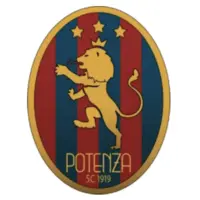
Unlike many Italian clubs, Potenza did not possess a single official crest for much of its early history. During the first decades following the foundation of Sport Club Lucano in 1920, the club often played without a formal badge, relying instead on its red-and-blue colours to establish its identity.
The first emblem to appear regularly on Potenza shirts arrived during the 1948–49 season. It consisted of a simple red-and-blue shield featuring the letter "P" at its centre. Around the same period, versions featuring a crowned lion also began to appear, marking the first use of the animal that would eventually become the club's defining symbol.
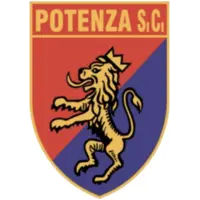
During the 1960s, coinciding with Potenza's historic years in Serie B, the club adopted one of its earliest recognisable crests. The badge featured a crowned lion accompanied by the inscription Potenza Sport Club. Although graphic details varied, the lion became firmly associated with the club and increasingly reflected the heraldic lion found in the city's coat of arms.
Throughout the 1970s and 1980s, several different versions of the lion appeared on shirts, pennants and club materials. Some badges incorporated the city's coat of arms, while others featured only the lion against a red-and-blue background. During this period the lion gradually evolved into the club's primary symbol. One particularly distinctive crest from the early 1980s featured only the lion's profile and mane, creating a bold and memorable identity.
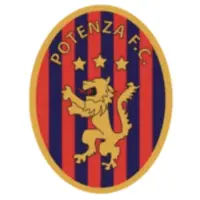
Following the club's first major bankruptcy in 1986, Potenza entered a period of significant instability. New entities such as Potenza Calcio, U.C. Potenza and F.C. Potenza adopted a variety of different crests. While the lion generally remained present, its appearance changed frequently. Some versions portrayed the animal facing left, while others returned it to its traditional right-facing position. Despite these variations, the lion continued to provide a visual link between successive incarnations of the club.
The early 2000s brought another period of experimentation. Following the emergence of A.S.C. Potenza, the club briefly abandoned the traditional lion in favour of a badge featuring a red-and-blue star topped by a football. This remains one of the few periods in Potenza's history when the lion was absent from the club's main visual identity.
After the various mergers and reorganisations that characterised Potenza football during the 2000s, the club gradually returned to its historic symbolism. The lion reappeared on traditional shields and heraldic-style badges, restoring continuity with the club's past and reconnecting supporters with the city's historic emblem.
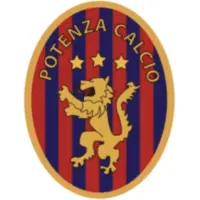
A significant redesign arrived in 2014, when a new shield-shaped crest was introduced. The badge featured a stylised lion at the centre of a modern red-and-blue design. This version accompanied the club through its climb back up the Italian football pyramid and became closely associated with the modern revival of football in Potenza.
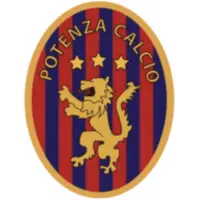
Following promotion back to the professional leagues in 2018, the crest was refined while retaining the lion and traditional colours. Modernised typography and cleaner graphic elements gave the badge a more contemporary appearance without sacrificing its historic identity.
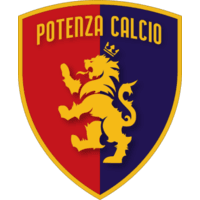
The most recent redesign arrived in 2022, when the club introduced a refreshed crest featuring a shield divided into red and blue halves with a prominent golden lion at its centre. The use of gold added a more elegant appearance while maintaining the connection to the city's heraldic traditions. 
Potenza Calcio Club History
Founded in 1920 as Sport Club Lucano, Potenza Calcio is the oldest and most important football club in the city of Potenza and one of the historic clubs of Basilicata. Established by Alfredo Viviani, a football enthusiast from Milan who had settled in Potenza, the club initially functioned as a multi-sport organisation before football became its primary focus. The team adopted the traditional red-and-blue colours, which remain central to its identity today and earned the club the nickname Rossoblù.
The greatest period in the club's history arrived during the 1960s. After securing promotion from Serie C in 1963, Potenza reached Serie B for the first time. The club spent five consecutive seasons in the second tier between 1963 and 1968, a remarkable achievement for a team representing one of Italy's smallest regional capitals.
The peak came during the 1964–65 season, when Potenza finished an extraordinary fifth place in Serie B, narrowly missing promotion to Serie A. The team became known throughout Italy as "Potenza Miracolo" ("Miracle Potenza"), one of the most celebrated provincial stories of the era. Among the club's stars was a young Roberto Boninsegna, who would later become one of Italy's greatest forwards and a World Cup finalist in 1970.
Following relegation from Serie B in 1968, Potenza spent much of the following decades competing in Serie C and Serie D. Although the club remained an important force in southern Italian football, it struggled to repeat the achievements of the 1960s.
Financial instability increasingly affected the organisation and culminated in the club's first major bankruptcy in 1986. Football in Potenza survived through successor organisations, but the following decades were marked by repeated reorganisations, ownership changes and sporting uncertainty.
The early 1990s brought renewed optimism when Potenza returned to the upper levels of Serie C and challenged for promotion. However, financial difficulties again undermined progress, leading to another collapse in 1994.
A further revival occurred during the 2000s. Potenza climbed back into the professional divisions and achieved promotion to Serie C1 in 2007 after winning the play-offs. For a brief period, the club appeared capable of rebuilding itself as a stable professional organisation.
Unfortunately, sporting sanctions and financial problems soon followed. Match-fixing investigations, administrative difficulties and mounting debts resulted in relegation and eventual exclusion from professional football. By the early 2010s, the historic club had effectively disappeared once again.
Football in the city survived through a successor organisation that inherited the colours, traditions and identity of the original Potenza. Starting from the amateur divisions, the new club gradually rebuilt both on and off the pitch.
The recovery culminated in 2018, when Potenza won promotion back to Serie C, restoring professional football to the city after years of instability. 
Potenza plays its home matches at the Stadio Alfredo Viviani, named after the club's founder. The stadium remains one of the most important sporting landmarks in Basilicata and has hosted generations of Rossoblù supporters.
The club's most important rivalry is with Matera. Matches between the two sides form the Derby della Basilicata, the most significant football rivalry in the region. Other notable rivalries have developed over the years with clubs such as Foggia, Taranto, Cavese and Juve Stabia through frequent encounters in the southern divisions.
 

Potenza Calcio Pins

Your Dynamic Snippet will be displayed here... This message is displayed because you did not provide enough options to retrieve its content.