Stadium:Estádio da Madeira (also known as Estádio da Choupana)
Capacity:5,132
1910
1990-Present
CD Nacional Crest History
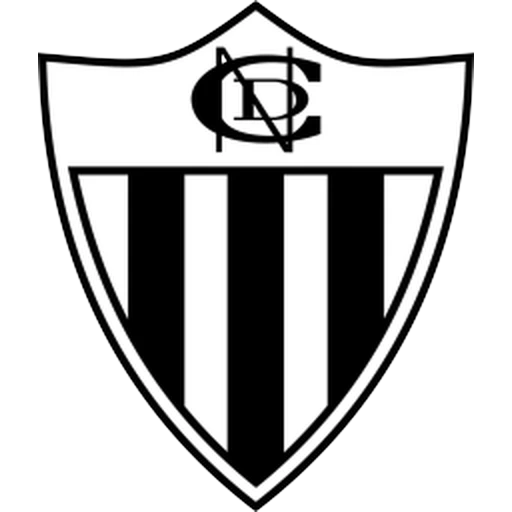
Clube Desportivo Nacional adopted in 1910 a simple yet distinctive crest that reflected the club's identity from its very beginning. The original badge consisted of a traditional shield featuring black-and-white vertical stripes, symbolising the club's colours, with an intertwined "C" and "N" monogram at the top representing Clube Nacional. Elegant and minimalist, the design became one of the most recognisable traditional football crests in Portugal and remained unchanged for many decades.
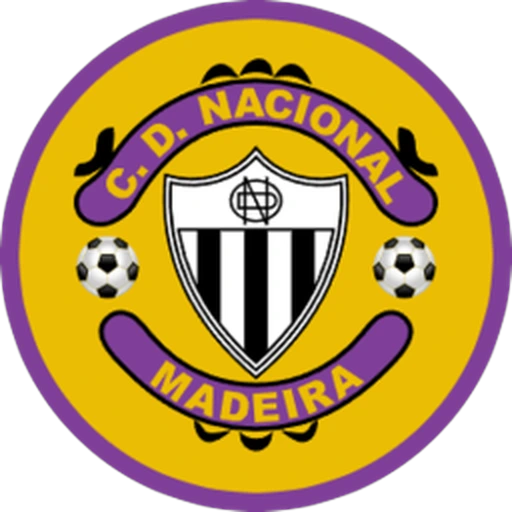
In 1990, Nacional introduced its first major redesign while carefully preserving its historic identity. The original striped shield was retained as the centrepiece but was placed inside a circular badge surrounded by a gold background and a purple outer ring. The new crest incorporated the words "C.D. Nacional" and "Madeira", proudly highlighting the club's island origins, while two footballs were added to emphasise the club's sporting identity. Decorative black flourishes completed the design, creating a more modern and colourful emblem suitable for the professional era.
CD Nacional Club History
Founded in 1910, Clube Desportivo Nacional is one of the oldest football clubs in Portugal and one of the most successful teams from the island of Madeira. Established in Funchal, the club adopted its famous black-and-white colours from its earliest days and quickly became a leading force in Madeiran football. Throughout its history, Nacional has been recognised for its strong local identity and its commitment to developing talented young players.
For much of the twentieth century, Nacional dominated regional competitions on Madeira while striving to establish itself in mainland Portuguese football. The club became one of the founding members of the Madeira Football Association and played a key role in raising the standard of football on the island alongside local rivals C.S. Marítimo and União da Madeira.
Nacional secured promotion to the Primeira Divisão on several occasions during the second half of the twentieth century, but it was the club's return to the top flight in 2002 that marked the beginning of its most successful era. Under a series of ambitious coaches, Nacional established itself as a consistent Primeira Liga side, regularly finishing in the upper half of the table despite operating with one of the league's smaller budgets.
The club enjoyed its greatest success during the 2000s. In the 2003–04 season, Nacional qualified for the UEFA Intertoto Cup, beginning a memorable period of regular European participation. The high point came in 2008–09, when the club finished fourth in the Primeira Liga, its highest-ever league finish, qualifying directly for the UEFA Europa League. During this period, Nacional competed against several well-known European clubs and earned a reputation for attractive attacking football.
One of Nacional's greatest contributions to world football was the development of Cristiano Ronaldo. Although he later joined local rivals Marítimo's youth system before moving to Sporting CP, Ronaldo spent part of his early football education at Nacional, and the club remains proud of its role in the development of one of the greatest players in football history.
The club's fiercest rivalry is the Madeira Derby against C.S. Marítimo, one of Portuguese football's oldest and most passionate regional rivalries. Matches against União da Madeira also carried great significance for many decades.