Historical Crests NEC Nijmegen
Name: NEC Nijmegen
Nickname(s):
Founded: 1910
Stadium: Gofferstadion (Nijmegen)
Capacity: 12,500
1960-1970
1970-1983
1983-1984
1984-1990
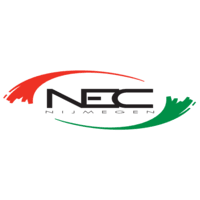
1990-2001
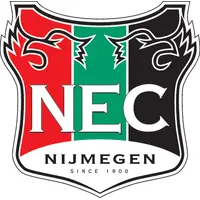
2001-Present
NEC Nijmegen Crest History
During the 1960s and 1970s, NEC adopted more modern logos that reflected contemporary design trends. Several versions featured stylised lettering and simplified graphic elements, moving away from traditional heraldic imagery while retaining the club's characteristic colour scheme.
In the 1980s, the club introduced a distinctive geometric logo centred around the initials NEC. This badge reflected the design style of the period and became strongly associated with the club's return to prominence. The logo focused on simplicity and recognisability rather than historical symbolism.
A major transformation arrived in 2001, when NEC introduced the crest that would become the foundation of its modern identity. The new badge adopted a traditional shield shape and prominently featured the double-headed eagle, a symbol taken from the historic coat of arms of Nijmegen. The eagle reflected the city's status as a former imperial city and established a much stronger visual connection between the club and its home.
The crest also incorporated NEC's famous red, green and black vertical stripes, creating one of the most distinctive colour combinations in Dutch football. Large white NEC initials were placed across the centre of the shield, while the city name Nijmegen appeared below, reinforcing the bond between club and city.
Since its introduction, the badge has undergone only minor refinements. Adjustments have focused on improving clarity and presentation while preserving the key elements of the design. The double-headed eagle, the tricolour shield and the prominent NEC initials have remained unchanged.
NEC Nijmegen Club History
Founded on 15 November 1910, NEC Nijmegen is one of the oldest and most historic football clubs in the Netherlands. While the club officially dates from 1910, its roots extend even further back. The oldest predecessor, Eendracht ("Unity"), was founded in 1900. In 1910, Eendracht merged with NVV Nijmegen, creating Nijmegen Eendracht Combinatie, from which the club derives its famous initials NEC.
Following the introduction of professional football in 1954, NEC became part of the new professional league structure. The club experienced periods in both the Eredivisie and Eerste Divisie, gradually building a reputation as a resilient and ambitious football institution.
A major milestone arrived in 1967, when NEC merged with local rival Eendracht Nijmegen, creating NEC Nijmegen. The merger strengthened professional football in the city and helped establish the foundations for the club's future growth.
Throughout the 1970s, NEC emerged as a competitive Eredivisie side and reached the KNVB Cup Final in 1973. Although the club was defeated, the achievement represented one of the greatest moments in its history and marked the beginning of a long-standing reputation as a dangerous cup team.
The club returned to the KNVB Cup Final in 1983, once again falling just short of lifting the trophy. Despite the disappointment, NEC continued to establish itself as one of the most respected clubs outside the traditional Dutch elite.
The 1990s brought another period of progress. NEC returned to the cup final in 1994, but once more finished as runners-up. During this era, the club became a stable Eredivisie participant and developed a reputation for strong youth development and passionate support.
A fourth appearance in the KNVB Cup Final followed in 2000, making NEC one of the most successful clubs never to have won the competition. Despite reaching the final on four occasions — 1973, 1983, 1994 and 2000 — the club has never succeeded in lifting a major national trophy.
One of the most significant developments in the club's history was the move to the Goffertstadion, which became the heart of NEC football. Although originally opened in 1939, the stadium underwent extensive modernisation and remains one of the most atmospheric venues in Dutch football.
The club's fiercest rivalry is with Vitesse Arnhem. Matches between the two are known as the Gelderse Derby ("Derby of Gelderland") and represent one of the most intense rivalries in Dutch football. The fixture is contested between the two largest cities of the province of Gelderland, Arnhem and Nijmegen, which are separated by only 24 kilometres.
Another important rivalry exists with De Graafschap. Encounters between the clubs are known as the Kleine Gelderse Derby ("Small Gelderland Derby").
NEC Nijmegen
Your Dynamic Snippet will be displayed here... This message is displayed because you did not provide enough options to retrieve its content.