Nickname(s):Las Chivas(The Goats),El Rebaño Sagrado (The Sacred Flock)
Founded:1906
Stadium:Estadio Akron
Capacity:46,232
1908-1911
1911-1917
1917-1923
1923-1984
1984-1987
1987-1997
1997-2002
2003-2006
2006-2007
2007-2009
2009-2010
2017
2018
2019-2020
2020-Present
CD Guadalajara Crest History
The crest history of Club Deportivo Guadalajara reflects the development of one of Mexico's most famous football institutions. Although the earliest emblems were very different from today's badge, the club eventually established an identity based on its traditional red, white and blue colours and the coat of arms of the city of Guadalajara.
The 1908–1911 crest was a simple red monogram formed from intertwined letters representing the club. At this stage, Guadalajara had not yet adopted the elaborate heraldic badge that would later become synonymous with Chivas.
From 1911 to 1917, the club used a circular red emblem containing another stylised monogram. The design remained relatively simple and reflected the early period of organised football in Guadalajara.
The 1917–1923 crest introduced the club's famous red-and-white vertical stripes. A dark-blue geometric monogram appeared in the centre, establishing the three colours that would become fundamental to Guadalajara's identity.
A decisive transformation occurred in 1923. Guadalajara adopted a much more elaborate crest based around the coat of arms of the city of Guadalajara. The municipal arms were positioned above the club's red-and-white stripes and surrounded by a blue circular band carrying the name GUADALAJARA.
This 1923–1984 design established the basic structure that has survived into the modern era. The combination of the city coat of arms, striped football identity and club name created one of the most distinctive badges in Mexican football.
Beginning in the 1980s, stars were added around the crest to represent Guadalajara's Mexican league championships. As Chivas won additional titles, the number and arrangement of these stars changed.
The versions used between 1984 and 2006 gradually refined the colours, outlines and details of the city coat of arms while preserving the traditional overall composition.
Following the Apertura 2006 championship, another star was added, reflecting the club's growing collection of league titles. Subsequent versions continued to make small adjustments to the positioning of the stars and the proportions of the central badge.
A major and controversial redesign appeared in 2009. The coat of arms was simplified significantly, removing several traditional heraldic details. The change proved unpopular with many supporters because it altered an emblem with deep historical connections to Guadalajara.
The traditional coat of arms was consequently restored, demonstrating the importance of the historic crest to the identity of the club and its supporters.
Guadalajara won another Mexican championship in Clausura 2017, bringing its total to 12 league titles. The stars surrounding the badge were updated accordingly.
From 2019, Chivas began simplifying the presentation of its identity. The championship stars were removed from the principal crest, allowing greater emphasis on the traditional shield itself.
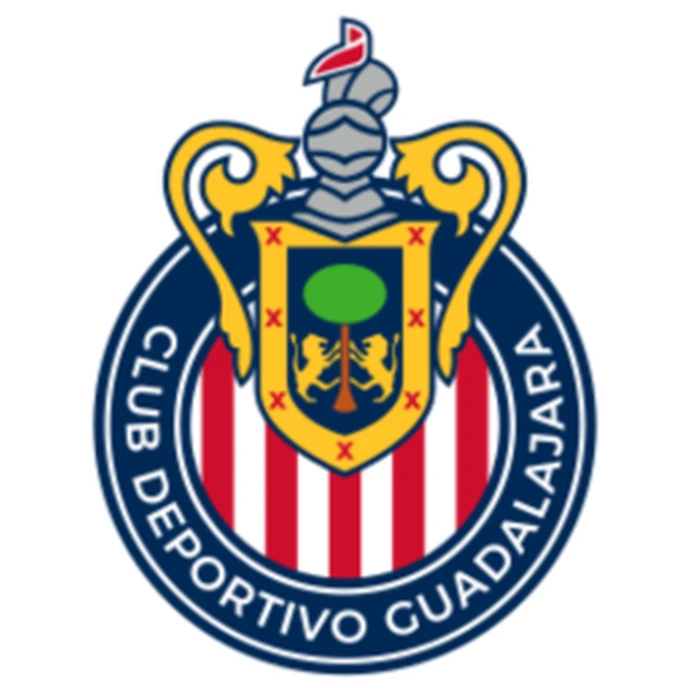
The 2020–present crest is a clean modern refinement of the historic design. It retains the Guadalajara coat of arms, red-and-white vertical stripes and dark-blue circular border carrying the name CLUB DEPORTIVO GUADALAJARA.
CD Guadalajara Club History
Club Deportivo Guadalajara, universally known as Chivas, is a professional football club from Guadalajara, Jalisco, founded on 8 May 1906. The club was established by a group led by Belgian businessman Edgar Everaert and was originally known as Club Unión before adopting the name Guadalajara in 1908.
During its early years, Guadalajara competed in regional football in Jalisco and gradually developed into one of the strongest clubs in western Mexico. Its red-and-white striped shirts became a defining part of the club's identity.
Guadalajara joined Mexico's newly established professional league in 1943. During this period, the nickname Chivas, The Goats, originally used mockingly by rivals, became increasingly associated with the club and was eventually embraced by its supporters.
The breakthrough came in the 1956–57 season, when Guadalajara won its first professional Mexican championship. The title began the most successful period in the club's history.
Between 1957 and 1965, Chivas dominated Mexican football, winning seven league championships in nine seasons. This legendary team became known as the Campeonísimo and established Guadalajara as one of the country's great football institutions.
Chivas also achieved international success during this era. In 1962, Guadalajara won the inaugural CONCACAF Champions' Cup, becoming the first champion of the competition.
After the Campeonísimo era, championships became less frequent. Nevertheless, Guadalajara remained one of Mexico's most popular clubs and added further league titles in 1969–70, 1986–87 and Verano 1997.
Chivas won another championship in the Apertura 2006, defeating Toluca in the final. The victory came during the club's centenary year and represented its eleventh professional league championship.
Guadalajara also became increasingly competitive internationally. The club reached the 2010 Copa Libertadores final, becoming only the second Mexican club to reach the final of South America's most prestigious club competition. Chivas eventually lost to Internacional of Brazil.
An important change occurred in 2010, when Guadalajara left the historic Estadio Jalisco and moved into its new purpose-built home, today known as Estadio Akron. The modern stadium became a new symbol of the club while maintaining its connection with Guadalajara.
Another major period of success arrived under coach Matías Almeyda. Chivas won the Clausura 2017 Liga MX championship, defeating Tigres UANL in the final and securing the club's 12th league title.
The following year brought another international triumph. Guadalajara won the 2018 CONCACAF Champions League, defeating Toronto FC on penalties in the final and qualifying for the FIFA Club World Cup.
Chivas has two particularly important rivalries. The local Clásico Tapatío against Atlas is one of the oldest derbies in Mexican football and reflects the historic football rivalry within Guadalajara.
Even larger is the Superclásico against Club América. The rivalry developed as Chivas and América became two of Mexico's most successful and widely supported clubs. Their meetings are among the biggest sporting events in the country and represent one of the defining rivalries of North American football.
Throughout its history, Guadalajara has produced and featured many important Mexican players, including Salvador Reyes, Javier “Chicharito” Hernández, Ramón Ramírez and Omar Bravo. The emphasis on Mexican talent remains an important element of the club's culture.